A CRM for travel agencies built around the departure date
Every quote gets a follow-up, and every client who comes home gets asked about the next trip.
- Unlimited seats
- Your own database
- AI waits for your approval
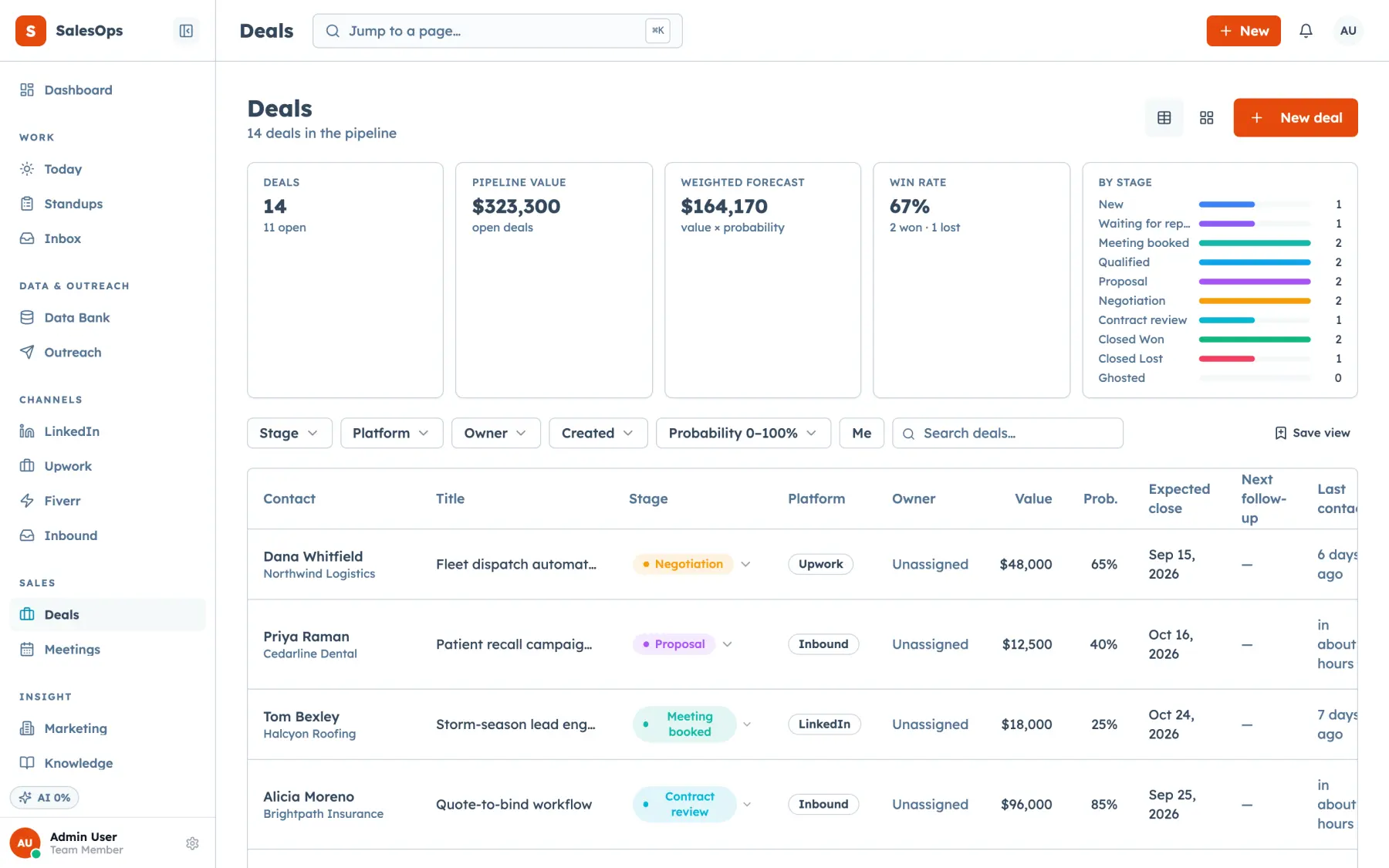
SalesCrew gives a travel agency a pipeline that runs from the first enquiry to the next booking. Three things set travel apart. A quote goes cold within days because the client is shopping the same trip elsewhere. The sale runs through deposit, final payment and departure. And the best lead you'll ever get is a client who just came home happy. SalesCrew follows up every quote, tracks each trip to departure, and starts the rebook conversation after every return.
A week at a busy travel agency
Three moments every advisor knows, and what gets set up for each.
Four honeymoon quotes went out last week
Each one took two hours to build. Two couples went quiet, probably comparing prices online. In SalesCrew each quote is a deal at the Proposal stage, and a follow-up goes out on day 2, day 5 and day 10. It stops the moment the couple replies.
The Italy group needs 16 travellers by March
Your organiser has 11 names and a deadline. A group pipeline tracks the minimum-numbers date on the deal. A cadence to the organiser keeps the sign-up moving, and your group coordinator sees every group's status on one board.
Your best clients got back from Japan on Sunday
They loved it, and nobody will ask where they want to go next year. A welcome-home cadence sends a note three days after return. Nine months later, a rebook note arrives, timed to when they usually start planning.
Who sells in a travel agency
Travel agencies are shaped differently from most small businesses. The owner runs the agency and often sells too. Travel advisors each build their own book of clients, and many work from home under a host agency. Group coordinators deal with one organiser who speaks for 20 travellers. Custom tour operators add trip designers who build the itinerary and an operations team that runs it.
That structure decides the access model. SalesCrew scopes records by channel, profile and area, so an advisor's clients stay with that advisor. The owner still sees the whole agency and every advisor's pipeline. Seats are unlimited, so a part-time advisor costs you nothing extra to add.
Corporate travel sells another way again. A small travel management company works target accounts, meets the company's travel buyer and proposes after a travel review. You get a separate pipeline for that, with a LinkedIn step your account manager sends by hand and logs against the contact.
What we configure for a travel agency
Pipelines, cadences and a shared inbox, set up around the trip.
- 1
Trip pipeline
Enquiry, Discovery call booked, Proposal sent, Revisions, Deposit paid, Final payment, Travelling, Welcome home, Rebook. Lost reasons cover price, booked direct online, another agency, dates changed and trip postponed.
- 2
Group and corporate pipelines
Groups run Organiser enquiry, Group proposal, Sign-up open, Minimum reached, Final numbers, Travelling. Corporate runs Target account, Intro meeting, Travel review, Proposal, Agreement.
- 3
Trip fields
Departure date, destination, party size and trip value, as custom fields on each deal. Your board sorts by departure date, so the trips leaving soonest sit at the top.
- 4
Shared inbox
Your bookings@ mailbox and each advisor's mailbox connect over IMAP/SMTP. Replies get labels: itinerary change, quote question, payment question, documents and complaint. Each advisor sees their own threads.
- 5
Cadences
Quote follow-up on day 2, 5 and 10. A welcome-home note three days after return, then a rebook note nine months on. An annual planning note to repeat clients, segmented by the month they usually travel.
- 6
Knowledge base and agent policy
Your booking terms, supplier notes and pre-contract information, loaded once. The Inbox agent drafts answers to quote questions from that knowledge and waits in review for an advisor to approve.
Your stack, and where SalesCrew fits
SalesCrew runs the selling. Bookings and payments stay where your agency already makes them.
| System | What it keeps | How SalesCrew connects |
|---|---|---|
| Gmail, Outlook or cPanel mail | Your bookings mailbox and each advisor's inbox | IMAP/SMTP mailbox connect; every thread in one shared inbox |
| Calendly | Discovery calls and trip-planning meetings | Webhook: each booking lands as a meeting on the client |
| Your website enquiry form | Trip requests with dates and budget | Inbound channel: each form lands as a lead with its source |
| Zapier, Make or n8n | Your glue between systems | Via outbound webhooks and the API or MCP |
| GDS, booking engine and supplier portals | Reservations, ticketing and supplier payments | These stay in your booking system; the deal stage records deposit, final payment and departure |
Mechanisms as listed on the SalesCrew integrations pages, September 2026.
The rules on travel selling, and what SalesCrew does
What the rules ask of your agency
- UK Package Travel Regulations 2018, in force since 1 July 2018: set information to the traveller before a package contract
- The same UK rules require insolvency protection by bond, insurance or trust
- California Seller of Travel law, B&P Code §17550.20: register at least 10 days before doing business in the state, and renew every year
- CAN-SPAM: a physical postal address and an opt-out in every promotional email, with opt-outs honoured within 10 business days
What SalesCrew does
- Holds your pre-contract information, booking terms and registration line in the knowledge base every draft reads
- Queues every external send for an advisor to approve before it reaches a client
- Suppresses a client on unsubscribe or bounce, and re-checks suppression at send time
- Records every AI action and every send in the audit log
Why the newsletter list needs suppression
Travel agencies email a lot: deals, brochures, early-booking offers. Every one of those is a commercial email under CAN-SPAM. The FTC's guide puts the penalty at up to $53,088 for each violating email (checked on ftc.gov, September 2026). A single send to a stale list of past enquiries adds up fast.
So SalesCrew checks the list twice. Suppression applies when you freeze an audience, and again at the moment of sending. An unsubscribe or a bounce suppresses the client straight away. You import past clients from a CSV into the data bank, and existing records are filled in by email, never overwritten. Your consent obligations stay yours, and SalesCrew enforces suppression and opt-out on every send. This is not legal advice.
What agency owners ask first
- What should a travel agency CRM do?
- A travel agency CRM follows every quote until the client books, then brings the same client back for the next trip. SalesCrew runs a pipeline from enquiry to rebook, a quote follow-up that pauses on a reply, and a welcome-home cadence after each trip. Core is $299 a month with unlimited seats.
- Can each travel advisor keep their own clients private?
- Yes. SalesCrew scopes access on three axes (channel, profile and area). An advisor sees their own book of clients, and the agency owner sees the whole business. The same scopes apply when someone works the CRM from Claude or ChatGPT over MCP.
- Does SalesCrew handle bookings and ticketing?
- Bookings, ticketing and supplier payments stay in your booking system or GDS. SalesCrew runs the selling around them: the enquiry, the proposal, the follow-up and the rebook. Each pipeline stage records where the trip stands, from deposit paid to travelling.
- How do we keep pre-contract information right in every quote email?
- Load your standard booking terms and pre-contract information into the knowledge base once. Every AI draft reads from it, and every external send waits in the approval queue by default. In the UK, the Package Travel Regulations 2018 set out what a traveller must be told before a package contract.
- What does SalesCrew cost for an agency with 12 advisors?
- The same as an agency with two. Seats are unlimited on every tier, and Core is $299 a month or $2,990 a year. The trial runs 14 days and needs a card to start.
Which plan fits a travel agency
Core covers quotes, follow-up, rebooking and the shared inbox.
Core is $299 a month with unlimited seats, so every advisor, full-time or part-time, logs in for the same price. It includes the CRM, the shared inbox, email cadences on your own mailboxes, the data bank and AI drafts with an allowance of about 5,000 model calls a month. Your agency runs in its own database, and you can export all of it any time. Every tier is on the pricing page.
Start with last season's unanswered quotes
Import them on day one and watch the first follow-ups line up in review.