Your own database, not a row in ours
Each SalesCrew client runs in a separate Supabase project: its own Postgres database, storage and edge functions, exportable in full at any time.
- One project per client
- Secrets held in a vault
- Full export on request
The short answer
- SalesCrew is single-tenant: one Supabase project per client, holding that client's Postgres database, file storage and edge functions.
- Credentials and API keys go into Supabase Vault and are never displayed again after you enter them.
- Access is controlled by Postgres row-level security plus a three-axis scope model (channel, marketplace profile and area) applied identically to the web app and to MCP tokens.
- Export is a full Postgres dump plus CSV of every object, and it is available whenever you ask, not only when you leave.
- SalesCrew carries no compliance badges. It gives you the machinery instead: your own database, a region you choose, export and deletion you control, and an audit log.
Architecture
What runs where, and who can reach it.
| Area | How SalesCrew does it |
|---|---|
| Tenancy | Single-tenant. One Supabase project per client instance, holding Postgres, storage and edge functions. No shared application database across clients. |
| Frontend | React and TypeScript hosted on Vercel. One build serves every instance; host configuration decides which project it talks to. |
| Data ownership | Your data lives only in your project. Export is a full Postgres dump plus CSV everywhere in the app. |
| Data residency | Set by the Supabase project region, which is chosen when the instance is provisioned. |
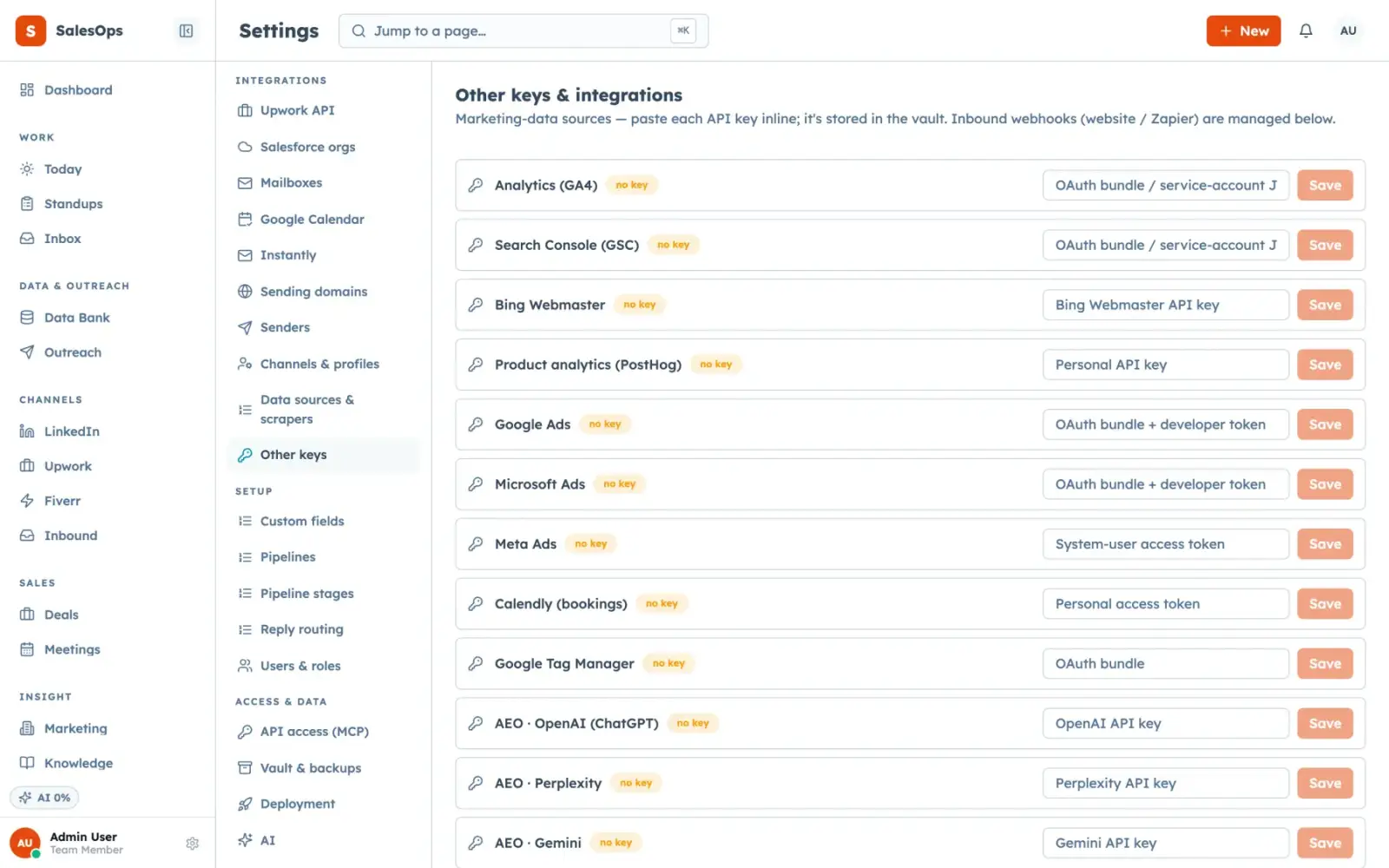
| Secrets | Credentials and API keys are stored in Supabase Vault. They are never shown again after entry, including to us. |
| Access control | Row-level security in Postgres, plus a three-axis scope model (channel, marketplace profile, area) enforced the same way for the UI and for MCP tokens. |
| Audit | An audit_log row records who did what and when, with the actor recorded as a user, a token or an agent. |
| Backups | Daily. Point-in-time recovery is available as a $120 a month add-on. |
| AI provider | Anthropic Claude through the ai-complete gateway. Use SalesCrew's managed key and be metered, or bring your own key, which is held in the vault and does not draw down your allowance. |
| Outbound webhooks | Deliveries are recorded with retries. Zapier, Make and n8n connect through those webhooks plus the API and MCP, not through a native app listing. |
What you can export, and when
Every object in SalesCrew exports to CSV from the screen you are looking at. That covers the day to day: a segment, a pipeline, a campaign's results. It is not the interesting part.
The interesting part is that your instance is a Postgres database you can take whole. A CSV export loses the relationships between objects, which is what makes most CRM exports useless the moment you try to load them somewhere else. A database dump keeps them: contacts still point at companies, deals still point at contacts, threads still point at both.
If you cancel, the ladder is deliberately slow. The instance goes read-only first, so nobody loses access to their own history on the day billing stops. Export stays available through that window. Deprovisioning happens after 90 days, and a person triggers it rather than a scheduled job. Handing the project itself to a departing client is on the roadmap; today the route out is the dump.
AI and your data
AI features send content to Anthropic Claude through one gateway, and every call is written to an ai_runs record with the feature that made it and what it cost. That record is the answer to "what did the model see", and it is in your database, not ours.
What gets sent is the material the feature needs: the thread for a reply draft, the record for a summary, the rubric inputs for a lead score. A feature you have not turned on sends nothing at all.
You can bring your own Anthropic key instead. The key goes into the vault, the calls bill to your account, and your tier allowance is untouched. For an agency running instances on behalf of clients, this is usually the cleaner arrangement, because the client's content then reaches the model provider under the client's own contract.
What GDPR means here
"Compliant" is not a property a vendor can hand you. What SalesCrew provides is the machinery: your own database, a region you choose, deletion and export you control, and an audit log that records who did what. Your obligations as a controller stay yours.
SalesCrew is a new product, and putting badges on this page it has not earned would be the fastest way to lose the argument the rest of the site is making. So it carries none.
Subprocessors
The services that can process instance data, and why.
| Subprocessor | Purpose |
|---|---|
| Supabase | Postgres database, file storage, secrets vault and edge functions per instance |
| Vercel | Hosting and delivery of the web application |
| Anthropic | Model calls made by AI features, unless you bring your own key |
These three are what every instance uses. Connecting an optional integration, such as a mailbox or a data source, sends data to that provider as well. Those providers are listed on each integration page.
Cold outbound is allowed here, and it is still your responsibility
Questions
- Is my data in the same database as other customers?
- No. Each client instance is a separate Supabase project with its own Postgres database, storage and edge functions. There is no shared application table with a customer ID column.
- Where is my data stored geographically?
- In the region of your Supabase project, which is chosen when the instance is provisioned. Pick the region before you import, because moving a project's region later means a migration.
- How do I get my data out?
- A full Postgres dump plus CSV of every object, whenever you ask. Relationships between objects survive the dump, which is the part CSV-only exports lose.
- Can an AI agent delete my records on its own?
- No. Contact merges, deletions and stage changes default to review, meaning a person approves them in the queue. Any external send defaults to review as well, and any spend is human-only. A kill switch on the Agents page stops every agent at once.
Request access
Your instance, your region, your export. Take the database with you on day 14 if it is not for you.