Follow up until someone answers, then stop the moment they do
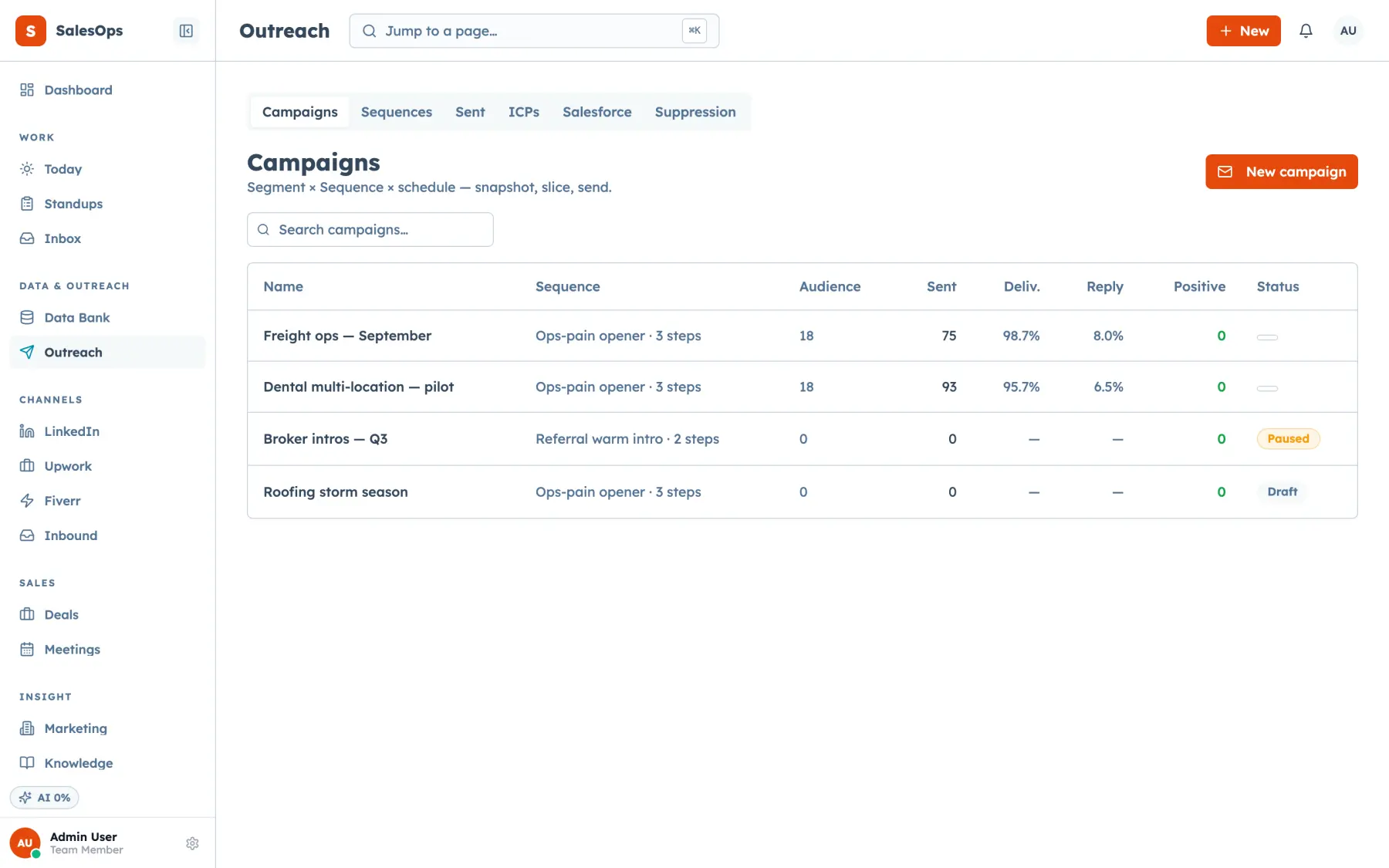
Multi-step sequences across email and LinkedIn that pause on any reply, hold a three-day minimum between touches per contact, and check the suppression list again at send.
- Pauses on any reply
- Three days between touches
- Suppression checked at send
The short answer
- A SalesCrew cadence is a list of steps with waits between them, and any reply on any channel pauses the enrolled contact rather than letting the next step go out.
- Guardrails are product defaults, not settings you have to remember: at least three days between touches per contact, per-cadence caps, per-mailbox and per-domain daily caps, and a business-hours send window.
- The suppression list is enforced twice, when the audience is frozen and again at the moment of send, so a contact who unsubscribed between those two points still does not get the email.
What it does
A cadence is built from steps and waits. You write the step, set the wait after it, and pick the channel. Email steps send. LinkedIn steps drop a queued item with paste-ready text into the LinkedIn queue, where a person executes it, because SalesCrew does not automate LinkedIn itself and says so rather than pretending otherwise. Enrol a segment, and each contact walks its own copy of the sequence from wherever they joined.
Stopping is the part that matters. A reply on the thread pauses that contact. An unsubscribe writes to the suppression list and stops them everywhere, not only in this cadence. A hard bounce does the same and takes the sending account down a notch in the pool. Campaigns wrap cadences for one-off sends against a frozen audience, and campaign history keeps what went out to whom.
Sending happens through a provider you choose per cadence. The Salesforce send path works today for teams pushing campaigns through an org they already own. The native mailbox-pool sender, the one that rotates across your own connected mailboxes with cooldown stamps, per-account daily caps, a suppression check at send, and bounce or complaint feedback writing straight back to suppression, lands at launch and appears on the changelog that day. The sender and domain registry, which mirrors what Instantly knows about your domains, is live now.
The MCP twins cover the whole loop. sequence_list and sequence_submit handle the sequences themselves, cadence_enroll puts contacts in, cadence_pause, cadence_resume, cadence_stop and cadence_stop_contact control what is running, cadence_status and cadence_funnel read the numbers back, and campaign_create, campaign_set_provider and campaign_history do the same for campaigns. On the sending side, pool_senders, pool_status and sender_set_policy manage the pool. Every one of those has an identical button in the app.
What is different here
Each of these hangs off one of the five ideas the product is built on.
Cold outbound is allowed here
Outbound-complete: most real CRMs forbid purchased and scraped lists in their acceptable-use policy, which is why teams run a second tool. SalesCrew allows the send and enforces suppression instead.
Read moreGuardrails are defaults, not homework
Human in the loop: touch spacing, daily caps per mailbox and per domain, a business-hours window and a suppression re-check at send ship on, and an agent cannot turn them off.
Read moreThe reply lands in the same database
The whole funnel in one place: a positive reply becomes a deal on the same board, with the thread and the cadence step that produced it still attached.
Read moreAn agent can run the sequence
Agent-operable by design: enrolling, pausing and reading the funnel are MCP tools, so a Claude or ChatGPT session can work the cadence with your permissions.
Read moreHow you get a cadence sending
Four steps, and nothing is on auto until you put it there.
- 1
Connect
Add the mailboxes you will send from, register the sending domains, and pick the provider for this cadence.
- 2
Configure
Write the steps and waits, set the per-cadence cap, and freeze an audience from a segment so the suppression list is applied to it.
- 3
Run in review
Enrol a small batch. Every send an agent proposes waits in the approval queue with the contact, the copy and the step it came from.
- 4
Move to auto
Once the copy is right, let the reply-side classes run themselves: classify the reply, pause the cadence, suppress on unsubscribe. External sends stay in review if you want them there.
Send providers, and what each one does
Pick one per cadence. The list is short on purpose.
| Provider | What it does | Status |
|---|---|---|
| Mailbox pool (native) | Rotates across your own connected mailboxes with cooldown stamps, per-account daily caps, a suppression check at send, and bounce or complaint feedback into suppression. | At launch — check the changelog |
| Salesforce send path | Pushes a campaign to a Salesforce org you already own and sends from there. | Available today |
| Instantly (registry sync) | Mirrors your sender and domain registry from Instantly so the CRM knows the state of your domains. | Available today |
| Instantly (send provider) | Sends the cadence through the Instantly API rather than your own pool. | On the roadmap |
Cadence step kinds sms, call_task and await_event are on the roadmap. Today the shipped step kinds are email and LinkedIn queue items.
In which tier
| Tier | Price | What you get on cadences |
|---|---|---|
| Core | $299/mo | Multi-step cadences on the mailbox pool, campaigns, segments, suppression, sender and domain registry. |
| Local | $499/mo | Core, plus SMS steps and speed-to-lead sends. Ships with the local-services pack — on the roadmap. |
| Outbound | $699/mo | Core, plus the Instantly send provider and the Campaign and LinkedIn agents, both on the roadmap. |
| Agency | $1,200/mo | Outbound, plus every agent, the data sources and one instance per client. |
Unlimited seats on every tier. The Agents pack adds in-product agents to Core for $199/mo.
Questions
- Will this get my domain blocked?
- Nothing removes that risk, and any vendor who says otherwise is selling. What the product does is cap volume per mailbox and per domain each day, hold at least three days between touches to the same contact, send inside a window you set, and pull a sending account out of rotation on bounces and complaints. Your list quality and your copy are still yours to get right.
- Is cold email allowed on this CRM?
- Yes. SalesCrew allows cold outbound, which most CRM acceptable-use policies do not. Allowed is not the same as exempt: CAN-SPAM, GDPR and every consent obligation stay with you. What the product enforces is suppression and opt-out.
- What actually stops a sequence?
- A reply on the thread pauses that contact. An unsubscribe or a hard bounce writes to the suppression list and stops them across every cadence. You can also stop one contact with cadence_stop_contact or the whole cadence with cadence_stop.
- Can a cadence send an SMS or book a call task?
- Not today. Those step kinds are on the roadmap with the local-services pack. Email and LinkedIn queue steps are what ships.
- Does LinkedIn automation come with this?
- No, and that is a deliberate choice. LinkedIn steps produce a queued item with the message ready to paste, and a person sends it. Automating LinkedIn itself risks the account, and it is not a risk we will take on your behalf.
- How many mailboxes can I connect?
- There is no seat or mailbox count on the plan. What limits you is the per-account and per-domain daily cap you set, which is the number that actually protects deliverability.
Run one cadence properly
Freeze a small audience, put the sends in review, and watch what the reply does to the deal.