Know what your quarter is worth, not what you hope it is worth
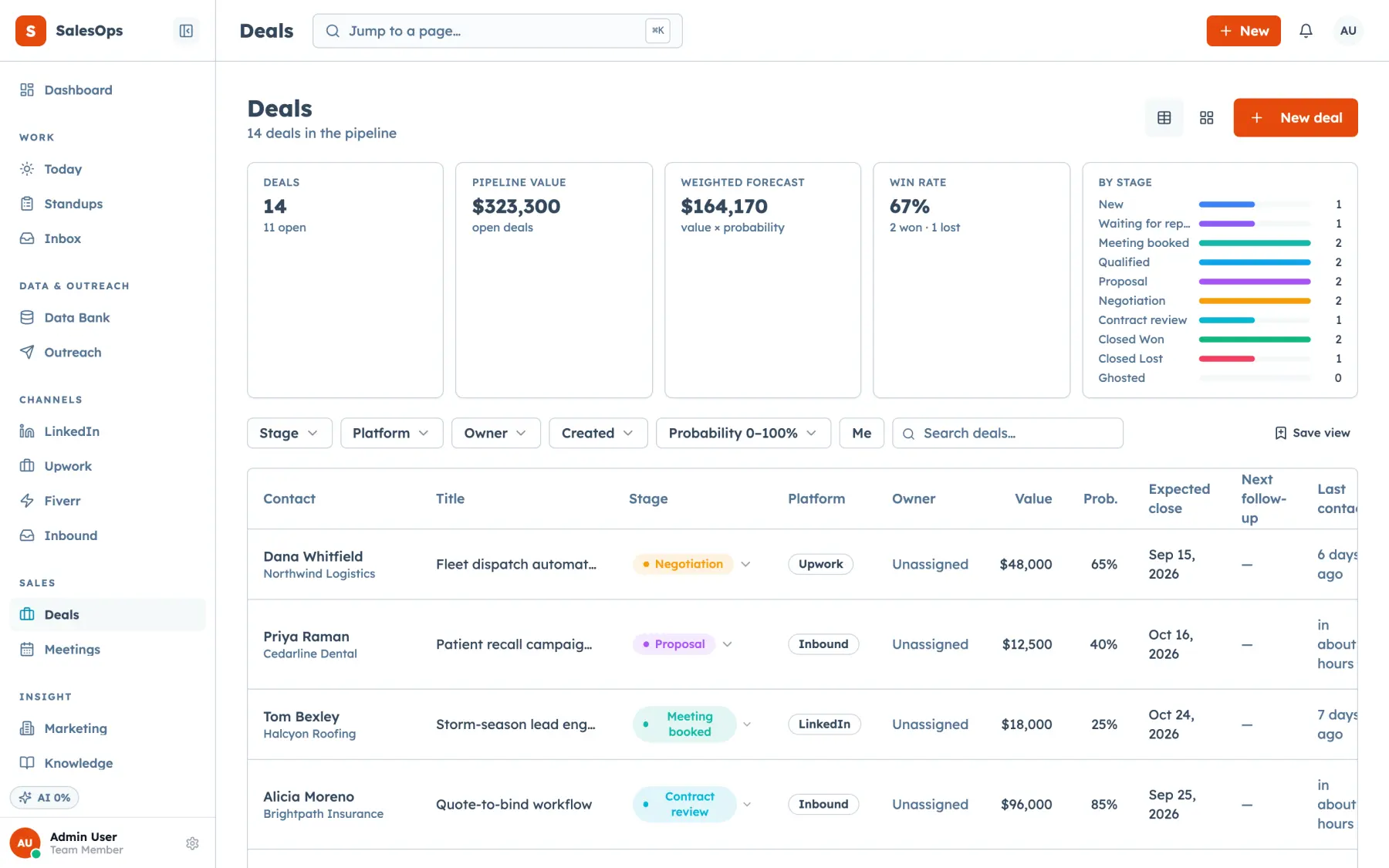
A kanban pipeline with stages, probability and a weighted forecast. Every deal links optionally to a contact and a company, and every stage change is written to the audit log.
- Weighted forecast built in
- Stage changes audited
- Same actions over MCP
The short answer
- SalesCrew gives every deal a stage, a probability and a weighted value, so the forecast is a sum of the board rather than a separate spreadsheet.
- Contact and company links on a deal are both optional, which means a marketplace bid or a referral can be a deal on day one without inventing a company record.
- When an agent moves a deal to a new stage, that move waits in the approval queue instead of changing the number behind your back.
What it does
The Deals board is a kanban view of your pipeline. Each column is a stage you named, each stage carries a default probability, and each card shows the deal value and the weighted value that probability produces. Drag a card to another column and the weighted total at the top of the board changes with it. Pipeline stages are yours to define: the same board serves a fixed-fee build shop and a monthly retainer agency because the stage list, and the probability on each stage, is configuration rather than code.
Open a deal and you get the record, not a link out to five other tabs. Tasks with owners and due dates, meetings, notes, files and a timeline of everything that has happened sit on the deal itself. The timeline pulls from the same database as the inbox, so an email thread that moved the deal appears in its history without an integration step. Contacts and companies each have the same shape, and a deal can point at one, both or neither.
Every button on that board is also a tool on the MCP server. deal_create opens a deal, deal_update_stage moves it, deal_get reads one back with its links, and pipeline_query returns the board as data an agent can reason over. Stage definitions themselves are readable and writable with pipeline_stage_list and pipeline_stage_upsert. stalled_deals returns the deals that have not moved, and task_create puts the follow-up on someone's list. The effect is identical either way: a human dragging a card and an agent calling the tool write the same row and leave the same audit entry, with the actor recorded as a user, a token or an agent.
Two record features arrive at launch rather than today. Lead scoring writes a score with its reasons and surfaces a next action on the top-scoring records, and record summary condenses a long timeline into a paragraph. Both are listed on the changelog the day they go live; until then the board is a human-scored board.
What is different here
Each of these comes from one of the five ideas the product is built on.
The board is also an API
Agent-operable by design: every action on the deal board exists as an MCP tool with the same effect and the same permissions. Nothing on this page is reachable only by mouse.
Read moreAgents propose, you dispose
Human in the loop: stage changes, merges and deletes default to review. An agent's move lands in the approval queue with its evidence, and you approve, edit or reject it.
Read moreLinks are optional, on purpose
A deal can exist without a company or a contact. Upwork bids, referrals and inbound forms become pipeline immediately instead of waiting for someone to tidy the data.
Read moreOne database behind the board
The whole funnel in one place: the reply that moved the deal, the cadence it came from and the ad spend that sourced it all live in the same Postgres project you own.
Read moreHow you get to a working board
The same four steps apply to every module. Nothing runs on auto until you move it there.
- 1
Connect
Import contacts and companies, or connect a mailbox so threads attach themselves to the right records from the start.
- 2
Configure
Name your stages, set a probability on each one, and decide which fields your team actually fills in.
- 3
Run in review
Turn on scoring and agent suggestions in review mode. Every stage change an agent proposes waits in the queue with its reasoning.
- 4
Move to auto
After a clean week, promote the low-risk classes — logging, tagging, task creation — to auto. Stage changes can stay in review as long as you like.
In which tier
The pipeline is not an upsell. It is on every plan, with unlimited seats.
| Tier | Price | What you get on the pipeline |
|---|---|---|
| Core | $299/mo | Full deals board, stages, probability, weighted forecast, tasks, meetings, notes, files, timeline. MCP tools included. |
| Local | $499/mo | Core, plus phone and appointment features that write back to the deal. Ships with the local-services pack — on the roadmap. |
| Outbound | $699/mo | Core, plus in-product agents that can propose stage changes and next actions inside the approval queue. |
| Agency | $1,200/mo | Outbound, plus marketplace deals and the marketing module beside the same board. |
Seats are unlimited on every tier. The Local tier ships with the P1 pack; see the roadmap for what is live today.
Questions
- We already have a CRM with a pipeline. Why move?
- Only move if the reason is structural. The two here are that an agent can operate this board through 140+ MCP tools with the same permissions a person has, and that your pipeline sits in a Postgres database that belongs to you rather than a shared tenant. If neither matters to you, a board is a board.
- Can I define my own stages and probabilities?
- Yes. Stages, their order and the probability on each are configuration, editable in the app and through pipeline_stage_upsert. The weighted forecast recalculates from whatever you set.
- Does a deal have to belong to a company?
- No. Contact and company links are both optional. That is deliberate: marketplace bids often have no company name available, and forcing one produces junk records.
- What stops an agent from mass-moving deals?
- Stage changes, merges and deletes default to review, so they queue for a person. Guardrails and a kill switch that stops every agent at once sit on the Agents page, and every tool call is written to the audit log with its actor.
- Can I add custom fields?
- Not today. Custom fields and AI-prompt fields are on the roadmap. The shipped record has the standard contact, company and deal fields plus notes, tasks, meetings and files.
- How do I get my data out?
- Your instance is its own Postgres project. Export is a full database dump plus CSV everywhere, not a partial export of selected objects.
Put a real forecast on one board
Import your contacts, name your stages, and run the first week with every agent action in review.