Read every reply in one place, and reply without leaving the record
Every connected mailbox lands in one thread list with rules-first classification, snooze and an SLA timer. AI drafts are labelled as AI and go out only when a person sends them.
- IMAP and SMTP mailboxes
- Rules classify before a model does
- No AI sends on its own
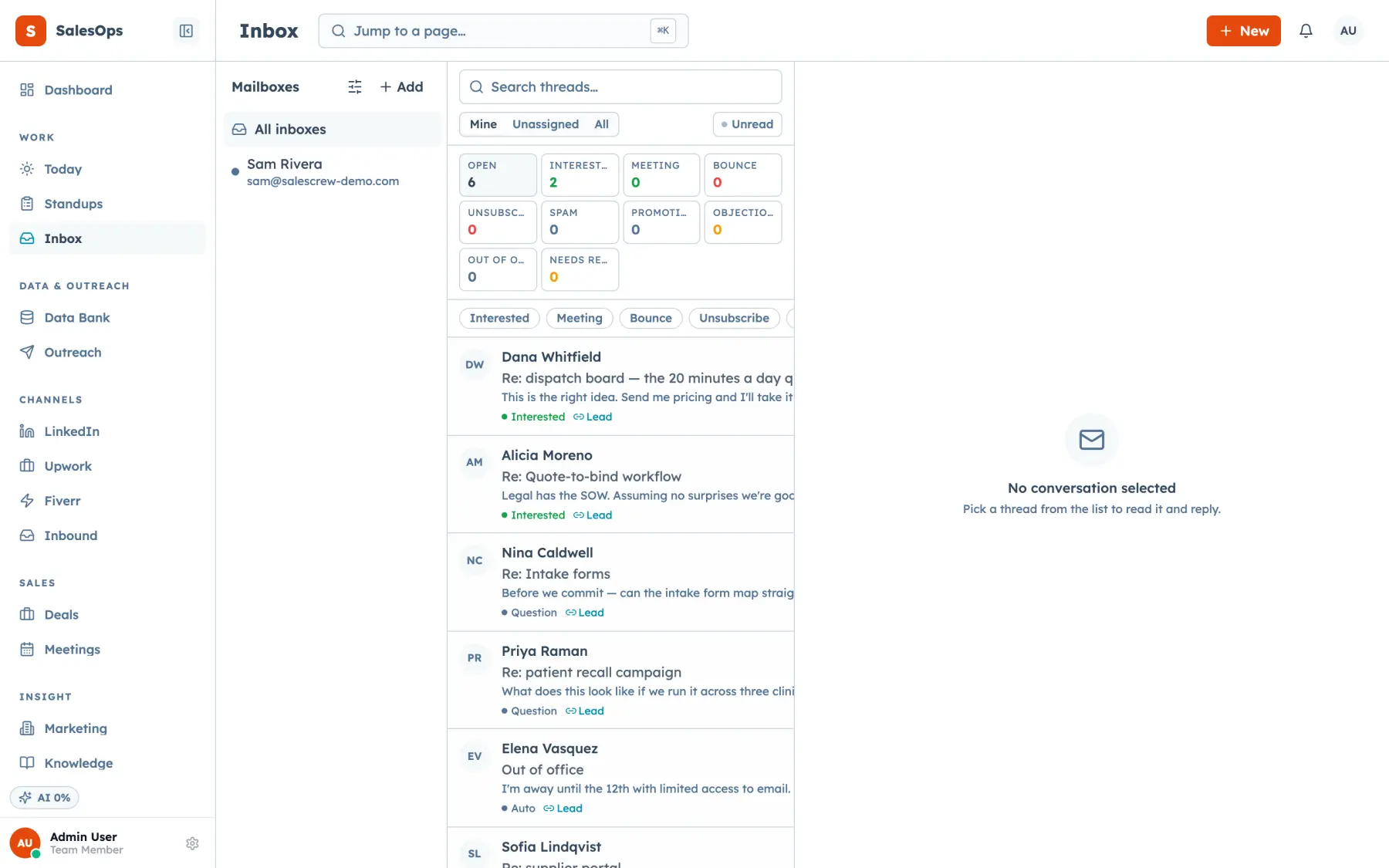
The short answer
- SalesCrew connects Gmail, Outlook and cPanel mailboxes over IMAP and SMTP, then shows every thread from all of them in one list with the matching contact, deal and cadence attached.
- Classification runs on your rules first; a model is a fallback that adds a label and nothing more, so a bad model day cannot silently reroute your pipeline.
- An unsubscribe or a hard bounce writes the address to the suppression list, and the suppression list is checked again at send time on every cadence.
What it does
Connect a mailbox in Settings and SalesCrew syncs it over IMAP and SMTP. Gmail, Outlook and standard cPanel mail all work the same way, and a team running four cold-sending domains plus two human mailboxes sees one thread list rather than six tabs. Each thread shows the contact it belongs to, the deal it is attached to, and the cadence it came from, because all of that is in the same database rather than joined across two products.
Triage runs on rules you write. Email categories match on the sender, the subject or the body, and a matched thread gets its label, its owner and its place in the queue without a model touching it. That matters more than it sounds: rules are inspectable, cheap and stable, and they handle the bulk of cold-reply traffic: out-of-office, unsubscribe, wrong person, bounce. A language model runs only when no rule matched, and even then it may add a label. It may not move a thread, send a reply or change a deal. Model classification arrives at launch and appears on the changelog when it does.
Every thread carries snooze and an SLA timer, so a reply you cannot answer today comes back on the day you said rather than sinking. Draft with AI writes a reply into the composer using the thread and your knowledge base, marks it as AI-written, and leaves it in the composer. Sending is a human action. If you would rather the drafting happen in the background, the Inbox agent does the same job in review mode and puts each draft in the approval queue with the thread and its confidence beside it. Both of those are launch features listed on the changelog.
The MCP twins are the same list of actions: inbox_threads and inbox_thread read, inbox_sync pulls new mail, inbox_classify applies triage, inbox_draft_reply writes a draft, inbox_reply_send sends one, and inbox_triage_report summarises what the queue looks like. Category rules are readable and writable with inbox_category_list and inbox_category_upsert. An agent calling inbox_reply_send does not bypass anything: an external send is an external send, and it waits in the approval queue by default.
What is different here
Each of these traces back to one of the five ideas the product is built on.
Rules first, model second
Human in the loop: deterministic rules do the routing and a model only labels what the rules missed. You can read a rule; you cannot read a probability.
Read moreEvery action is also a tool
Agent-operable by design: reading threads, classifying, drafting and sending are all MCP tools, scoped by the same channel and area grants as your UI login.
Read moreReplies feed the outbound loop
Outbound-complete: a reply pauses the cadence, an unsubscribe writes to the suppression list, and a bounce takes the sender out of rotation.
Read moreMail lives in your database
Your own database: threads and drafts sit in the Postgres project that belongs to you, so an export includes the conversation history, not only contact rows.
Read moreHow you get to a working inbox
The pattern is the same across the product: connect, configure, run in review, then let the safe parts run themselves.
- 1
Connect
Add each mailbox with its IMAP and SMTP settings. Credentials go into the secrets vault and are never shown again.
- 2
Configure
Write your category rules, set an SLA per category, and decide who owns which queue under the channel and area grants.
- 3
Run in review
Turn the Inbox agent on in review mode. It drafts, the queue holds the draft with its evidence, and you approve, edit or reject.
- 4
Move to auto
Promote the classes you trust, such as classify a reply, pause a cadence on reply and suppress on unsubscribe, to auto. External sends can stay in review forever.
In which tier
The inbox itself is on every plan. What changes is how much of the triage an agent does for you.
| Tier | Price | What you get in the inbox |
|---|---|---|
| Core | $299/mo | All mailboxes, threads, drafts, snooze, SLA, rule classification, suppression on unsubscribe and bounce. Agent work runs through MCP. |
| Local | $499/mo | Core, plus SMS and call transcripts in the same list. Ships with the local-services pack — on the roadmap. |
| Outbound | $699/mo | Core, plus the in-product Inbox agent drafting replies into the approval queue. |
| Agency | $1,200/mo | Outbound, plus every agent and one instance per client, each with its own mailboxes. |
Unlimited seats on every tier. The Agents pack adds in-product agents to Core for $199/mo. The Local tier ships with the P1 pack; see the roadmap.
Questions
- Will an AI ever send an email from my mailbox without me?
- Not unless you set it to. Every agent ships in review mode, and any external send, whether email, a LinkedIn message or a marketplace proposal, is a review-class action by default. The queue holds the draft; a person approves it. One kill switch on the Agents page stops every agent at once.
- Which mailbox providers work?
- Anything that speaks IMAP and SMTP, which covers Gmail, Outlook and cPanel mail. Credentials are stored in the secrets vault and are not displayed after entry.
- Is the classification a black box?
- No. Your rules run first and they are the ones doing the routing. Model classification is a fallback that adds a label only, and it appears on the changelog when it ships.
- Does the inbox track opens and clicks?
- Not today. Open and click tracking is on the roadmap. Reply, bounce and unsubscribe are what the shipped product measures, and they are the signals that actually change a cadence.
- Can I put SMS and calls in the same list?
- That is on the roadmap with the local-services pack. Outbound calls through Vapi work today and are logged against the record.
- How do the drafts know what to say?
- From the thread itself and from your knowledge base, which you load with the kb_ tools or the Knowledge page. Every draft in the review queue shows its sources beside it so you can check the claim before you approve.
Put every mailbox in one list
Connect a mailbox, write three rules, and run the first week with drafting in review.