The CRM for med spas that lose consults between the DM and the chair
Every enquiry from Instagram, the site or the phone becomes a booked consult, with a record of what they asked about.
- Unlimited seats
- Your own database
- AI waits for your approval
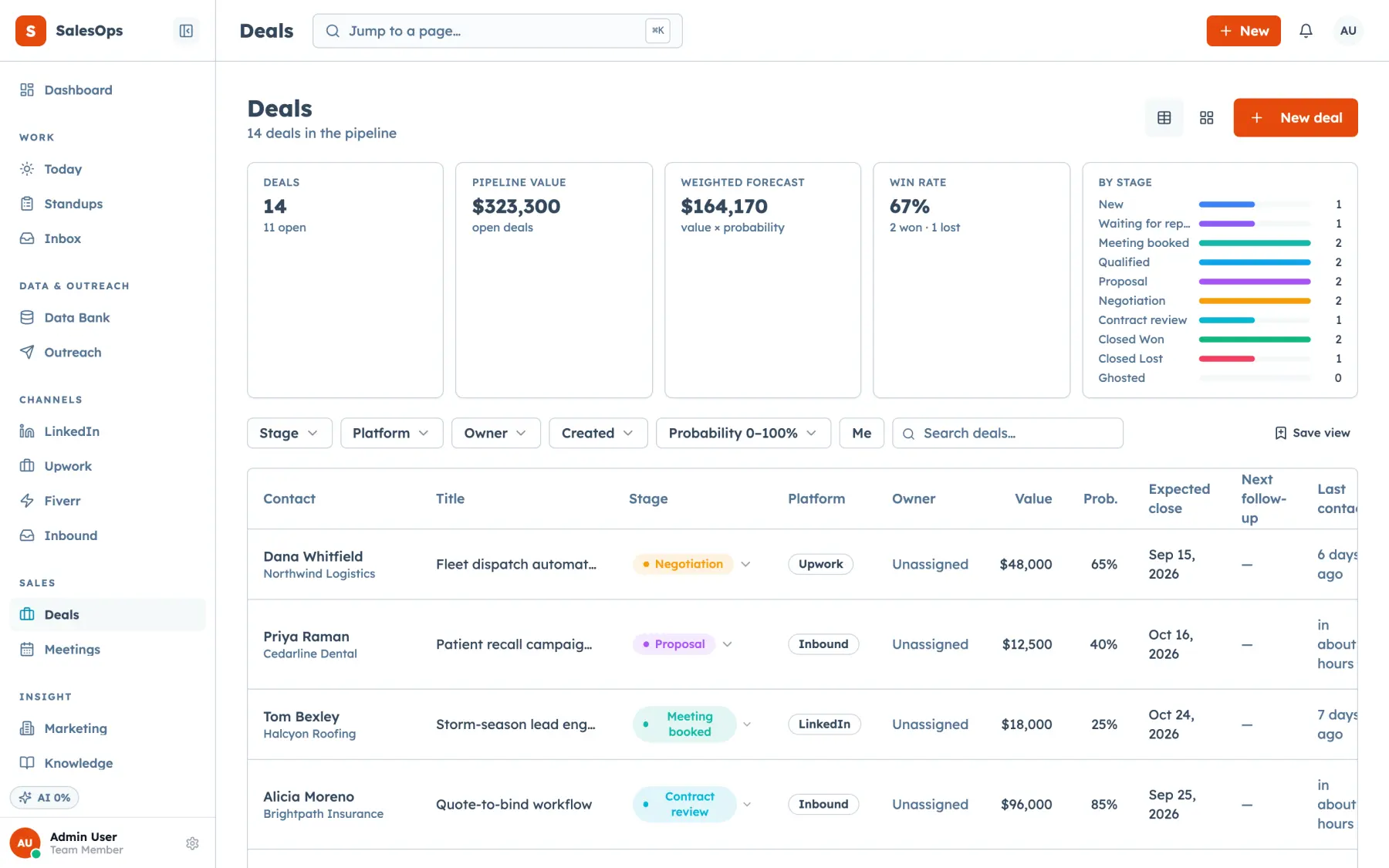
Boulevard and Zenoti run the schedule, the charting and the checkout. What no booking system does well is the hour between someone asking about tox pricing in an Instagram DM and someone sitting in a consult chair. SalesCrew owns that hour, and the months afterwards when a package sits half used and nobody calls.
Three gaps between the enquiry and the chair
What breaks in an aesthetics practice, and what gets configured for each.
DMs sit unanswered for hours
Instagram is a primary lead source in aesthetics in a way it is not in most healthcare, and the front desk is not watching it while injecting. Configure the enquiry as a tracked lead the moment it reaches the shared inbox or the site form, with a first-response timer on it.
Consults no-show
A free consult has no financial commitment attached, so the no-show rate on it is not the no-show rate on a booked treatment. Configure a reminder sequence at 24 hours and 2 hours before, and a recovery sequence for the people who do not arrive.
Packages expire unused
The economics of this business are consult, then treatment plan, then a package or a membership. A client with four laser sessions left and a busy autumn quietly becomes a churned client. Configure a segment for packages with sessions remaining and no visit in 90 days.
Who is answering, and when they cannot
A med spa's front desk is not a call centre. It is one or two people who also greet arrivals, take payment, handle rebooking and cover the phone, and who go quiet for forty-minute stretches whenever the practice is busy. That is the overflow problem in this trade, and it is a staffing shape rather than a technology failure.
It is made harder by turnover. Aesthetics practices cycle front-desk staff, and when the person who knew which follow-ups were outstanding leaves, that knowledge leaves with them if it lived in their head or a personal notes app. A pipeline with stages and a cadence that runs on its own survives that handover. A sticky note does not.
The buyer is usually the owner, who is often the medical director or the lead injector, and sometimes a practice manager running two or three locations. They are not shopping for another booking system, because they already have one and switching it is painful. They are shopping for the enquiry-to-consult layer that sits in front of it.
What we configure for you
A working setup for an aesthetics practice, inside the first 14 days.
- 1
Pipeline stages
Enquiry, Consult booked, Consulted, Treatment plan presented, Package purchased, and a separate retention stage for clients on a membership.
- 2
Channels
The practice mailbox connected over IMAP, the website enquiry form pointed at the inbound webhook, and Calendly consult bookings arriving as meetings with the treatment interest recorded.
- 3
Cadences
A same-day enquiry follow-up, a consult-to-treatment sequence for people who came in and did not book, and a reactivation sequence for unused package sessions.
- 4
Agent policy
The Inbox agent in review mode, drafting the reply to a pricing question so the front desk approves rather than composes. Guardrails cap touches and hold sends to business hours.
- 5
Knowledge-base voice
Your treatment menu, your consult policy, your pricing bands and your cancellation terms loaded as knowledge, so a draft never invents a price or promises a clinical result.
Your stack, and what sits beside it
Booking and charting stay exactly where they are. This is the boundary.
| What you run | What it keeps | What SalesCrew adds |
|---|---|---|
| Boulevard | The schedule, the client profile, checkout, memberships and packages | Enquiry capture before the booking exists, consult follow-up, and reactivation segments |
| Zenoti | Multi-location scheduling, inventory, payroll, packages and memberships | The enquiry-to-consult pipeline in front of it, and outreach to lapsed clients |
| Vagaro | Booking, payments and the client-facing marketplace listing | Multi-step follow-up on enquiries that never booked, plus a unified inbox |
| Aesthetic Record | Clinical charting, before-and-after photos, consent forms, e-prescribing | Nothing clinical. Charts and photos stay there and should |
| The DMs themselves and the audience | Nothing today. Meta DM is on the roadmap; enquiries reach us by form or email now | |
| Your payment processor | Card processing and package billing | Nothing. Quotes with a payment link on your own Stripe key are on the roadmap |
These connections run through webhooks, CSV import and the API. None is a native app listing. Treatment records and clinical photographs belong in your charting system, not here.
HIPAA, and what has to be true before you store anything
When your booking system is the better answer
A configurable CRM (SalesCrew)
- Enquiry, consult and package stages set up for how aesthetics actually converts
- Cadences that keep working when the front desk is in a treatment room
- Unlimited seats, so every injector and coordinator can see their own enquiries
- One Postgres database per practice, with a full export whenever you want it
- No appointment scheduling, no charting, no consent forms, no clinical photos
- No payment processing and no package or membership billing
- No Instagram DM inbox today, which is a real gap for this trade
- Not HIPAA-certified, BAA status unconfirmed, and no med spa customers yet
The practice tool (Boulevard, Zenoti, Vagaro, Aesthetic Record)
- The schedule, the client record and checkout in one place, built for this business
- Packages, memberships and gift cards handled as first-class objects with billing
- Charting, consent and before-and-after photography in a clinical system of record
- Client-facing online booking your regulars already use
- Marketing tools are usually broadcast email, not a sequence that stops on a reply
- The enquiry that never became a booking often has no record at all
- Reporting stops at the appointment, so an enquiry-to-consult rate is hard to see
- Per-seat or per-location pricing that grows with the team
The call that comes while everyone is in a room
The call pattern in a med spa is not the trades' pattern. Very little arrives at 2am. What happens instead is that enquiries cluster in normal hours and land while the only two people who could answer are both with clients. The DM at 11am and the call at 2pm are both missed for the same reason, and both callers are comparing you with the clinic four blocks away.
The roadmap answer for that is a receptionist that takes the treatment interest, books the consult and hands the record to the pipeline, with a text-back when the caller hangs up first. Two rules will be built into it. It must never give medical advice or discuss whether a treatment is suitable for a specific person, and a call about a reaction after a treatment transfers to a human immediately.
Texting adds its own constraint on top of HIPAA. A phone number given at a consult is a consumer mobile under the TCPA, and consent for appointment reminders is not consent for a promotion on a filler special. When SMS ships it carries consent handling, STOP keyword processing and 10DLC registration. Suppression and opt-out are enforced today on email, at audience freeze and again at send.
Where this gets used
Three jobs an aesthetics practice does every week, described as mechanism.
Answering a pricing enquiry the same day
The enquiry lands as a lead with the treatment interest attached. The Inbox agent drafts a reply from your treatment menu and pricing bands, and a coordinator approves it. Nothing sends on its own.
Getting the consult to become a plan
A client who consulted and did not book moves into a follow-up sequence over two weeks. Any reply pauses it and lands in the shared inbox, and a booking drops them out.
Waking an unused package
A segment finds clients with sessions remaining and no visit for 90 days, taken from an export of your booking system. Suppression is applied at freeze, and one sequence goes out from the practice mailbox.
What med spa owners ask first
- Is this HIPAA compliant?
- No software is HIPAA compliant on its own, and any vendor claiming to be is telling you something meaningless. What matters is whether we will sign a business associate agreement, so ask us directly before you store anything about a treatment. Until an agreement is in place, use SalesCrew for enquiry and scheduling data only and keep clinical records in your charting system.
- We already have Boulevard. Why would we add this?
- Because Boulevard starts at the booking. If your problem is that enquiries never become bookings, the record you need does not exist in there. Keep Boulevard for the schedule, the client profile and checkout. Add this only for the layer in front of it. If your enquiries all convert, you do not need us.
- Can it reply to our Instagram DMs?
- Not today. The Meta DM inbox is on the roadmap and we will not describe it in the present tense before it ships. Today, enquiries reach the CRM through your website form and your mailbox. Some practices route the DM to email as a workaround, which is honest but not elegant.
- Our front desk turns over. How much retraining is this?
- That is the argument for it rather than against it. The follow-ups run from configured cadences, not from a person's memory, so a new coordinator inherits a pipeline with stages instead of a list of things the last person knew. Seats are unlimited, so adding someone on their first day costs nothing.
- Will it text clients without us approving it?
- No. SMS is not available yet, and when it ships every external send defaults to review in the agent policy table: the agent drafts, a person approves. There is a kill switch that stops every agent at once and an audit log of every action, including which agent did what.
- What does it cost?
- Core is $299 a month with unlimited seats, which covers the pipeline, the inbox, email cadences and the data bank. Local at $499 adds phone numbers, SMS, reminders and the review request pack, and that tier ships with the roadmap items above. The meter is AI calls, not people.
Which tier fits a med spa
Core today, with a clear reason to move to Local later.
Start on Core at $299 a month. It holds the enquiry-to-consult pipeline, the shared inbox and email sequences, with unlimited seats for coordinators and injectors. Local at $499 is the tier that adds SMS reminders and no-show recovery, which is where most of the value sits for a consult-driven practice — and it ships with the roadmap pack, so buy it when it lands.
Related
Start with last quarter's enquiries
Import the people who asked about a treatment and never booked a consult, and put the first sequence in review.