An AI intake agent for law firms that books into a real CRM
Built for the after-hours intake: matter type, jurisdiction and urgency captured with the conflict-check fields, a consult booked, and no legal advice given at any point.
- On the roadmap, not available today
- No legal advice by design
- Conflict-check fields captured
For personal injury and family law, intake speed decides the case. Someone who has just been in a collision or has just been served calls three firms in one evening, and the one that answers gets the matter. This page describes an intake agent designed for that evening. It does not exist yet.
The call a law firm actually loses
Legal intake is the only call on this site where the caller is often in the worst hour of their life and the firm still has to run a process before it can help. The process exists for good reason. A conflict check has to come before an engagement, and an engagement cannot happen on a phone call at nine at night.
That gap is where firms lose matters. The caller wants somebody to tell them what happens next, and voicemail tells them nothing. The next firm on the list answers, takes the details, and books a consult for the morning.
What makes the design tractable is that intake is genuinely structured. Matter type, jurisdiction, when the events happened, who the other parties are, and whether any deadline is approaching. All of that is capture, none of it is advice, and the line between the two is the whole of the design.
The intake flow it runs
Capture only, with a hard stop before anything that resembles advice. None of this ships today.
- 1
State what it is and what it cannot do
The opening line says it is an automated intake, that it cannot give legal advice, and that speaking to it does not create an attorney-client relationship.
- 2
Take the matter type and jurisdiction
Practice area and where the matter arises, since a firm not licensed in that jurisdiction should stop the call early rather than after twenty minutes of details.
- 3
Capture the conflict-check fields
The names of the other parties and any insurer or employer involved. This is captured for the firm to run, never checked or cleared by the agent.
- 4
Establish urgency and any deadline
Whether there is a hearing date, a filing deadline, an arrest, a custody issue or a statute question. Any of those ends the flow and reach a person.
- 5
Take the narrative in the caller's words
A short account of what happened, recorded verbatim. It goes to the intake queue for a person to review, and is never summarised into a conclusion by the agent.
- 6
Book the consult
A real slot with the attorney who covers that practice area, and a clear statement that the consult, not this call, is where advice happens.
What it will do, and what stays with a person
Everything on the right is either advice, judgement or a decision only the firm can make.
| Situation | The planned agent | A person |
|---|---|---|
| A deadline, hearing date, arrest or custody issue | None. Immediate transfer or an urgent alert to the on-call attorney | An attorney, without delay |
| Personal injury enquiry, collision last week | Matter type, jurisdiction, parties, narrative, then books the consult | Runs the consult and advises |
| "Do I have a case?" | None. States that it cannot advise and books the consult | An attorney, at the consult |
| "How much will this cost me?" | Gives your published fee structure only | Quotes the matter |
| Running the conflict check | None. Captures the party names for the firm to check | The firm, before any engagement |
| Existing client asking about their matter | Identifies the caller and routes to the responsible attorney | The attorney on the file |
Rows describe intended behaviour of a roadmap feature. Nothing here answers a call today. Matter files stay in your practice management system.
Why an intake agent needs a CRM behind it
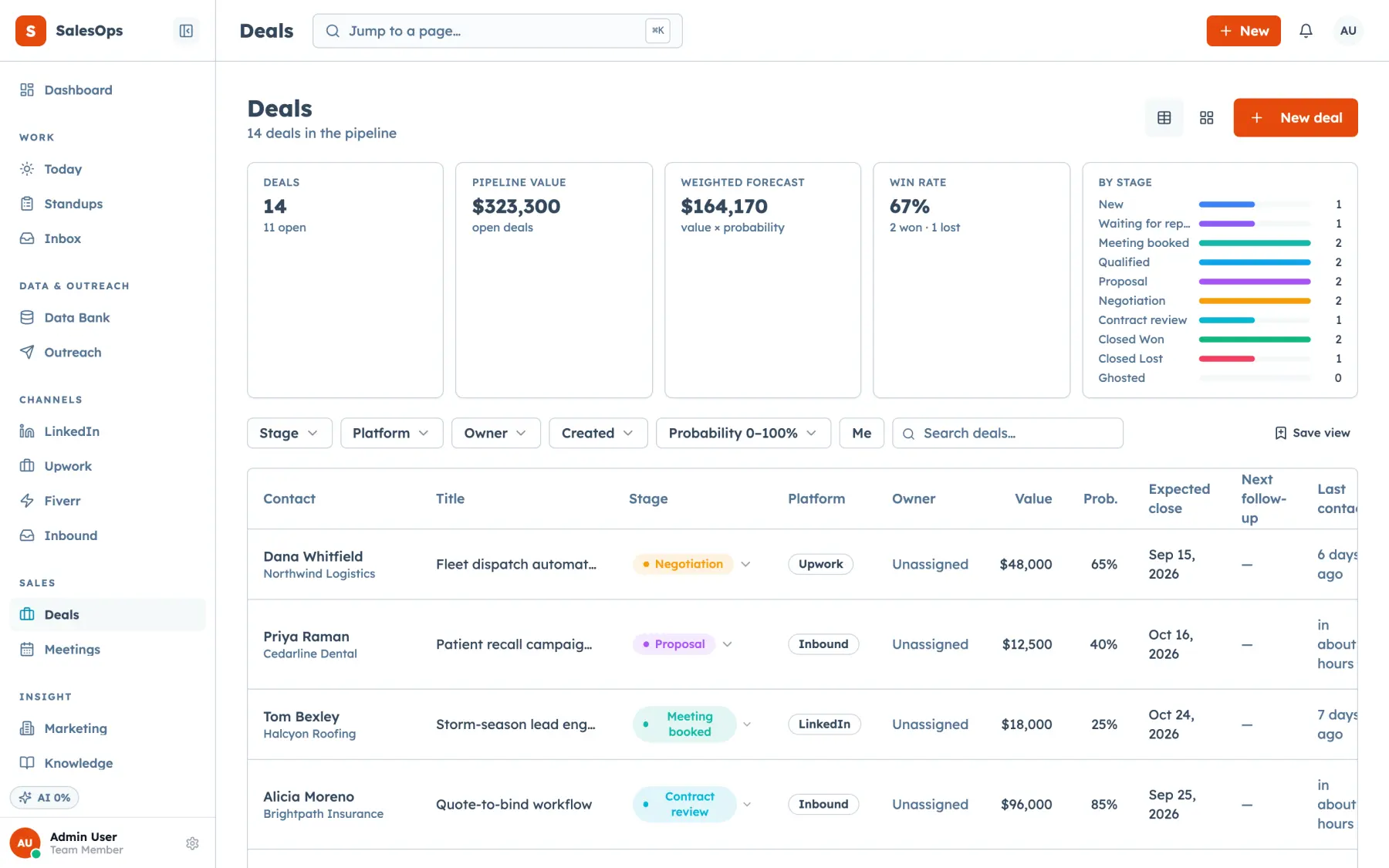
An intake agent that books into nothing is an answering service with a script. The value is the queue that exists in the morning: matters sorted by practice area and urgency, each with the conflict-check names attached, ready for a person to accept or decline.
Practice management software holds matters, not leads. That is the gap this fills. A caller is not a matter until the firm has run the conflict check and signed an engagement, so the period before that needs somewhere to live where it can be followed up, measured and, when the answer is no, closed cleanly.
It is also where the cadence lives. Consults get booked and missed, engagement letters get sent and not signed, and both need a sequence against a record. So the intake pipeline, the consult cadences and the approval queue are live now, beside Clio or MyCase rather than replacing them.
Settle this before it ships. Bar advertising and solicitation rules govern how a firm may present itself, and confidentiality obligations sit over everything an intake captures. Whether you must disclose an AI caller, and whether a call may be recorded, vary by jurisdiction. These are questions for your own counsel and your bar. This is not legal advice.
What firms ask about this
- Will it sound like a robot?
- The voice is not usually the tell on current platforms. Delay is, and so is an answer that misses what a distressed caller just described. Legal intake is the hardest test of that, because the caller wants reassurance the agent is designed not to give. The design handles it by being brief and clear about what happens next rather than by sounding warm.
- What happens when it cannot answer something?
- It says so plainly, which in legal intake is most of the call. The facts it may state come from your knowledge base: your practice areas, your jurisdictions, your published fee structure, your consult process. Everything that resembles an assessment of the caller's situation gets a scripted refusal and a consult booking. That boundary is the entire reason the design is narrow.
- Will it say it is an AI?
- Yes, in the opening line, together with a statement that the call does not create an attorney-client relationship. Several jurisdictions are moving toward requiring AI disclosure, and bar rules add their own requirements about how a firm communicates with prospective clients. Confirm both with your own counsel and your bar. This is not legal advice.
- What will it cost per minute?
- We do not publish a figure. It depends on your voice provider, your model class and your call length, and legal intake calls run longer than any other trade on this site because the narrative takes time. The components are a platform fee, the model, speech to text, text to speech and telephony, and our calculator page publishes the formula.
- Is it legal to record the calls?
- It depends where you and the caller are, and some jurisdictions require every party on the call to consent. A consent line in the opening is part of the design for that reason. Recording an intake also raises confidentiality questions about storage and access that go beyond the recording rule itself, so take the whole question to your own counsel. This is not legal advice.
- Can it transfer to me?
- Yes, and the trigger list here is the strictest in this batch. Any deadline, hearing date, arrest, custody issue or statute question transfers or raises an urgent alert immediately. So does any request for a person and any question that asks for an assessment. If the on-call number does not answer, the fallback is an urgent task at the top of the morning intake queue.
Build the intake queue before the agent arrives
Intake stages, consult cadences and engagement follow-up run today, beside your practice management system.