The CRM for law firms that lose intakes after 6pm
Intake, conflict check, consult and engagement as stages, with follow-up that runs without a paralegal chasing it.
- Unlimited seats
- Your own database
- AI waits for your approval
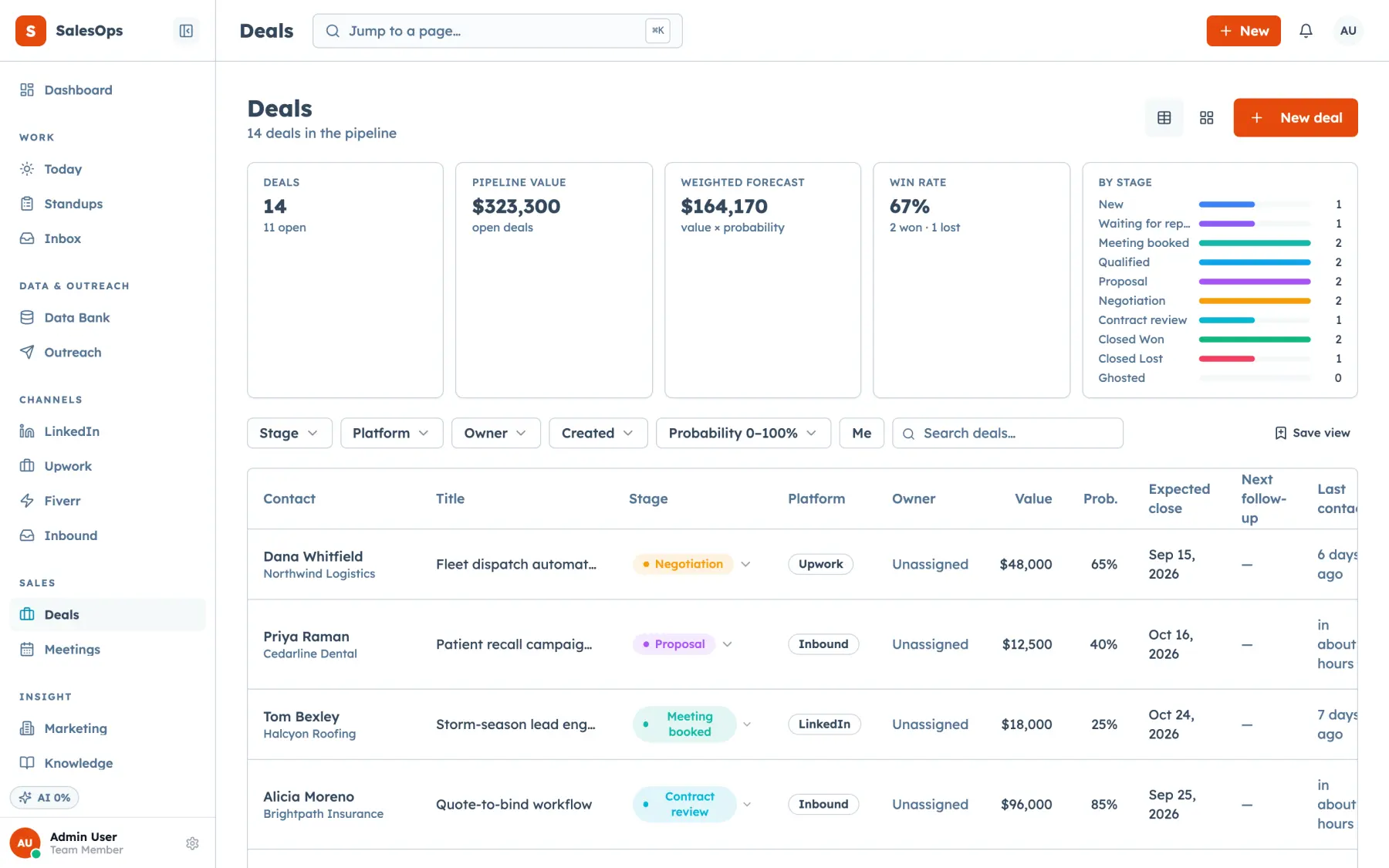
Clio and MyCase hold matters. A matter exists after someone signs. Everything before the signature (the 9pm call from a person who was rear-ended this afternoon, the conflict check, the consult that was booked and not attended, the engagement letter sitting unsigned for two weeks) usually lives in a spreadsheet or an inbox. SalesCrew is configured for that stretch, and stops where privilege begins.
Three places intake leaks
What breaks in a small firm, and what gets configured for each.
After-hours intakes go to voicemail
In personal injury and family law the caller is in a bad moment and calling several firms in the same hour. Configure the site intake form and the inbound webhook so the enquiry that arrives at 9pm is a tracked lead with matter type and jurisdiction on it before anyone opens the office.
Consults are booked and never attended
A free consult with no deposit is easy to skip. Configure the consult as a stage with a follow-up sequence, so the person who did not attend gets contacted again instead of silently dropping out of the pipeline.
Engagement letters sit unsigned
The prospect said yes, the letter went out, and nobody looked at it again for eleven days. Configure the engagement stage with a follow-up cadence and a task, so the gap between yes and signed stops being invisible.
The conflict check is a stage, not an afterthought
Every other business in this list can move from enquiry to sale in a straight line. A law firm cannot. Before anyone takes a case, the firm has to check whether it already represents someone adverse to the prospective client, and that check has to happen before substantive information is taken and certainly before an engagement is offered.
That single requirement changes the shape of the pipeline. The stages are Intake received, Conflict check, Consult booked, Consulted, Engagement sent, Signed — with the conflict check sitting as a hard gate between the second and third. A deal that skips it is a process failure the pipeline should make visible, not a step someone remembers.
It also changes what belongs in the record. Enough to run the check and book the consult: names of the parties, the matter type, the jurisdiction, the date of the incident. Not the narrative the caller gave. That distinction is the discipline this page keeps coming back to.
What we configure for you
A working intake setup for a small or mid-sized firm, inside the first 14 days.
- 1
Pipeline stages
Intake received, Conflict check, Consult booked, Consulted, Engagement sent, Signed, with a declined stage carrying a reason so referral-out decisions are recorded.
- 2
Channels
The firm mailbox connected over IMAP, the website intake form pointed at the inbound webhook with matter type and jurisdiction as fields, and Calendly consult bookings landing as meetings.
- 3
Cadences
A same-day intake response, a consult follow-up for people who booked and did not attend, and an engagement-letter chase. Referral-source cadences for the doctors, agents or firms who send you work.
- 4
Agent policy
The Inbox agent in review mode with a tighter than usual guardrail set. It drafts a scheduling reply; it does not draft anything that reads as advice, and a lawyer approves before anything sends.
- 5
Knowledge-base voice
Your practice areas, your jurisdictions, your fee structure and your consult policy loaded as knowledge, so a draft never states a fee or a limitation period you did not authorise.
Your stack, and what sits beside it
Practice management keeps the matter. We keep the lead. The line between them is the point.
| What you run | What it keeps | What SalesCrew adds |
|---|---|---|
| Clio Manage | Matters, time entries, trust accounting, documents, billing | Intake and conflict-check stages before a matter exists, plus referral-partner outreach |
| Clio Grow | Clio's own intake product, if you already pay for it | Cadences that run across email and other channels, a unified inbox, and outbound to referral sources |
| MyCase | Case management, client portal, invoicing and payments | The pipeline in front of the case, with consult and engagement follow-up |
| PracticePanther | Matters, workflows, billing and trust | Intake tracking, consult no-show recovery, and lead source on every enquiry |
| Lawmatics | A legal-specific intake and marketing platform | Consider this a direct overlap. If Lawmatics is working for you, keep it |
| Your answering service | Live pickup after hours | The lead record and the follow-up once the call ends, by webhook or CSV |
These connections run through webhooks, CSV import and the API. There is no native app listing for any of them. Trust accounting, time entries and documents are not things SalesCrew touches.
Confidentiality, and what an AI draft may not see
When practice management software is the better answer
A configurable CRM (SalesCrew)
- Intake, conflict check, consult and engagement configured as real stages with a gate
- Cadences that chase a consult or an unsigned engagement without a paralegal remembering
- Unlimited seats, so paralegals, intake staff and every attorney have access
- One Postgres database per firm, with a full export whenever you ask for it
- No matter management, no time tracking, no trust accounting, no document assembly
- No native connector to Clio, MyCase or PracticePanther — webhooks and CSV only
- No native mobile app, and e-sign on engagement letters is on the roadmap
- Not a legal-specific product: no conflict-check database, only the stage that reminds you to run one
The legal tool (Clio, MyCase, PracticePanther, Lawmatics)
- Trust accounting and billing built to the rules your state bar audits against
- Matter-centric records, document assembly and a client portal
- Legal-specific intake forms and conflict-check tooling in the same system
- Vendors that already understand confidentiality obligations and sign the paperwork
- Intake follow-up is often a task, not a sequence that runs and stops on a reply
- Referral-source development and outbound are not what case management is for
- Per-attorney pricing that makes intake staff seats an expense to argue over
- Your data lives in their system, and export is a report rather than a database dump
The 9pm intake call
Intake speed decides the case in personal injury and in family law, because the caller has a browser tab of firms open and is going down it. The call comes after a car accident, after an arrest, after a service of process, and it does not wait for office hours. Voicemail is effectively a decline.
Today SalesCrew captures the web intake form and the Calendly consult booking at any hour, and makes outbound calls through Vapi. It does not answer the phone. An AI intake assistant that takes the matter type, the jurisdiction and the urgency, runs the conflict-check fields and books the consult is on the roadmap, along with numbers, SMS and text-back.
The design constraints on that assistant are stricter than for any other trade on this site. It must not give legal advice, must not comment on the merits, and must say it is an assistant rather than a person. Anything touching a filing deadline, a custody matter or an arrest gets transferred to a human immediately, because a missed limitation period is not a recoverable error.
There is a smaller constraint that catches firms out. A number captured on an intake call is a consumer mobile, and the TCPA applies to marketing texts to it even though the person contacted you first. Firm newsletters and check-in campaigns are marketing. Suppression and opt-out are enforced today at audience freeze and again at send.
Where this gets used
Three intake jobs described as mechanism.
Answering an overnight enquiry first thing
The 9pm form submission is a lead at Intake received, with matter type and jurisdiction as fields. The Inbox agent drafts a scheduling reply from your consult policy, and an attorney or intake lead approves it.
Recovering a missed consult
A prospective client who booked and did not attend moves into a short follow-up sequence, with the reschedule handled by a person. Any reply pauses the sequence and lands in the shared inbox.
Keeping referral sources warm
Treating physicians, financial advisers and firms that refer out are contacts with a partner cadence, not names in someone's phone. Every touch is logged against the source, so you can see which relationships actually produce files.
What firms ask first
- How is client confidentiality protected if an AI is reading our inbox?
- By configuration and by scope. Every agent runs in review mode, so a model drafts and a person approves before anything leaves the firm. Your firm runs in its own Postgres project rather than a shared tenant, credentials sit in a secrets vault, and every tool call is written to an audit log with the actor recorded. You can also bring your own AI key so requests run against your account. The stronger control is what you put in: keep the narrative in your practice management system and the CRM holds matter type, jurisdiction and status.
- We already pay for Clio Grow. Is this the same thing?
- There is real overlap, and if Clio Grow is working we would tell you to keep it. It is legal-specific and it sits next to your matters. The reasons a firm moves are outbound to referral sources, unlimited seats, and running the CRM from Claude or ChatGPT over MCP. If none of those matter to you, this is not a switch worth making.
- Will attorneys actually use it?
- Mostly they should not have to. Intake staff and paralegals live in it; attorneys see their consult calendar and approve drafts. That is the honest adoption picture, and it is why unlimited seats matter. Nobody is excluded to save a licence fee. There is no mobile app, only responsive web.
- Does it run conflict checks?
- No. It gives you a conflict-check stage that a matter cannot pass without being marked, and fields for the parties. The check itself runs against your practice management system or your own records. Any product claiming to run a conflict check against data it does not hold is describing something else.
- Can it send an engagement letter for signature?
- Not yet. Quotes and documents with typed e-sign are on the roadmap, and a payment link on your own Stripe key comes with them. Today the engagement letter goes out however you send it now, and SalesCrew tracks the stage and runs the follow-up so it does not sit for two weeks.
- What does it cost, and what happens if we leave?
- Core is $299 a month with unlimited seats, Local is $499, Outbound is $699 and Agency is $1,200. If you leave, you take the database: a full Postgres dump plus CSVs, because your firm's instance is a separate project. It goes read-only with export available, and a human deprovisions it after 90 days.
Which tier fits a law firm
Core for intake. Local when the phone pack ships.
Core at $299 a month holds the intake pipeline, the shared inbox, email sequences and the data bank, with unlimited seats for intake staff and attorneys. Local at $499 adds phone numbers, SMS, text-back and reminders — the pack that matters most for a practice where the after-hours call decides the case, and the one described in the roadmap note above.
Related
Start with the intakes that never became consults
Import last quarter's enquiries, and see how many stopped at a voicemail nobody returned.