The CRM for landscapers who sell in March and forget in August
A season that compresses a year of selling into six weeks, and contracts that renew without anyone asking.
- Unlimited seats
- Your own database
- AI waits for your approval
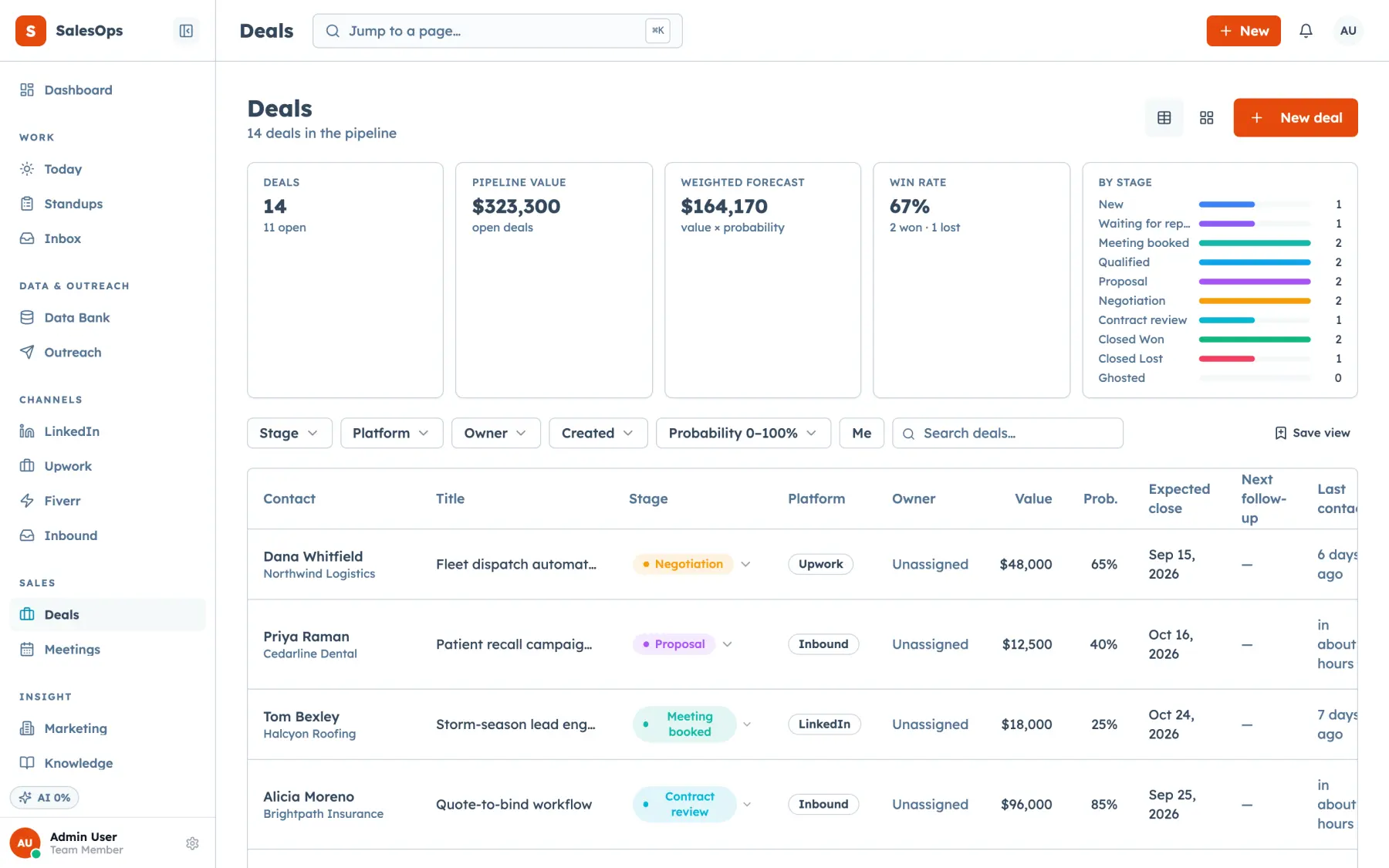
Landscaping has the sharpest seasonality of any trade on this site and two genuinely different buyers inside one company. Maintenance is recurring revenue sold on price and reliability; design and build is a project sale with a portfolio and a long decision. Your operations software runs the crews and the routes. SalesCrew runs the estimate backlog and the renewals.
A year in a landscaping company
Three patterns owners recognise, and what gets configured for each.
Six weeks of spring, and a hundred estimates behind
Demand in this trade is not spread across a year. A short window in spring produces most of the enquiries, arriving faster than anyone can quote them, and the ones quoted late are the ones lost. Configure an estimate pipeline with an age view, so the oldest unanswered quote is visible rather than buried under this morning's arrivals.
Maintenance contracts renew, or quietly do not
A recurring maintenance client who does not sign again in February is usually gone before anyone notices in April. Configure a segment on contract end date with a renewal cadence starting sixty days out, when there is still time to have the conversation.
Autumn and winter services never get offered
Leaf clean-up, winter protection and snow work are sold to people you already serve, and mostly they are not sold at all because everyone is busy. Configure a seasonal segment of existing maintenance clients and a cadence timed to the shoulder weeks rather than to the day the weather turns.
Who is buying, and who is typing
The owner buys. The office manager or an estimator lives in it. Crews stay in whatever routing and time-tracking app you run, and nothing here asks them to open anything.
The access split that matters in this trade is between the two sides of the business. A maintenance account manager working renewals does not need the design-build board, and the designer chasing a patio project does not want a list of hedge-trimming renewals. Access is scoped by channel, profile and area, so both fit in one system without either seeing the other's noise.
Seats are unlimited on every tier, which matters when you take on seasonal office help in March.
What we configure for you
A working setup for a company doing both maintenance and design-build.
- 1
Two pipelines
A maintenance pipeline from enquiry to signed contract, short and price-led, and a design-build pipeline with design, proposal and contract stages that runs for months.
- 2
Segments
Estimates unanswered by age rather than by date sent, maintenance contracts ending within sixty days, existing clients with no seasonal service booked, and design enquiries that stalled after the site visit.
- 3
Cadences
An estimate chase that runs during the busy season without anyone remembering, a sixty and thirty day renewal cadence, and a seasonal upsell cadence timed to the shoulder weeks.
- 4
Channels
The office mailbox over IMAP, the website form pointed at the inbound endpoint, and site visit bookings landing as meetings with the source recorded.
- 5
Knowledge base
Your service area, what your maintenance contract includes and excludes, your minimum project size and your renewal terms, so drafts state your terms rather than approximating them.
Your stack, and what sits beside it
Routing, crews and job costing stay where they are.
| What you run | What it keeps | What SalesCrew adds |
|---|---|---|
| Aspire | Job costing, crew scheduling, route management, purchasing | The estimate backlog by age, renewal segments and seasonal upsell cadences |
| LMN | Estimating, budgeting, time tracking, crew management | Follow-up on estimates that were sent and never answered |
| Jobber | Quotes, jobs, invoicing and the field app for smaller companies | Cadences that keep running after the quote, and a renewal segment on contract dates |
| Service Autopilot | Scheduling and routing for recurring maintenance | The renewal conversation sixty days before the contract ends |
| QuickBooks | Books and payroll | Nothing. We do not touch accounting |
| Your design software | Plans and renderings for design-build work | The design enquiry as a tracked deal with stages, rather than a folder |
Connections run through webhooks, CSV import and the API rather than a native app listing.
When a configurable CRM is wrong for you
A configurable CRM (SalesCrew)
- The estimate backlog sorted by age, which is the screen that matters in April
- Renewals as a dated segment rather than something someone notices in spring
- Two pipelines for two genuinely different buyers, with access scoped between them
- Unlimited seats, including the seasonal office help you hire in March
- No routing, crew scheduling or job costing
- No estimating tools and no material or labour pricing
- No field app for crews, and no native mobile app at all
- New product with no landscaping customers yet and no third-party reviews
The landscape operations platform
- Routing, crew scheduling and job costing built for this trade
- Estimating with real material and labour costs
- A crew app that works from a truck
- Recurring maintenance visit scheduling at scale
- The estimate backlog is a list rather than a worked pipeline
- Renewal outreach is usually manual or a batch send
- Seasonal upsell to existing clients is rarely modelled at all
- Your data lives in their multi-tenant system rather than a database you can dump
The spring rush, and what a phone system would and would not fix
The call pattern here is unlike the emergency trades. Nobody rings a landscaper at midnight. What happens instead is that six weeks in spring produce more calls in a day than the rest of the year produces in a week, and the office is quoting rather than answering.
That makes the missing capability a volume problem rather than an out-of-hours one. Where things stand: SalesCrew captures forms and bookings around the clock with the arrival time recorded, and places outbound calls through your own Vapi account. It does not answer inbound calls, does not text back a missed caller and has no AI receptionist. Those are roadmap items.
It is worth being clear about the limit even when it ships. A receptionist that books a site visit for a maintenance quote is useful. One that tries to price a patio installation from a phone description is not, and the escalation rule should send any design-build enquiry to a person.
One constraint to plan around now. Residential clients are consumers, so the TCPA applies to marketing texts and calls to their mobiles, and a seasonal upsell message to last year's customer is marketing rather than a response to an enquiry. Consent has to be recorded rather than assumed. SalesCrew enforces suppression and opt-out; the consent is yours to collect, and this is not legal advice.
Where this gets used
Three jobs a landscaping office does each year, described as mechanism.
Working the estimate backlog by age
Every estimate carries the date it was sent. The pipeline view sorts by age so the oldest unanswered quote surfaces first, and a cadence chases it without anyone deciding to.
Renewing before the contract lapses
A segment on contract end date drives a cadence at sixty and thirty days out. Suppression is applied when the audience freezes, and anyone who signs drops out of the sequence.
Selling the autumn service to existing clients
A segment of maintenance clients with no seasonal service booked receives one timed offer in the shoulder weeks. A reply pauses it and lands in the shared inbox.
What landscaping owners ask first
- We use Aspire. Does this replace it?
- No. Aspire runs routing, job costing and crews and you should keep it. This runs the estimate backlog, renewals and seasonal upsells, which most operations platforms treat as a report rather than a worked list.
- We are busy for six weeks and quiet for six months. Is a subscription sensible?
- That is the fair question for this trade. The renewal and seasonal cadences run in the quiet months, which is when the software earns its keep. If your entire year is those six weeks and nothing else, the maths is tighter.
- Can we keep maintenance and design-build separate?
- Yes, and you should. Two pipelines and access scoped by area means the account manager and the designer see different boards without running two systems.
- Will crews have to use it?
- No. This is office and estimator software. Crews stay in your routing and time-tracking app, and there is no mobile app here anyway.
- Can it text customers about renewals?
- Not today. SMS is on the roadmap, so renewal cadences run over email for now. When SMS ships, every external send starts in review with a person approving it.
- What does it cost?
- Core is $299 a month, Local is $499, Outbound is $699 and Agency is $1,200, with unlimited seats on all four. AI usage is the meter, with a hard stop at the cap that never stops manual work.
Which tier fits a landscaping company
Core for most; Outbound if you sell to commercial property managers.
Core at $299 a month covers both pipelines, the segments, email cadences and the shared inbox with unlimited seats. Outbound at $699 adds the sender pool and campaign agents, which is the tier for a company doing genuine cold outreach to commercial property managers and HOAs.
Start the trial before the spring rush, not during it
Import last season's unanswered estimates and set the renewal segment while there is time.