The CRM for independent agencies that renew all year
Quote follow-up, renewal outreach and cross-sell as one pipeline, beside the agency management system that holds the policies.
- Unlimited seats
- Your own database
- AI waits for your approval
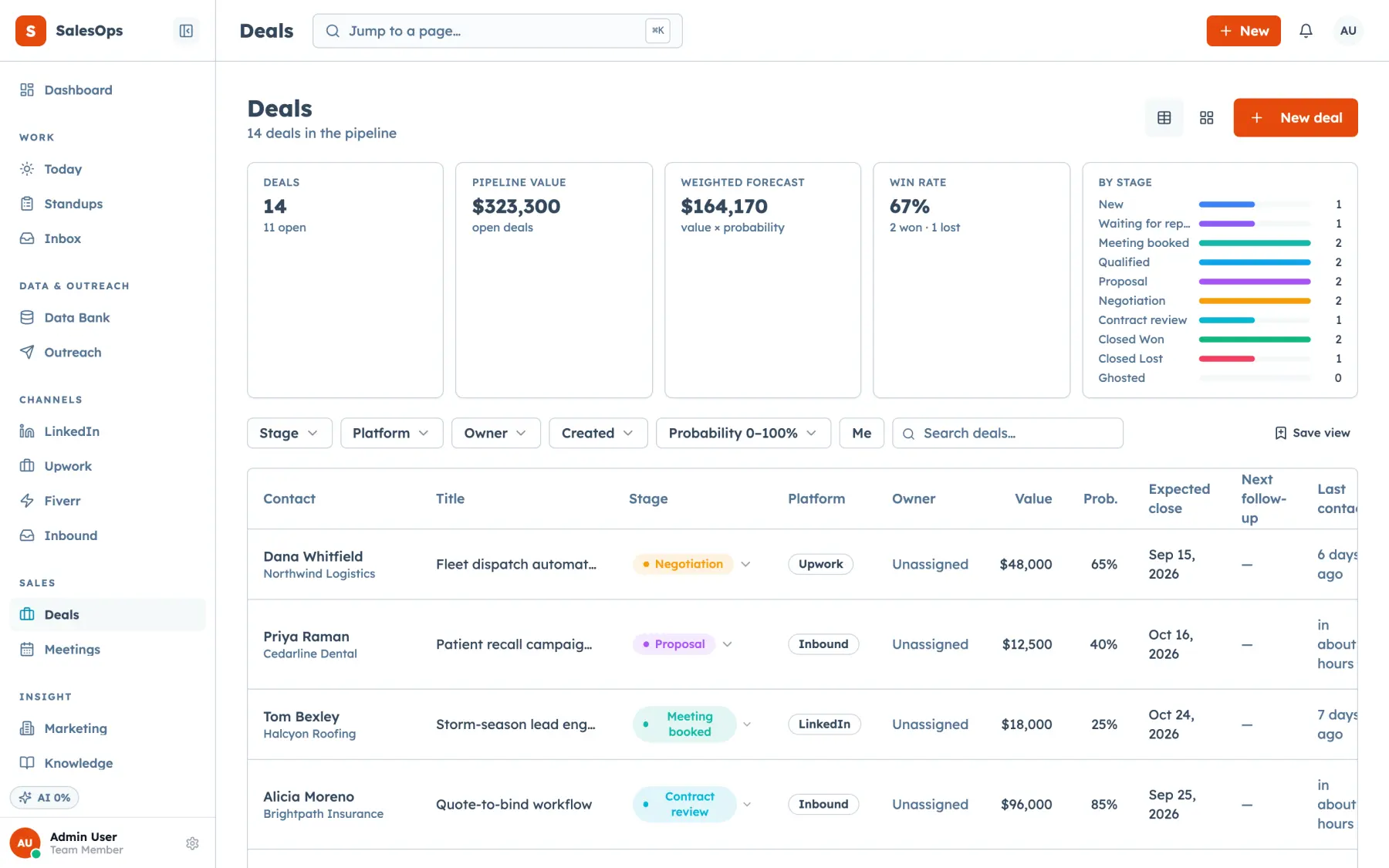
An independent agency does not have a sales season. It has twelve of them, because every policy renews on its own anniversary and the work arrives spread evenly across the year in small, easy-to-miss pieces. The agency management system knows every one of those dates. It was never built to run the outreach that goes with them. That gap is what this page is about.
A week in a five-person agency
Three things every principal recognises, and what gets configured for each.
Quotes go out and nobody follows up
A producer rates a home and auto package on Tuesday, emails it, and the prospect goes quiet. In a market where the same risk is being quoted by two other agencies in the same week, the quote that gets a second and third contact is the one that binds. Configure a quote pipeline with Quoted, Follow-up 1, 2 and 3, Bound and Lost-with-reason, and a cadence that stops the moment they reply.
Renewals are worked by whoever remembers
The renewal list exists in the management system, and the outreach around it exists in a service rep's head. Configure segments on renewal date at 60 and 30 days out, and separate cadences for each window, so the conversation about a carrier increase happens before the renewal notice lands, not after the client calls angry.
Monoline clients stay monoline forever
The client with only auto is the cheapest new business in the agency and nobody ever asks. Configure a segment for households holding one line, and a cross-sell cadence that offers the home, umbrella or life conversation on a schedule rather than when a producer has a slow afternoon.
Retention is the product, and the maths is unforgiving
A property and casualty book compounds. Every policy you retain this year is commission you keep next year without selling anything, which is why a point of retention is worth more to a small agency than a point of new business. That single fact should decide how the CRM is shaped, and in most agencies it does not, because the system was bought to file policies rather than to run conversations.
The practical version is that renewals and cross-sell get configured before anything else. A segment on renewal date drives the 60 and 30-day cadences. A segment on lines held drives the cross-sell. A segment on last contact date finds the clients who have not heard a human voice since they bound, which is the population that leaves when a competitor's mailer arrives.
There is a staffing reality underneath this. Producers sell and service reps retain, and they do not want the same view. The three-axis access model (channel, profile, area) lets a producer see their own book and their own quotes while service staff see the renewal queue for the whole agency. Seats are unlimited on every tier, so nobody is kept out of the system to save a licence fee.
What we configure for you
A working setup for an independent P&C agency, inside the first 14 days.
- 1
Pipeline stages
A new-business pipeline (Lead, Information gathered, Quoted, Follow-up, Bound, Lost with reason) and a renewal pipeline (Renewal 60 days, Reviewed, Remarketed, Retained, Lost with reason), because a renewal is not a deal and should not sit in the same board.
- 2
Channels
Your agency mailbox connected over IMAP, the quote request form on the site posting to the inbound webhook with the lines of business as fields, and Calendly review appointments landing as meetings with the source attached.
- 3
Cadences
A three-touch quote follow-up, a 60-day and a 30-day renewal cadence, a monoline cross-sell cadence, a win-back cadence for policies lost to price, and a referral cadence for the clients who send you business.
- 4
Agent policy
The Inbox agent set to review, so it drafts a reply about a quote or a renewal appointment and a licensed person approves it. Guardrails hold sends to business hours and cap touches per contact at three days apart.
- 5
Knowledge-base voice
Your carrier panel, the lines you write, your service standards, your appointment policy and your agency licence line loaded as knowledge, so a draft never quotes a premium, states a coverage term or promises a carrier decision you did not authorise.
Your stack, and what sits beside it
The management system keeps the policy. We keep the conversation around it. Read this row by row.
| What you run | What it keeps | What SalesCrew adds |
|---|---|---|
| Applied Epic | Policies, endorsements, accounting, carrier download, the servicing record | Quote follow-up, the renewal outreach calendar and cross-sell segments in front of it |
| HawkSoft | Policy management and servicing built for independent agencies | Multi-step cadences that keep running, one shared inbox and lead source on every new prospect |
| EZLynx | Comparative rating across carriers and management for smaller agencies | The pipeline around the quote, and the follow-up after it is sent |
| AgencyZoom | A sales and retention layer sold into this exact gap | Consider this a direct overlap. If AgencyZoom is working for you, keep it |
| Carrier portals and download | Policy data, endorsements, commission statements | Nothing. Carrier data stays where the carrier put it |
| Your comparative rater | Premiums and eligibility across your panel | Nothing. We never rate a risk and never quote a premium |
Connections to the tools above run through webhooks, CSV import and the API. There is no native agency-management-system connector, and we would rather say that plainly than call it an integration it is not.
When an agency-specific tool is the better choice
A configurable CRM (SalesCrew)
- Separate new-business and renewal pipelines, because they are separate motions with separate owners
- Segments on renewal date, lines held and last contact, which is where retention actually comes from
- Unlimited seats, so producers, service staff and the agency principal all have access
- One Postgres database per agency, exportable whenever you ask, which matters when a book changes hands
- No policy management, no carrier download, no commission accounting, no certificates
- No comparative rating, and no premium anywhere in the system
- No native connector to Applied Epic, HawkSoft or EZLynx — webhooks and CSV only
- Two-way SMS for renewal reminders is on the roadmap, and new product with no agency customers yet
The agency tool (Applied Epic, HawkSoft, EZLynx, AgencyZoom)
- Policy data, download and servicing in one system built to this industry's record-keeping expectations
- Renewal lists that come from the policy record itself rather than an import
- Comparative rating and carrier connections that already exist
- Vendors who understand agency compliance and errors-and-omissions expectations
- Outreach is usually a task list, not a sequence that runs and stops on a reply
- Cold outbound to commercial prospects is not what a management system is for
- Per-seat pricing that makes service staff logins an expense to argue over
- Your book's data lives in their system, and export is a report rather than a database dump
The claim call, the quote call, and the service call
The phone in an agency rings for three completely different reasons, and mixing them up is the most expensive mistake the front desk makes. A claim call is urgent and belongs with a human immediately. A quote call is revenue and needs to reach a producer while the caller is still shopping. A service call, a certificate request or an ID card, is volume that eats the day and rarely needs anyone senior.
Today SalesCrew captures the web quote request at any hour, records the source, drafts the first reply through the Inbox agent for a licensed person to approve, books the review appointment through Calendly, and makes outbound calls through Vapi. It does not answer the phone.
When the receptionist ships, the triage above is the design. Claim first, always to a human, with the policy number captured on the way. Quotes captured with the lines of interest and routed to a producer. Service requests logged and answered in the morning. Numbers with inbound routing, missed-call text-back and the assistant that books into the calendar are in the phone pack on the roadmap.
Two constraints to plan around now. Personal-lines clients are consumers, so the TCPA governs marketing texts and calls to their mobile numbers, and a number given for servicing a policy is not consent for a cross-sell campaign. Separately, insurance marketing is regulated at state level: departments of insurance set rules on how a licensed agency may advertise and describe coverage, and those rules differ by state, so check the requirements in every state you are licensed in and keep your agency licence line in your templates. Suppression and opt-out are enforced today. This is not legal advice.
Where this gets used
Three jobs an agency does every week, described as mechanism.
Chasing a quote that went quiet
The quote moves to Follow-up 1 the day after it is sent. A three-touch cadence runs over two weeks, pauses the second the prospect replies, and the reply lands in the same inbox as everything else. Lost deals record a reason, so price-versus-coverage becomes a report.
Running the 60 and 30-day renewal windows
A segment finds every policy renewing in the next 60 days. Suppression is applied when the audience is frozen, the cadence runs, and anyone who books a review appointment drops out of it. A second, shorter cadence covers the 30-day window for the ones who did not.
Offering the second line
A segment finds households holding a single line of business. The cross-sell cadence offers the conversation rather than a premium, because no draft in this system quotes a number your knowledge base did not authorise.
What agency principals ask first
- Does it sync with Applied Epic or HawkSoft?
- Not natively, and we will not pretend otherwise. The mechanism is webhooks, CSV import and the API. In practice agencies export the book on a schedule and import it, or push events to the inbound webhook. What you get back is renewal and cross-sell segments a management system does not run for you. If a native two-way sync is a hard requirement, an agency-specific tool is the better buy today.
- Where does carrier data live?
- Where the carrier put it. Policy data, download, endorsements and commission statements stay in your management system, and we do not ingest carrier feeds. What sits in SalesCrew is the contact, the household, the renewal date, the lines held and the conversation history. That line keeps the compliance surface small and it keeps the two systems from arguing about which one is right.
- Will producers actually use it?
- Producers use the quote pipeline because it tells them who to call today, and service staff use the renewal queue because it replaces a list they were keeping by hand. Nobody is asked to re-enter policy data. Unlimited seats mean the whole agency has access, including the person who only ever runs the renewal reports. There is no native mobile app, only responsive web.
- Can it text clients about renewals?
- Not yet. Two-way SMS with consent handling and STOP keywords is in the phone pack on the roadmap. Today renewal outreach runs by email and by calls your team makes, with the outreach recorded against the policy record you keep here.
- Can we do cold outbound to commercial prospects?
- Yes, and this is where the product is unusual. Cold email is allowed rather than quietly forbidden, and the suppression list is enforced when the audience is frozen and again at send. The data bank, segments and the sender pool are built for exactly the contractor, restaurant or trucking prospecting a commercial producer does. What we do not do is take on your consent obligations: CAN-SPAM, TCPA and your state's rules stay yours.
- What does it cost, and what happens if we leave?
- Core is $299 a month with unlimited seats, Local is $499, Outbound is $699 and Agency is $1,200. Agencies doing serious commercial prospecting usually want Outbound for the sender pool. The trial is 14 days and a card is required to start it. If you leave, you take a full Postgres dump plus CSVs, because your agency's instance is a separate project. It goes read-only with export available, and a person deprovisions it after 90 days.
Which tier fits an independent agency
Core for personal lines. Outbound when commercial prospecting is the growth plan.
Core at $299 a month covers both pipelines, the shared inbox, email cadences and the data bank, with unlimited seats for producers and service staff. Outbound at $699 adds the sender pool, the Instantly send provider and the campaign agent, which is the tier a commercial producer building a book from cold actually needs. Local at $499 is the phone and SMS tier and ships with the roadmap pack described above.
Start with the quotes nobody followed up
Import last quarter's unbound quotes and your next 60 days of renewals, and watch both cadences line up in review.