The CRM for HVAC companies that lose the Saturday call
Every call, form and estimate lands in one pipeline, with follow-ups that run without the office manager remembering.
- Unlimited seats
- Your own database
- AI waits for your approval
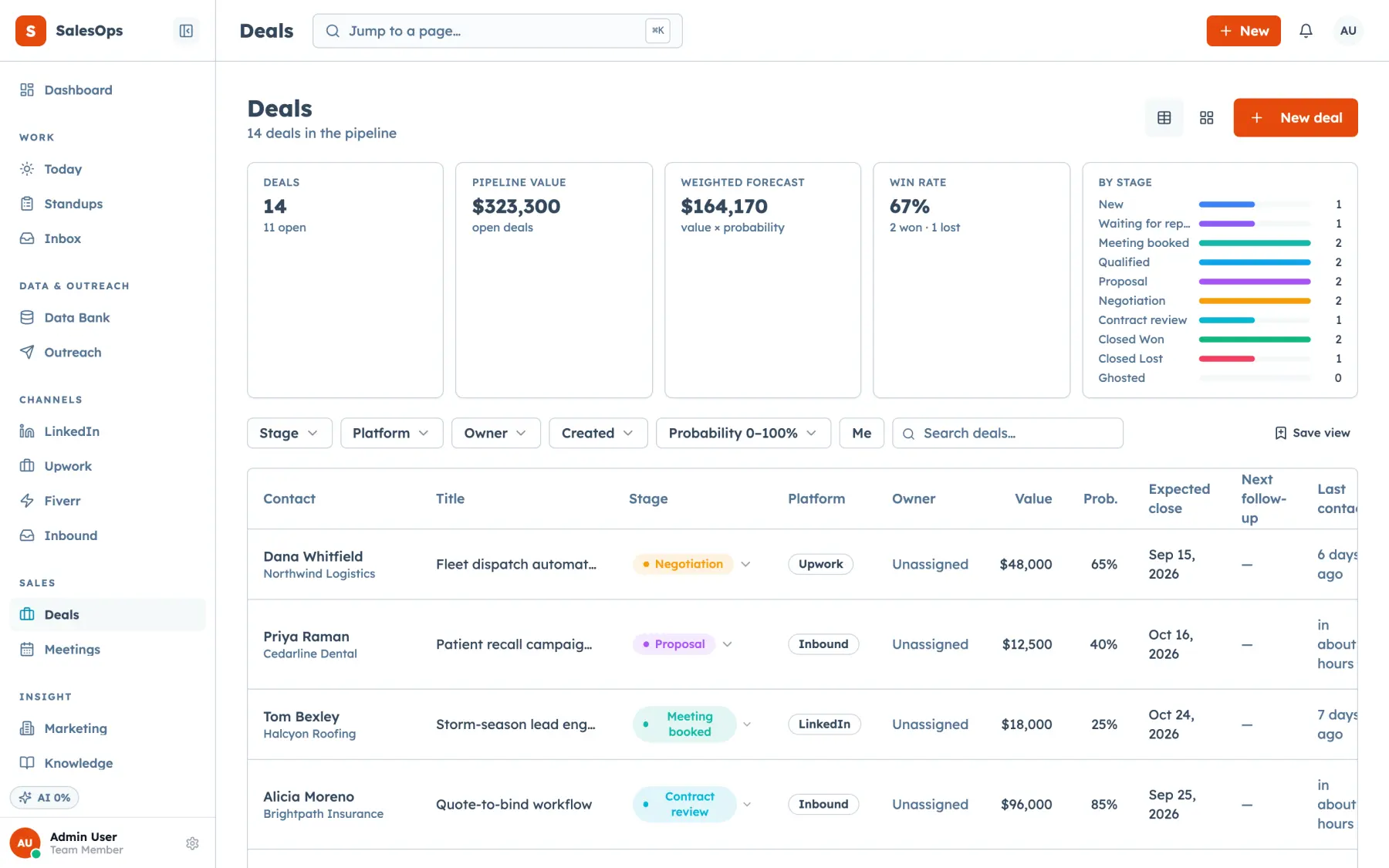
Your dispatch software runs the truck. It was never built to chase the estimate the comfort advisor left on a kitchen table in June, or to send the agreement renewals in March and September. SalesCrew sits beside ServiceTitan or Housecall Pro and owns the part they treat as an afterthought: lead to sold, and sold to renewed.
A week in an HVAC office
Three things every owner with two to fifteen techs recognises, and what gets configured for each.
Unsold estimates die in the truck
A comfort advisor quotes a $12,000 changeout at 4pm and the homeowner says they want to think about it. Nobody calls again. Configure it as pipeline stages (Estimate sent, Follow-up 1, 2 and 3, Financing, Sold) with a cadence that fires on its own schedule and stops the moment the customer replies.
The first hot week buries the phones
Demand in this trade is not smooth. The first genuinely hot week and the first genuinely cold week produce a spike of no-cool and no-heat calls, and most of them come outside office hours. Configure an inbound webhook and web form so nothing that arrives on a Saturday waits until Monday in a shared inbox.
Maintenance agreements renew in a spreadsheet
The renewal list lives in a tab someone updates when they remember. Configure a segment for agreements expiring within 60 days, and a seasonal cadence that goes out in spring and autumn before the shoulder months.
Who is actually buying, and who is actually typing
In most HVAC companies these are two different people. The owner-operator signs for the software. The office manager lives in it all day, and a comfort advisor, the person who sells replacement systems rather than fixes them, needs to see only their own estimates and follow-ups.
That split matters for how a CRM gets set up. SalesCrew uses a three-axis access model (channel, profile, area), so the comfort advisor sees the replacement pipeline, the office manager sees every inbound lead, and the service techs are not asked to log into anything at all. Their work stays in the field service software you already run.
Seats are unlimited on every tier, which is the reason this works. There is no cost argument for keeping a person out of the system, so the record stays complete.
What we configure for you
Not a blank CRM with a help centre. A working setup for a residential HVAC company, done in the first 14 days.
- 1
Pipeline stages
Two pipelines, because HVAC has two sales motions: a service pipeline that closes in a day, and a replacement pipeline with Estimate sent, Follow-up 1/2/3, Financing and Sold.
- 2
Channels
Your office mailbox connected over IMAP, the website form pointed at the inbound webhook, and Calendly bookings landing as meetings with the lead source attached.
- 3
Cadences
An unsold-estimate cadence over email today, a spring and autumn agreement-renewal cadence, and a reactivation cadence for customers whose last visit was over two years ago.
- 4
Agent policy
The Inbox agent set to review, so it drafts a reply to a homeowner enquiry and a human presses send. Guardrails cap touches per contact and hold sends to business hours.
- 5
Knowledge-base voice
Your brands, your service area, your financing partner and your agreement terms loaded as knowledge, so drafts say what your office would say.
Your stack, and what sits beside it
SalesCrew does not replace your field service software. Read this row by row before you decide anything.
| What you run | What it keeps | What SalesCrew adds |
|---|---|---|
| ServiceTitan | Dispatch board, technician scheduling, invoicing, price book, job costing | The replacement pipeline before the job exists, estimate follow-up cadences, and renewal segments |
| Housecall Pro | Scheduling, payments, the technician mobile app | Multi-step follow-up on unsold estimates, a unified inbox, and lead source on every record |
| Jobber | Quotes, jobs, invoicing for smaller shops | Cadences that keep running after the quote is sent, plus cold outbound to commercial property managers |
| FieldEdge | Dispatch, service agreements, QuickBooks sync | Agreement expiry segments and the seasonal campaign that works them |
| QuickBooks | Books, payroll, the financial record | Nothing. We do not touch accounting. |
| Google Local Services | Your LSA leads and the Google-side booking | The lead lands in the pipeline with its source, so cost per booked job by channel is a query |
Connections to the tools above run through webhooks, CSV import and the API, not a native app listing. We would rather say that plainly than call it an integration it is not.
When a configurable CRM is wrong for you
A configurable CRM (SalesCrew)
- Sales stages, fields and cadences you set up for how you actually sell replacements
- Every action is also an MCP tool, so Claude or ChatGPT can query the pipeline
- Unlimited seats, so the office manager and both comfort advisors cost nothing extra
- One Postgres database per company, exportable whenever you want it
- No dispatch board, no technician routing, no price book
- No technician mobile app — there is no native app at all, only responsive web
- Fewer prebuilt connectors than the big field service platforms
- New product with no HVAC customers yet and no third-party reviews
The trade tool (ServiceTitan, Housecall Pro, FieldEdge)
- Dispatch, routing, technician time and invoicing in one place, built for this trade
- Price books and flat-rate pricing your techs already know
- A field app your crew will actually open
- Years of HVAC-specific features you would otherwise configure by hand
- Sales follow-up is usually a task list, not a running cadence
- Cold outbound to builders and property managers is not what they are for
- Per-seat pricing makes it expensive to give everyone a login
- Your data lives in their multi-tenant system, not a database you can dump
After hours, and the first hot week
The most valuable HVAC call of the year is the one that comes at 7pm on the first Saturday the temperature breaks ninety. The caller has no relationship with you. They are working down a list of local companies, and they rarely leave a voicemail. Whoever answers gets the job.
Here is the honest state of that today. SalesCrew captures web forms and Calendly bookings around the clock, and it makes outbound calls through Vapi. Answering an inbound call is not something it does yet. Phone numbers with inbound routing, business hours, whisper and voicemail transcription are on the roadmap, along with missed-call text-back and an AI receptionist that books into the calendar and transfers to a person on an emergency.
When it does ship, the triage matters more than the technology. A no-cool call in July and a maintenance question are not the same call, and a caller reporting a gas smell should be transferred to a human immediately, never handled by an assistant reading from a script.
One constraint to plan around now. Homeowner mobile numbers are consumer numbers, so the TCPA applies to every text and every marketing call you send them. Consent has to be recorded before the first message, not assumed because they once bought a furnace. SalesCrew enforces suppression and opt-out, and a DNC scrub plus a consent gate on call start are on the roadmap. The consent itself is yours to collect, and this page is not legal advice.
Where this gets used
Three jobs an HVAC office does every week, described as mechanism.
Chasing an unsold estimate
The estimate moves to Follow-up 1 the day after it is sent. A cadence sends three touches over two weeks, pauses the second the homeowner replies, and the reply lands in the same inbox as everything else.
The March and September renewal push
A segment finds every maintenance agreement expiring in the next 60 days. Suppression is applied when the audience is frozen, the cadence runs, and anyone who books drops out.
Cost per booked job by source
Google Ads and GA4 data land in the same database as the leads. Lead source sits on every record, so the spend and the booked jobs can be joined instead of compared across two dashboards.
What HVAC owners ask first
- We already have ServiceTitan. Why would we add anything?
- You would not replace it, and we would tell you to keep it. ServiceTitan owns dispatch, the price book and invoicing. What it does not do well is chase a $12,000 estimate for three weeks or run a renewal campaign in March. Add SalesCrew only if unsold estimates and agreement renewals are where your money is leaking. If they are not, stay where you are.
- Our techs will not use another app.
- They should not have to. This is office software. The office manager and the comfort advisors work in it; techs stay in the field service app they already have. There is no native mobile app to install, and access is scoped so people only see their own area.
- Is the AI going to text our customers by itself?
- No. Every agent ships in review mode, which means it writes the draft and a person approves it. Any external send is set to review by default in the policy table, and there is a kill switch that stops every agent at once. You can move an agent to auto later; nothing does that for you.
- How many seats do we get?
- Unlimited, on every tier. Core is $299 a month, Local is $499, Outbound is $699 and Agency is $1,200. Seats are not the meter. AI calls are, with an allowance and a hard stop at the cap. Manual work never stops when the AI allowance runs out.
- What about our Google Local Services leads?
- They come in as a lead with their source recorded, through the inbound webhook or a CSV import. That is the honest mechanism: webhooks and the API, not a native Google connector. The value is that LSA, Ads and organic leads then sit in one table with your ad spend next to them.
- How long before it is actually set up?
- The 14-day trial is the setup window. Day one you connect the office mailbox and calendar, day two you import your customer list, day three the first cadence is waiting in review, day seven the agents are running in review, and on day fourteen you either continue or export everything and leave.
Which tier fits an HVAC company
Most contractors start on Core and move to Local when the phone pack ships.
Core at $299 a month covers the pipeline, the inbox, email cadences and the data bank, with unlimited seats. Local at $499 adds phone numbers, SMS, missed-call text-back and reminders, and it ships with the roadmap pack described above — so it is not the tier to buy today for a capability you need this week.
Related
Start the trial with your own estimate list
Import last quarter's unsold estimates on day two and watch the first cadence line up in review.