The CRM for remodelers with a six-month sales cycle
Twenty deals a year at six figures each. Losing track of one is not a rounding error.
- Unlimited seats
- Your own database
- AI waits for your approval
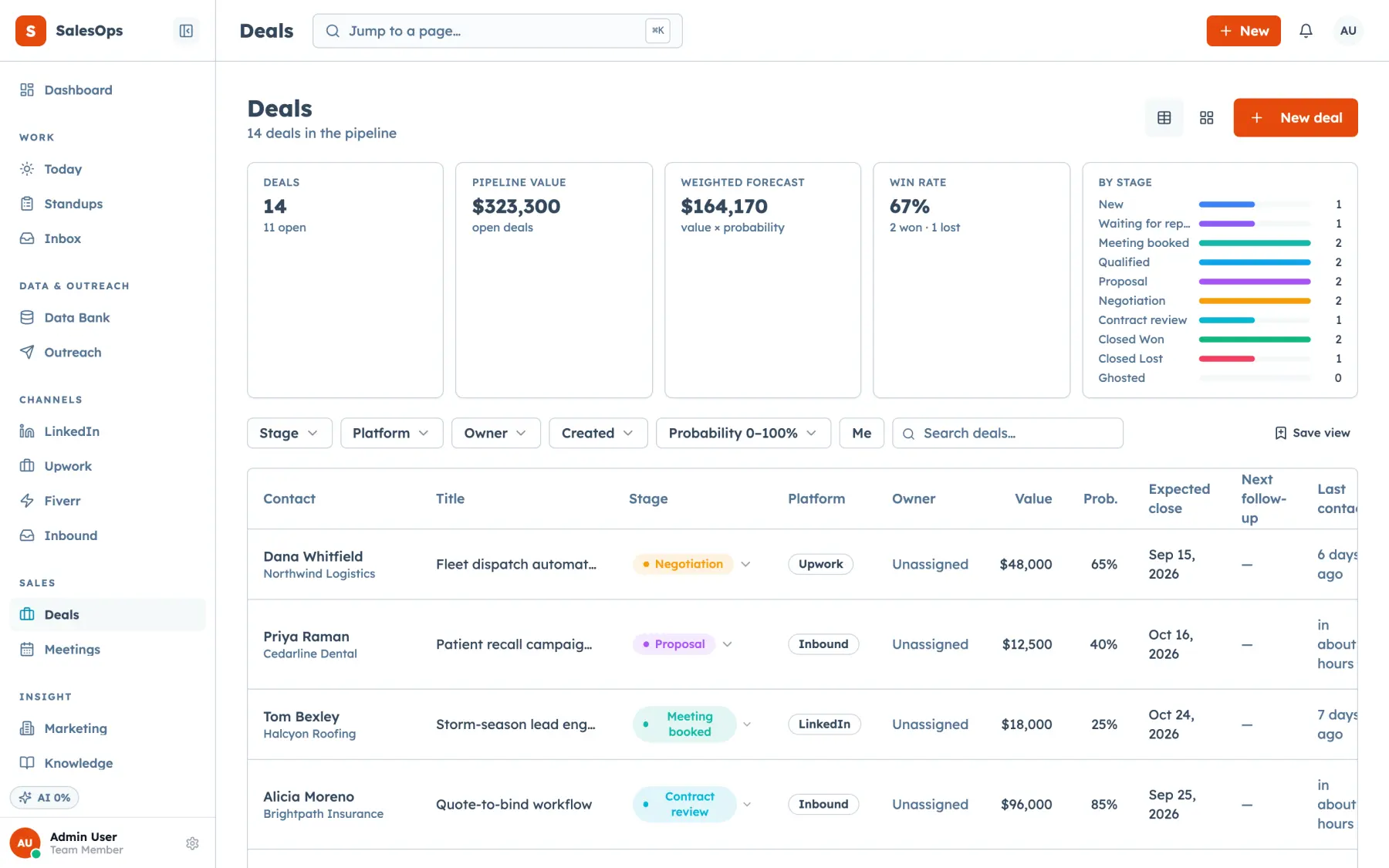
Remodeling inverts the usual home services arithmetic. Instead of hundreds of small jobs you have a few dozen very large ones, each taking months to close, with a design phase in the middle that other trades do not have. Your project management software runs the build. SalesCrew runs the six months before it.
A year in a design-build company
Three patterns owners recognise, and what gets configured for each.
The consultation that goes quiet for four months
A homeowner has an in-home consultation in March, is genuinely interested, and is not ready until the autumn. Every other trade's three-touch cadence is useless here. Configure a long-cycle cadence measured in months, with touches that give something rather than ask something.
The design agreement is a sale inside the sale
Design-build companies charge for design before the construction contract exists, so there are two separate closes with a gap between them. Configure them as distinct stages, because a signed design agreement that never becomes a build is a different failure from a lost lead.
Past clients are the best source and never get asked
A kitchen from three years ago is a bathroom this year and a referral to a neighbour. At this ticket size a single referral pays for the software many times over. Configure a past-client segment with an anniversary cadence rather than relying on being remembered.
Who is buying, and who is typing
The owner buys, and often sells as well. In a company doing twenty projects a year the owner or a single designer is usually the salesperson, which means the CRM has one or two real users rather than a team.
That changes what good looks like. With twenty deals in flight, the value is not throughput, it is never losing one. A stalled-deal view and a cadence that keeps running for six months matter far more than automation volume.
Seats are unlimited on every tier, which here means the project manager and the bookkeeper can see the pipeline without a per-user conversation, and the designer keeps their own view.
What we configure for you
A working setup for a design-build remodeler.
- 1
Pipeline
Enquiry, consultation booked, consultation held, design agreement sent, design agreement signed, proposal, contract signed. Two signature stages, because design and build are separate closes.
- 2
Segments
Consultations held with no design agreement after three weeks, design clients who have not moved to a build proposal, past clients past their project anniversary, and referral sources with no contact this year.
- 3
Cadences
A six-month nurture cadence with touches spaced in weeks rather than days, a design-agreement follow-up, and an anniversary and referral cadence for past clients.
- 4
Channels
The office mailbox over IMAP, the website enquiry form pointed at the inbound endpoint, and the consultation booking landing as a meeting with its source recorded.
- 5
Knowledge base
Your typical project range and minimum, your service area, your design fee structure, your lead times and your licence details, so drafts do not imply a timeline you cannot meet.
Your stack, and what sits beside it
Project management stays where it is. This is the part before a project exists.
| What you run | What it keeps | What SalesCrew adds |
|---|---|---|
| Buildertrend | Schedules, selections, change orders, client portal, job costing | The six months before a contract: nurture cadences, stalled-deal views and referral tracking |
| CoConstruct | Estimating, selections, client communication during a build | Multi-month follow-up on consultations that have not converted |
| Houzz Pro | Lead generation, portfolio, some project tools | A pipeline with two signature stages, and a source on every lead so you can judge Houzz against referrals |
| Your estimating software | Take-offs, material and labour pricing | The proposal as a tracked deal with a date rather than a document in a folder |
| QuickBooks | Books, payroll, job cost accounting | Nothing. We do not touch accounting |
| Your photographer and portfolio | The work that wins the next job | Nothing, though a past-client segment is how that portfolio gets in front of people again |
Connections run through webhooks, CSV import and the API rather than a native app listing.
When a configurable CRM is wrong for you
A configurable CRM (SalesCrew)
- Cadences that run for months, which is the actual length of this sales cycle
- Design and build as two separate closes with their own stages
- A stalled-deal view, which at twenty deals a year is the most valuable screen you have
- Unlimited seats and one Postgres database per company
- No scheduling, selections, change orders or client portal
- No estimating, take-offs or job costing
- No e-signature today, so contracts are signed wherever you sign them now
- New product with no remodeling customers yet and no third-party reviews
The construction project platform
- Schedules, selections and change orders built for a build
- A client portal homeowners genuinely use during a project
- Job costing tied to the estimate
- Subcontractor coordination in the same tool
- The sales phase is usually a light lead list rather than a pipeline
- Long nurture cadences are rarely supported at all
- Past-client and referral programmes are not modelled
- Your data lives in their multi-tenant system rather than a database you can dump
The phone matters less here, and the follow-up matters more
Unlike the emergency trades, a remodeling enquiry rarely needs answering within minutes. A homeowner researching a kitchen renovation is comparing portfolios over weeks, and a considered reply the next morning loses nothing. That is genuinely good news, because answering the phone is the thing SalesCrew cannot do today.
Where it stands: forms and bookings are captured around the clock with the arrival time recorded, outbound calls run through your own Vapi account, and there is no inbound answering, no SMS and no missed-call text-back. For this trade specifically, that gap costs you less than it would cost a plumber.
What does cost you here is the signature. Design agreements and construction contracts are the two moments a deal converts, and e-signature with a payment link is a roadmap item rather than a feature. Today the document is signed wherever you sign it now and attached to the deal.
Two constraints to plan around now. Homeowner mobiles are consumer numbers, so TCPA obligations attach to marketing texts and calls. Separately, most jurisdictions require a contractor licence number in advertising and many require specific cancellation-rights language in home improvement contracts, with the rules differing by state. Put your licence details in the knowledge base and take advice on contract language; this is not legal advice.
Where this gets used
Three jobs a remodeling office does every month, described as mechanism.
Nurturing a consultation for six months
The deal sits in a nurture cadence with touches weeks apart. It pauses on any reply, and the stalled-deal view surfaces anything that has not moved, so nothing simply ages out of attention.
Chasing an unsigned design agreement
Three weeks without a signature puts the deal in a segment. A short cadence follows up on the design agreement specifically, which is a different conversation from a general check-in.
Asking a past client for a referral
A segment on project completion anniversary drives one message a year. At this ticket size, a single referral out of that list pays for the software for several years.
What remodelers ask first
- We have Buildertrend. Why add this?
- Buildertrend starts when the project starts. This covers the six months before, where a design-build company loses most of its opportunities. If your pipeline is already fully tracked, you do not need it.
- We only do twenty projects a year. Is a CRM overkill?
- At six-figure tickets, losing track of one deal costs more than several years of software. The value here is a stalled-deal view rather than automation volume, and that works at twenty deals as well as at two hundred.
- Can it send a contract for signature?
- Not today. E-signature and quotes with payment links are on the roadmap. Sign wherever you sign now and attach the document to the deal, and the follow-up cadence still runs.
- Does it handle change orders?
- No. Change orders belong in your construction platform along with selections and schedules. This is the sales side only.
- Is the AI going to email our clients by itself?
- No. Every agent ships in review, so it drafts and a person approves. External sends are review by default and a kill switch stops every agent at once.
- What does it cost?
- Core is $299 a month, Local is $499, Outbound is $699 and Agency is $1,200, with unlimited seats on every tier and a 14-day trial that requires a card.
Which tier fits a remodeler
Core is almost certainly the right tier here.
Core at $299 a month covers the pipeline, segments, long-cycle email cadences and the shared inbox with unlimited seats. The phone and SMS pack on Local matters less in this trade than in the emergency ones, and it ships with the roadmap pack rather than today.
Start the trial with every consultation from this year
Import them on day two and see how many are still open and unworked.