The CRM for roofers who chase storm leads and lose the rest
Every inspection request becomes a tracked deal with adjuster, estimate and follow-up stages built in.
- Unlimited seats
- Your own database
- AI waits for your approval
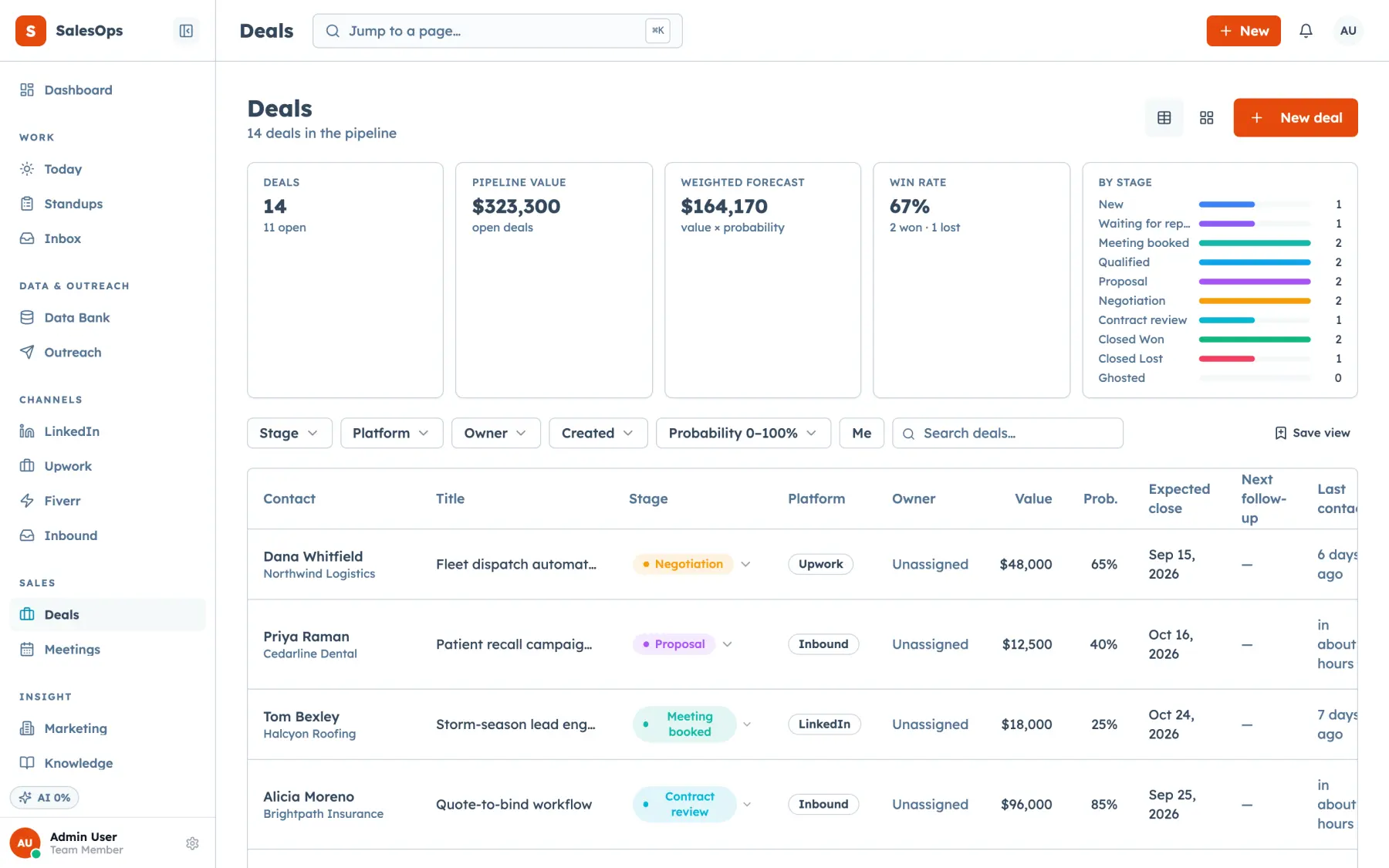
A roofing sale is rarely one decision. It is a claim: inspection, adjuster meeting, scope agreement, approval, supplement, then build, with a homeowner who is not really the payer and a carrier who is. Production software like AccuLynx or JobNimbus runs the build. SalesCrew runs the weeks before it, when the deal is a claim in progress and the outcome depends on whether anyone followed up.
Three ways a roofing pipeline leaks
What breaks in a storm-driven business, and what gets configured for each.
Canvassed leads live on paper
A door knocker fills a legal pad with addresses and half of them never reach the office. Configure a mobile-friendly intake form so the address, the damage noted and the canvasser's name land as a deal on the spot, with the source recorded for commission.
Adjuster meetings are untracked
The single most schedule-sensitive appointment in the trade is the one where your rep meets the carrier's adjuster on the roof. Configure claim stages — Inspection, Adjuster meeting, Scope agreed, Approved, Supplement, Build scheduled — with the carrier, claim number and adjuster contact as fields on the deal.
Retail quotes go quiet
Not every roof is a claim. The out-of-pocket replacement customer takes three bids and thinks about financing for a month. Configure a five-touch cadence over that month, with the inspection photos attached to the first send.
Storm season is not a busy period, it is a different business
Most trades have seasonality. Roofing has events. A hailstorm crosses three zip codes on a Thursday afternoon and by Saturday there are out-of-state crews knocking the same streets as your canvassers. Lead volume for that week can be a multiple of a normal month, and it arrives faster than any office can process by hand.
Two things break under that load. First, intake: leads come from canvassers, from the website, from a Facebook form and from referrals, and they need to be one list with one source field rather than four piles. Second, speed: in a market where four companies are knocking, the inspection that gets booked first usually gets the claim.
Then the opposite problem arrives. The storm passes, the deals sit in the claim process for weeks, and the office goes quiet while sixty deals wait on adjusters. That is the period when a pipeline view earns its keep, because the question is not how many leads came in but which claims are stuck and at which stage.
What we configure for you
A working setup for a residential roofing and storm restoration contractor, in the first 14 days.
- 1
Pipeline stages
An insurance pipeline from Inspection through Adjuster meeting, Scope agreed, Approved, Supplement and Build scheduled, plus a separate retail pipeline for out-of-pocket replacements.
- 2
Channels
A mobile intake form for canvassers pointed at the inbound webhook, your office mailbox connected, and Calendly for inspection bookings, each carrying a lead source.
- 3
Cadences
A five-touch retail quote cadence over four weeks, a claim-status update cadence to keep the homeowner warm while the carrier decides, and a post-build referral sequence.
- 4
Agent policy
The Inbox agent in review mode. It drafts the reply to a homeowner asking where the claim stands, and a person approves it. Guardrails cap touches and hold sends to business hours.
- 5
Knowledge-base voice
Your workmanship warranty, your manufacturer certifications, your financing partner and your service area loaded as knowledge, so drafts do not invent terms you do not offer.
Your stack, and what sits beside it
Production and estimating software stays. This is the boundary, row by row.
| What you run | What it keeps | What SalesCrew adds |
|---|---|---|
| AccuLynx | Production scheduling, material orders, labour, job costing, Xactimate-side workflow | The claim pipeline before production, retail quote cadences, and canvasser attribution |
| JobNimbus | Job boards, production tasks, invoicing and the mobile job workflow | Multi-touch follow-up on retail bids, a unified inbox, and outbound to property managers |
| Roofr | Aerial measurements and the proposal document itself | Follow-up on the proposal after it is sent, plus stages for what happens next |
| CompanyCam | Photo documentation on every roof, timestamped and shared with the carrier | Nothing. Photos stay there; we link the deal to the job, not the images |
| EagleView | Aerial measurement reports | Nothing. The measurement is not our job |
| Facebook lead forms | The ad and the form itself | The lead arrives by webhook with its source and enters the same pipeline as canvassed doors |
Every connection above runs through webhooks, CSV import or the API. There is no native app listing for any of them, and calling it one would be false.
When the trade tool is the better choice
A configurable CRM (SalesCrew)
- Claim stages, carrier fields and adjuster contacts configured for how insurance work actually moves
- Cadences that keep running through the weeks a claim sits with the carrier
- Unlimited seats, so every canvasser can submit leads without a per-user cost argument
- One Postgres database per company, exported in full whenever you want it
- No production scheduling, no material ordering, no job costing
- No Xactimate or EagleView connection, and no measurement or estimating tools
- No native mobile app — canvassers use a responsive web form, not an installed app
- New product with no roofing customers yet and no third-party reviews
The trade tool (AccuLynx, JobNimbus, Roofr)
- Production, crews, material orders and job costing built for roofing specifically
- Photo and document workflows aimed at what carriers ask for
- Proposal and measurement tooling that produces the document you actually send
- Field apps your crews and canvassers already have on their phones
- Sales follow-up is usually a reminder, not a sequence that runs on its own
- Cold outbound to property managers, HOAs and commercial buildings is out of scope
- Per-seat pricing makes it costly to give a seasonal canvassing crew logins
- Your data sits in their shared system, and export is a report rather than a database
The post-storm inspection call
After a hail event the call pattern changes shape. It is not emergencies at 3am, which is restoration work. It is a burst of daytime calls from homeowners who have just been told by a neighbour, a canvasser or a news report that their roof may be damaged, and who want someone to come and look. They will call three companies in ten minutes.
What matters on that call is short: the address, whether they have filed a claim yet, which carrier, and an inspection slot. The rest can wait. An active interior leak is the one answer that should stop the script and put a person on the line, because that is an emergency tarp job and not an inspection booking.
Today SalesCrew captures the web form and the Calendly booking around the clock and makes outbound calls through Vapi. Answering an inbound call is not something it does. Phone numbers with routing, voicemail transcription in the same thread list, missed-call text-back and an AI receptionist that captures the address and insurance status before booking are on the roadmap.
Two constraints worth writing into your process now. Homeowner mobiles are consumer numbers, so the TCPA governs the texts and marketing calls you send after a storm, and a door knock does not create consent for a text campaign. Separately, several states regulate what a roofer may say and offer to a homeowner on an insurance claim, including contractor licence disclosure on contracts and rules about waiving or absorbing a deductible. The rules and the exact wording vary by state and change often, so check the ones you work in. Ask your own counsel; this page is not legal advice.
Where this gets used
Three roofing jobs described as mechanism.
Turning a knocked door into a deal
The canvasser submits the mobile form from the sidewalk. A deal is created at Inspection stage with the address, the damage note and the canvasser as the source, so attribution for the commission is a field and not an argument.
Keeping a claim from stalling
Deals sitting at Adjuster meeting past a set number of days surface as stalled. A task is created, and the homeowner gets a status update from the cadence so silence from the carrier is not silence from you.
Working a whole zip code after a storm
A segment built from the data bank for an affected area, suppression applied when the audience is frozen, and one campaign sent from your own mailbox pool with every opt-out permanently suppressed.
What roofing owners ask first
- We use JobNimbus for production. Are you replacing it?
- No, and you should keep it. JobNimbus owns the job once it is sold: boards, production tasks, material orders and invoicing. SalesCrew owns the part before that, which is the claim and the bid. If your production side is working and your sales side is a whiteboard, that is the gap this fills.
- Can it handle a storm week without falling over?
- Volume is not the hard part. Each company runs in its own Postgres project, so a spike in one instance does not touch anyone else's. The real limit is human: agents default to review mode, so a hundred drafted replies still need a person. That is deliberate, and it is why the guardrails cap touches per contact.
- How do we credit the door knocker who found the lead?
- Lead source is a field on every record, set by the intake form the canvasser submits. Reporting by source is a query in the same database, so commission arguments are settled by the record rather than by memory.
- Does it connect to Xactimate or EagleView?
- No. Estimating and aerial measurement are not things we do, and there is no connector on the roadmap. Those files stay in your estimating tool. What comes across, by webhook or CSV, is the fact that a deal moved.
- Will the AI email a homeowner about their claim on its own?
- No. Every external send is set to review by default, so the agent drafts and a person approves. That matters more here than in most trades, because a wrong sentence about coverage or a deductible is a problem you do not want an assistant creating. There is a kill switch and an audit log of every action.
- What does it cost, and how many logins?
- Core is $299 a month, Local is $499, Outbound is $699, Agency is $1,200, and seats are unlimited on all of them. That is the point for a business with seasonal canvassers: adding ten people in April costs nothing. The AI allowance is the meter, with a hard stop at the cap, and manual work never stops.
Which tier fits a roofing contractor
Core for the pipeline. Outbound if you canvass commercial as well.
Core at $299 a month covers the claim pipeline, the inbox, email cadences and the data bank, with unlimited seats for the whole canvassing crew. Outbound at $699 adds volume sending and the campaign agents if you also prospect property managers and HOAs. Local at $499 is the phone and SMS tier, which ships with the roadmap pack described above.
Related
Start with the claims that are sitting still
Import the deals waiting on an adjuster, and see which ones have not been touched in two weeks.