The CRM for restoration companies where the first call decides the job
Your real sales channel is not homeowners. It is the plumbers, agents and property managers who send you the work.
- Unlimited seats
- Your own database
- AI waits for your approval
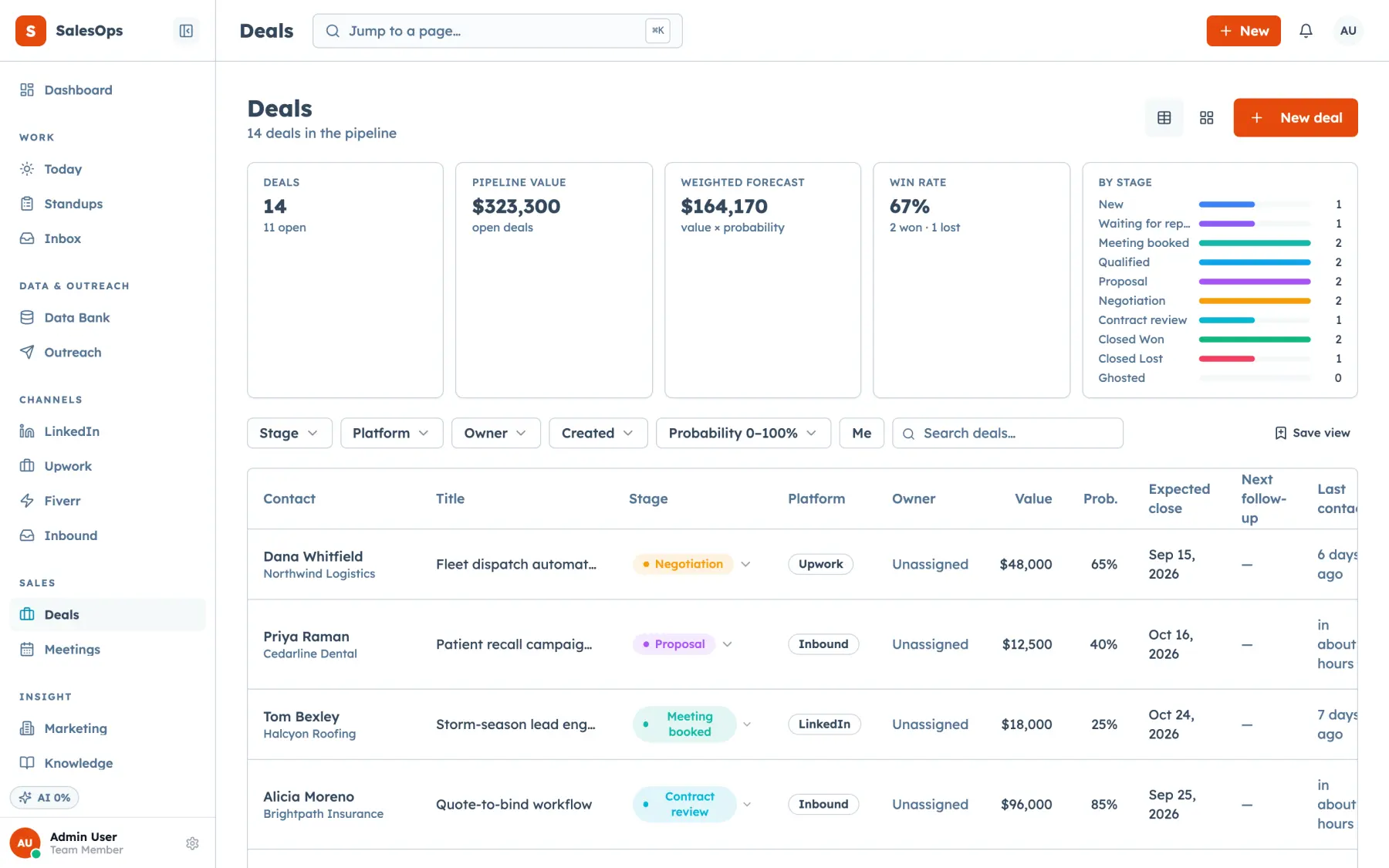
Restoration is the only trade on this site where the buyer is almost never the person paying. Work arrives from a plumber at 2am, an insurance agent, a property manager or a third-party administrator, and whoever answers first usually keeps the job. Your estimating and job documentation software runs the loss. SalesCrew runs the referral relationships that produce it.
A month in a restoration company
Three patterns owners recognise, and what gets configured for each.
The referral partner nobody has spoken to since spring
A plumber who sent you four jobs last year and none this year has almost certainly started calling someone else. That relationship is your pipeline and it decays silently. Configure a partner segment with a contact-recency filter and a quarterly cadence that is not a sales pitch.
Program work and direct work behave nothing alike
A job through a third-party administrator arrives with its own rules, its own documentation requirements and its own margin, while a direct call from a homeowner has none of that. Configure them as separate pipelines, because averaging their conversion rates tells you nothing useful about either.
Claims stall at the adjuster and nobody notices
Between the mitigation and the rebuild sits an adjuster decision that can take weeks and has no owner in most companies. Configure claim stages with an expected date, so a claim that has not moved surfaces as stalled rather than being assumed to be progressing.
Who is buying, and who is typing
The owner or a business development manager buys, and the business development role is unusually important in this trade. Someone whose job is visiting plumbers, agents and property managers is a real position here in a way it is not in most home services.
That person needs a partner pipeline rather than a customer pipeline: who was last contacted, how many jobs they sent this year, and which relationships are cooling. The office manager separately needs the claim board. Access scoped by area keeps both in one system without either drowning in the other's records.
Seats are unlimited on every tier, so project managers can see their own claims without anyone calculating whether it is worth a licence.
What we configure for you
A working setup for a water and fire restoration contractor.
- 1
Two pipelines
A claim pipeline with intake, inspection, mitigation, adjuster review, approval, rebuild and closed, and a partner development pipeline for the relationships that produce the claims.
- 2
Segments
Referral partners with no contact in ninety days, partners whose job volume has dropped year on year, claims stalled past their expected adjuster date, and program work by administrator.
- 3
Cadences
A quarterly partner nurture that gives rather than asks, a lapsed-partner re-engagement, and a claim follow-up that chases the adjuster decision on a schedule rather than on memory.
- 4
Channels
The office mailbox over IMAP, the website form pointed at the inbound endpoint, and a source on every job so you can see which partner produced it.
- 5
Knowledge base
Your service area and response commitment, which certifications you hold, which administrators and carriers you work with, and what you do and do not handle, so drafts stay inside your actual scope.
Your stack, and what sits beside it
Estimating and job documentation stay where they are.
| What you run | What it keeps | What SalesCrew adds |
|---|---|---|
| Xactimate | Estimating, scope and pricing for insurance work | The referral relationships that produce the claim, and a stalled-claim view |
| DASH | Job management, documentation and workflow for restoration | Partner development as a pipeline rather than a contact list |
| Encircle | Field documentation, photos, moisture readings, reports | Nothing on the job itself. That documentation stays where it belongs |
| Your moisture and drying logs | Equipment readings and drying records | Nothing |
| QuickBooks | Books, payroll, job costing | Nothing. We do not touch accounting |
| Third-party administrator portals | Program assignments and their own compliance | The assignment as a tracked deal with its source, so program and direct work can be compared |
Connections run through webhooks, CSV import and the API rather than a native app listing.
When a configurable CRM is wrong for you
A configurable CRM (SalesCrew)
- Referral partners as a pipeline with contact recency and job volume
- Program and direct work separated so their numbers mean something
- Stalled claims surface instead of being assumed to be moving
- Unlimited seats, so every project manager can see their own claims
- No estimating, no scope writing, no Xactimate-style pricing
- No field documentation, photos or moisture logging
- No 24-hour answering, which is the single most valuable capability in this trade
- New product with no restoration customers yet and no third-party reviews
The restoration job platform
- Job workflow and documentation built for insurance requirements
- Field capture of photos and readings from a phone
- Direct fit with estimating and carrier expectations
- Compliance records the administrators actually want
- Referral partner development is usually a contact list at best
- Business development activity is rarely tracked at all
- Program versus direct performance is hard to separate
- Your data lives in their multi-tenant system rather than a database you can dump
The night call, and an honest warning about it
This trade has the strongest after-hours case of any on this site. A burst pipe at 2am goes to whoever answers, the caller is distressed, and the job is worth thousands. Answering machines lose this work outright.
So the honest position needs saying plainly. SalesCrew does not answer inbound calls. There is no phone number, no missed-call text-back and no receptionist. If night coverage is why you are shopping, buy an answering service or a voice platform today, because this product does not solve that problem this month and the roadmap has no date attached to it.
What it does solve now is the other half. Referral partners who have gone quiet, claims stuck at the adjuster, and the question of which partner actually sends you work. Those are worth real money in this trade and they are entirely available today.
Two constraints to plan around now. Homeowners are consumers, so TCPA obligations attach to marketing texts and calls to their mobiles. Separately, states regulate how restoration contractors may solicit after a loss, several restrict contact in the immediate aftermath of a disaster, and assignment of benefits rules differ significantly by state. Check what applies where you operate before running any homeowner outreach. This is not legal advice.
Where this gets used
Three jobs a restoration office does every quarter, described as mechanism.
Keeping a referral partner warm
Partners with no contact in ninety days enter a segment. A quarterly cadence goes out that gives something useful rather than asking for work, and any reply pauses it and lands in the shared inbox.
Chasing a claim stuck at the adjuster
Each claim carries an expected decision date. When it passes, the deal surfaces in the stalled view and a follow-up goes to the adjuster rather than the homeowner.
Comparing program work to direct work
Source on every job and separate pipelines mean the conversion rate, cycle time and volume of program and direct work are separate numbers rather than one misleading average.
What restoration owners ask first
- Can it answer the phone at 2am?
- No. That is the honest answer and it is the most important line on this page for your trade. There is no inbound answering. Keep or buy an answering service, and use this for partners and claims.
- We use DASH for job management. Does this replace it?
- No. DASH runs the job, the documentation and the workflow. This runs the referral relationships that produce jobs and the claims that stall, which job platforms do not model.
- Can it track which plumber sends us the most work?
- Yes, and that is the main reason to use it here. Source on every job plus a partner pipeline means job volume by referrer over time is a query rather than an impression.
- Does it integrate with Xactimate?
- Not natively. Data moves by CSV, webhook or the API. Estimating stays entirely in Xactimate and we are not trying to replicate it.
- Is the AI going to contact homeowners after a loss?
- Only if you configure it to, and it would draft rather than send, because every external send is review by default. Given the solicitation rules in this trade, that default is a feature rather than a limitation.
- What does it cost?
- Core is $299 a month, Local is $499, Outbound is $699 and Agency is $1,200, with unlimited seats on every tier and a 14-day trial that requires a card.
Which tier fits a restoration company
Core for claims and partners; Outbound if business development is a real role.
Core at $299 a month covers both pipelines, the partner segments, email cadences and the shared inbox with unlimited seats. Outbound at $699 adds the sender pool and campaign agents, which suits a company with a dedicated business development manager working partner outreach at volume.
Start the trial with your referral partner list
Import it on day two and see how many have not heard from you this year.