The CRM for plumbers whose best jobs come in at 11pm
Emergency calls get answered and booked, and the drain-cleaning customer gets a maintenance reminder next spring.
- Unlimited seats
- Your own database
- AI waits for your approval
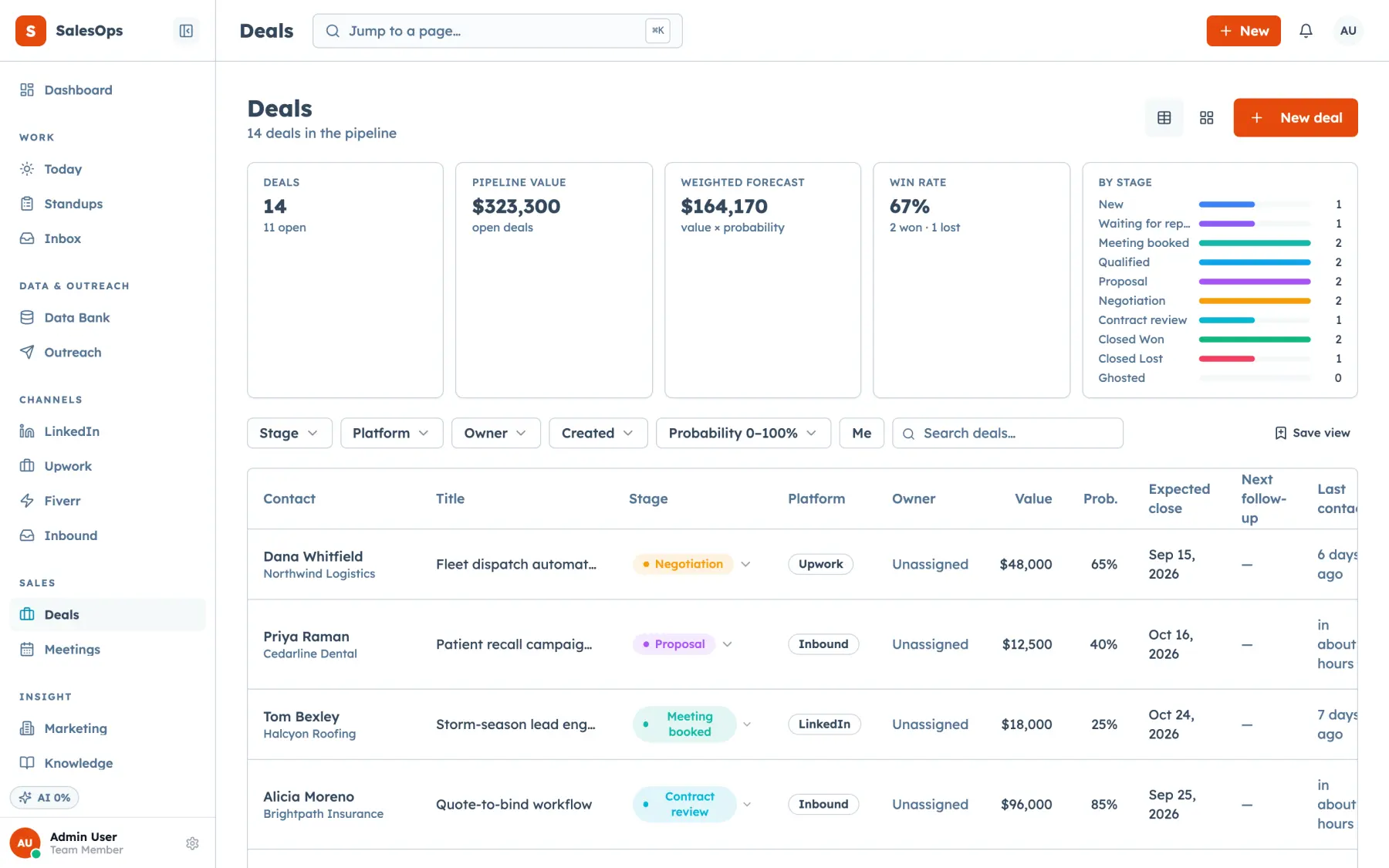
Plumbing is the trade where the highest-value work arrives at the worst hour. A burst supply line at 11pm is a customer with no price sensitivity and no loyalty, and the shop that picks up wins. SalesCrew runs beside ServiceTitan or ServiceM8 and takes the two jobs those tools leave half done: capturing what comes in after hours, and turning a one-off drain call into a water heater quote and then a membership.
Three leaks in a plumbing business that are not water
What breaks, and what gets configured for it.
Night calls go to a voicemail nobody checks
The overflow after 6pm is where the emergency premium lives, and a caller standing in two inches of water does not leave a message. Configure the web form and inbound webhook so anything that does arrive at night is a tracked lead by 7am, with the address and the failure captured on the record.
Water heater and repipe quotes sit unanswered
Service work closes on the spot. The estimate-driven jobs — tank swaps, tankless conversions, whole-house repipes — do not, because the homeowner is getting two more prices. Configure stages for Quote sent, Follow-up 1/2/3 and Won, with a cadence that runs while they shop.
Memberships are sold when someone remembers
The annual inspection plan is the retention lever in this trade, and it is usually pitched by whichever tech happens to think of it. Configure a post-job cadence that offers the plan a few days after the invoice, and a renewal segment twelve months later.
Two jobs, two motions, one database
A plumbing company runs two businesses that look nothing alike. Emergency and service work is dispatch: speed, availability, a truck with the right part. Replacement and repipe work is a sale: a quote, a comparison, sometimes financing, and a decision that takes a week.
Most plumbing software is built for the first one, which is correct — that is where the day goes. The result is that the second one runs on memory. The owner or the office manager knows there are seven open water heater quotes, roughly, and follows up on the two they remember.
Configuring two pipelines is the whole fix. Service jobs move fast and close in a day. Estimate work sits in stages with a cadence attached, and the deal stays visible until it is won or lost with a reason recorded. The reason field is worth more than it looks: after three months it tells you whether you are losing on price, on timing, or on being second to call back.
What we configure for you
A working setup for a residential plumbing and drain company, inside the first 14 days.
- 1
Pipeline stages
A service pipeline that closes same-day, and an estimate pipeline for water heaters, repipes and sewer line work with follow-up stages and a lost-reason field.
- 2
Channels
Your office mailbox connected, the site's emergency form pointed at the inbound webhook, and Calendly bookings arriving as meetings with the source attached.
- 3
Cadences
A quote cadence for estimate work, a post-job membership offer a few days after the invoice, and a spring reminder to the drain-cleaning customers you saw last year.
- 4
Agent policy
The Inbox agent in review mode so it drafts the reply to a homeowner and a person sends it. Guardrails hold sends inside business hours and cap touches per contact.
- 5
Knowledge-base voice
Your service area, your emergency call-out fee, your warranty terms and your membership plan details loaded as knowledge so drafts sound like your office.
Your stack, and what sits beside it
We do not replace your dispatch software. This table is the honest version of what each thing owns.
| What you run | What it keeps | What SalesCrew adds |
|---|---|---|
| ServiceTitan | Dispatch, technician scheduling, flat-rate price book, invoicing | The estimate pipeline for repipes and heaters, quote cadences, membership offer sequences |
| Housecall Pro | Scheduling, payments, customer notifications, the tech app | Multi-step quote follow-up, a unified inbox for every reply, lead source on every record |
| Jobber | Quoting, job tracking and invoicing for a smaller shop | Cadences that keep working after the quote is sent, plus outbound to property managers and builders |
| ServiceM8 | Job cards, checklists and the field workflow on iOS | A sales pipeline in front of the job card, and retention campaigns after it |
| QuickBooks | Books, payroll and the financial record | Nothing. Accounting is not ours to touch. |
| Your answering service | Live humans picking up at 2am | The lead record and the follow-up once the call is over, via webhook or CSV |
These connections run through webhooks, CSV import and the API. None of them is a native app listing, and we will not describe them as one.
When the trade tool is the better choice
A configurable CRM (SalesCrew)
- Two pipelines set up for how plumbing actually sells: same-day service and multi-week estimates
- Cadences that run on their own and stop when the customer replies
- Unlimited seats on every tier, so a two-person shop pays the same as a ten-person one
- One Postgres database per company, with a full export whenever you ask
- No dispatch board, no routing, no flat-rate price book
- No app for the truck. Responsive web only, and there is no native app on the roadmap
- SMS and phone numbers are not available yet, which matters more in this trade than most
- No plumbing customers yet, no reviews yet, and we will not pretend otherwise
The trade tool (ServiceTitan, ServiceM8, Housecall Pro)
- Dispatching a truck to an address at 11pm is exactly what they are built for
- Flat-rate pricing your techs present from a tablet in the customer's kitchen
- A field app crews already know, with job photos and signatures
- Membership plans as a first-class object with billing attached
- Estimate follow-up is a task someone has to remember, not a running sequence
- Cold outbound to property managers and general contractors is out of scope
- Per-seat pricing discourages giving everyone in the office access
- Export is a set of CSVs from a shared system, not your own database
The 11pm call, and what happens to it today
Emergency work carries the highest ticket and the lowest close resistance in the trades. It also arrives when nobody is at a desk. The realistic sequence tonight is: the phone rings, it rolls to an answering service or voicemail, and the caller hangs up and dials the next plumber on the search results page.
What SalesCrew does about that today is narrow and worth stating plainly. Web forms and Calendly bookings are captured any hour, so the customer who fills in the emergency form at 1am is a tracked lead with an address before the first truck rolls. Outbound calls run through Vapi. Answering the ringing phone is not something the product does yet.
On the roadmap: phone numbers with inbound routing and business hours, voicemail transcription in the same thread list as email, missed-call text-back, and an AI receptionist that triages an emergency, captures the address and books the slot. The escalation rule for this trade is not subtle — an active flood transfers to a human on the spot. No assistant should be collecting a service history while water is running through a ceiling.
The constraint that governs all of it. Every homeowner mobile you text is a consumer number under the TCPA, and an emergency call does not create consent for a spring drain-cleaning promotion six months later. Record the consent when you take the number. SalesCrew enforces suppression and opt-out at freeze and again at send; DNC scrub and a consent gate on call start are on the roadmap. This is not legal advice.
Where this gets used
Three plumbing jobs described as mechanism, not outcome.
Chasing a water heater quote
The deal moves to Quote sent, and a three-touch cadence runs over ten days while the homeowner collects prices. Any reply pauses it and lands in the inbox. Lost deals record why.
Selling the membership after the job
A segment picks up customers whose job closed in the last week and who have no plan. Suppression is applied when the audience is frozen, the offer goes out, and anyone who signs drops out of the sequence.
Waking last spring's drain customers
A reactivation segment finds everyone whose last visit was a drain call twelve months ago. One seasonal cadence, sent from your own mailbox pool, with unsubscribes suppressed for good.
What plumbing owners ask first
- We are two people. Is this overkill?
- Possibly, and it is worth being honest about that. If you take fewer than twenty leads a month and remember all of them, a spreadsheet is cheaper. The point at which this pays is when quotes start going unanswered because nobody had time. Seats are unlimited, so a two-person shop pays the same $299 a month on Core as a ten-person one.
- We already run ServiceTitan. Are you asking us to switch?
- No. Keep it. It owns dispatch, the price book, technician time and invoicing, and none of those are things we do. SalesCrew handles the estimate pipeline in front of the job and the retention campaigns after it. If you do not sell estimate-driven work, you probably do not need us.
- Can it answer the phone at night?
- Not today. Inbound calling, SMS and the AI receptionist are on the roadmap and we will not describe them in the present tense until they ship. What works now is the after-hours web form, Calendly bookings, email and outbound calls through Vapi.
- Will it text customers without us seeing it first?
- No, on two counts. SMS is not available yet, and when it arrives every external send defaults to review in the agent policy table. An agent drafts, a person approves. There is also a kill switch that stops every agent at once, and an audit log of every action.
- Does it handle our membership plan billing?
- No. Plan billing stays where it is, usually in your field service software. What SalesCrew does is find the customers who should be on a plan and are not, run the offer, and track the renewal date. Quotes with payment links on your own Stripe key are on the roadmap.
- What happens to our customer list if we leave?
- You take all of it. Each company runs in its own Postgres project, so the export is a full database dump plus CSVs, not a partial report. On churn the instance goes read-only with export available, and it is deprovisioned after 90 days by a human.
Which tier fits a plumbing company
Core today. Local when the phone and SMS pack ships.
Core at $299 a month covers the pipeline, the unified inbox, email cadences and the data bank, with unlimited seats. Local at $499 adds phone numbers, SMS, missed-call text-back and reminders that send — the pack described in the roadmap note above. For a trade that lives on the phone, that pack is the one that matters, so buy Core now and move when it lands.
Related
Start with your open quotes
Import the water heater and repipe estimates nobody has called back, and put the first cadence in review.