An AI receptionist for plumbers that books into a real CRM
Built around the 11pm burst pipe: triage the emergency, take the address, write the dispatch note, and hand an active flood straight to a person.
- On the roadmap, not available today
- Will capture the service address
- Transfer rule part of the design
Plumbing has the highest emergency share of revenue in the trades, and an emergency does not wait for office hours. The call that pays for your month arrives when a supply line lets go at eleven at night and the homeowner cannot find the shutoff. This page describes an agent designed for that call. It is a roadmap feature and does not answer a phone today.
The call a plumbing company actually loses
There is a specific panic in a middle-of-the-night plumbing call that no other trade produces. The caller can hear water. They are standing in it. They are not going to leave a message, and they are not going to wait while a hold recording plays.
Two things decide whether that call becomes a job. The first is whether anyone picks up. The second is whether the person who picks up asks the right question in the first fifteen seconds, which is not the address and is not the price. It is whether the water is still running, because the answer to that changes the entire call.
A drain that backed up an hour ago is a morning appointment. A supply line still spraying into a finished basement is a truck rolling now. An answering service cannot make that distinction reliably, which is why the design starts there.
The call flow it runs
What it will handle, in order. None of this ships today.
- 1
Ask whether water is still running
The first question in the planned script, before name or address. Everything after it branches on the answer, because an active leak and a stopped one are two different jobs.
- 2
Walk to the shutoff, or transfer
For an active leak the design transfers immediately rather than attempting guidance. Talking a stranger through finding a main shutoff while their house floods is a human job.
- 3
Capture the service address precisely
Read back and confirmed, including the unit number and gate code. A wrong address at midnight costs a whole truck roll.
- 4
Classify the fixture and the fault
Water heater, drain, toilet, sewer line, repipe or fixture install. This is the field that decides which van and which parts, so it is captured as a value rather than as free text.
- 5
Write the dispatch note
A short structured summary the on-call tech can read at midnight: what failed, whether it is contained, and access details.
- 6
Book or hand off
Non-emergency calls will be offered real slots from your calendar. Emergency calls will produce a contact, a note and an alert rather than a booking, because after-hours dispatch is your decision to make.
What it will do, and what stays with a person
The split is drawn around water that is still moving.
| Situation | The planned agent | A person |
|---|---|---|
| Active flooding, water still running | None. Immediate transfer, no triage questions first | Takes the call and decides whether to roll a truck |
| Backed-up drain, no standing water | Classify the fixture, capture the address, offer a morning slot | Only on request |
| Water heater leaking slowly from the tank | Capture age, fuel type and location, book the next window | Decides repair against replacement on site |
| "What do you charge to snake a drain?" | Gives your published call-out terms from the knowledge base and books the visit | Prices the actual job at the property |
| Sewer smell or suspected gas near a water heater | Transfer without troubleshooting | Follows your safety script |
| A repipe estimate for a whole house | Captures the property details and books an estimator | Walks the house and quotes |
Rows describe the intended behaviour of a roadmap feature. Nothing here answers a call today.
Why a voice agent needs a CRM behind it
An agent that books into nothing is an answering machine that talks back. The point of answering a midnight call is not the call. It is the record that exists afterwards: a contact with a confirmed service address, a job classified by fixture, and a note the morning dispatcher can act on without phoning the customer again to ask what happened.
Plumbing makes this obvious because your best revenue sits downstream of the emergency. The drain-cleaning customer from tonight is next spring's maintenance reminder. The water heater you patched at midnight is a replacement quote in eighteen months. Neither happens if the call died in a voice dashboard that does not know what a fixture is.
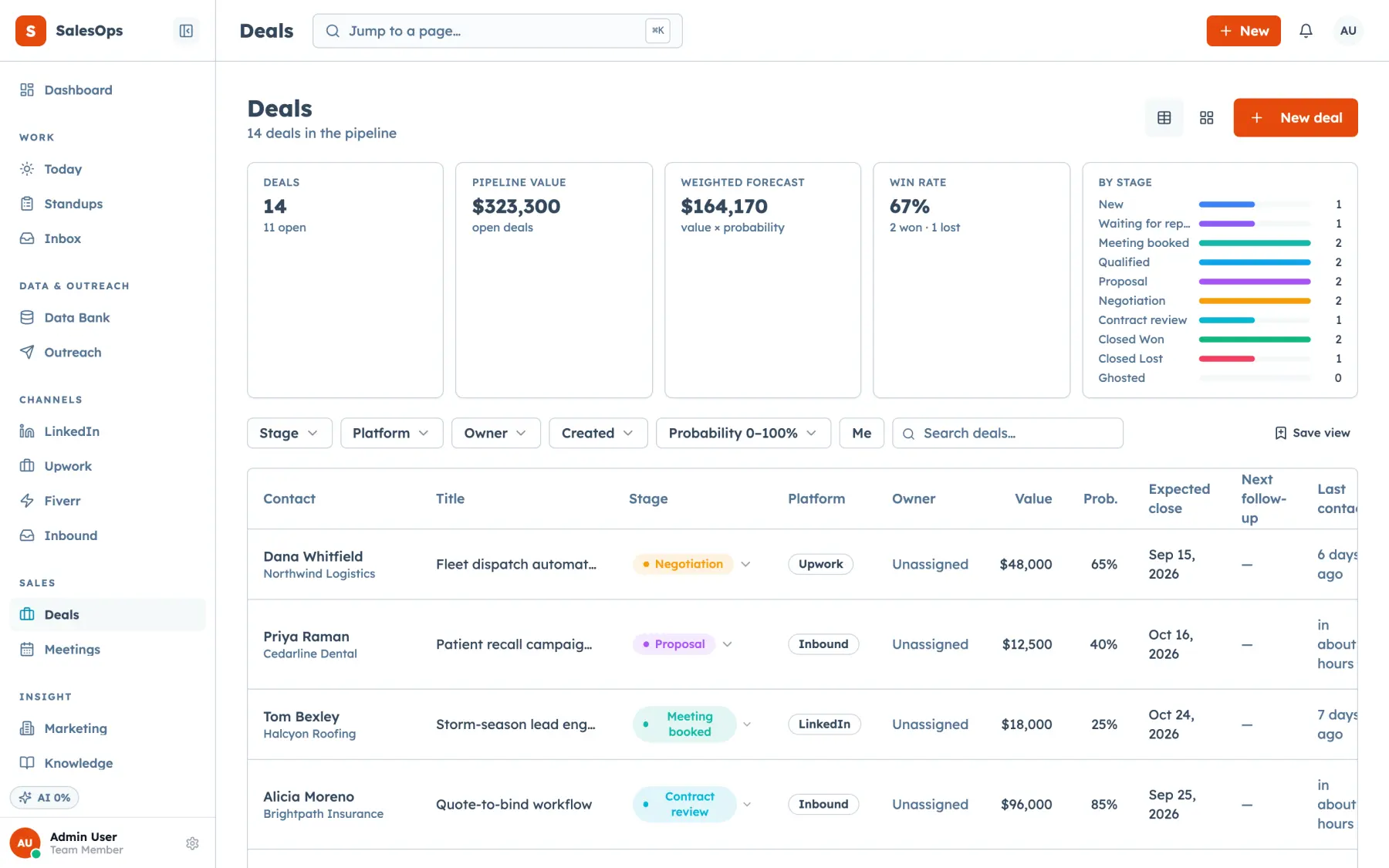
That is why the order of building matters. The pipeline, the calendar, the knowledge base and the approval queue exist now. The receptionist will write into them when it ships, rather than to be a second system someone has to reconcile.
Plan for this now. Disclosing that a caller is speaking to an AI, and recording the call at all, are governed differently depending on where the parties are. A follow-up text to a homeowner mobile has its own consent requirement. Settle your position with your own counsel. This is not legal advice.
What plumbing owners ask about this
- Will it sound like a robot?
- Current platforms are well past flat synthesised speech, so the voice itself is rarely the problem. A long gap before it answers is, and so is a reply that ignores what the caller just said. A panicking caller is the hardest test of both, so the design keeps the script narrow and the first response fast rather than conversational.
- What happens when it cannot answer something?
- It says so and offer a person. Its facts come from your knowledge base: service area, after-hours call-out terms, the brands you install. A refusal rule sets the wording for anything outside that. It will not estimate a repipe or guess whether a warranty covers a tank. An agent that invents an answer at midnight creates a dispute at nine.
- Will it say it is an AI?
- Yes, by design, and we would not suggest hiding it. Requirements are moving in that direction in several jurisdictions, and a caller who works it out mid-emergency is a worse outcome than one told at the start. The rule that applies to you depends on where you operate, so confirm it with your own counsel. This is not legal advice.
- What will it cost per minute?
- We will not publish a number. It depends on your voice provider, your model class and your call mix, and emergency calls run longer than booking calls. The cost is a platform fee plus the model, speech to text, text to speech and telephony, and our calculator page shows the formula.
- Is it legal to record the calls?
- It depends on where the parties are. Some jurisdictions are satisfied with one party consenting and others require everyone on the line to agree, which is why a consent line at the top of the call is built into the design rather than left as a setting. Check what applies to your area with your own counsel. This is not legal advice.
- Can it transfer to me?
- That is the most important behaviour on the list. Escalation will be written as literal triggers rather than judgement: water still running, a caller asking for a person, a gas smell near an appliance. When one fires, the agent stops and connects. If the on-call phone does not answer, the fallback is a message plus a task so the call is not lost.
Start with the database the calls will land in
Quote follow-up and membership cadences run today. The voice half will write into the same records.