The CRM for MSPs whose sales pipeline lives in the PSA
Prospecting, quoting and quarterly review follow-up beside ConnectWise or Autotask, without a second ticketing system.
- Unlimited seats
- Your own database
- AI waits for your approval
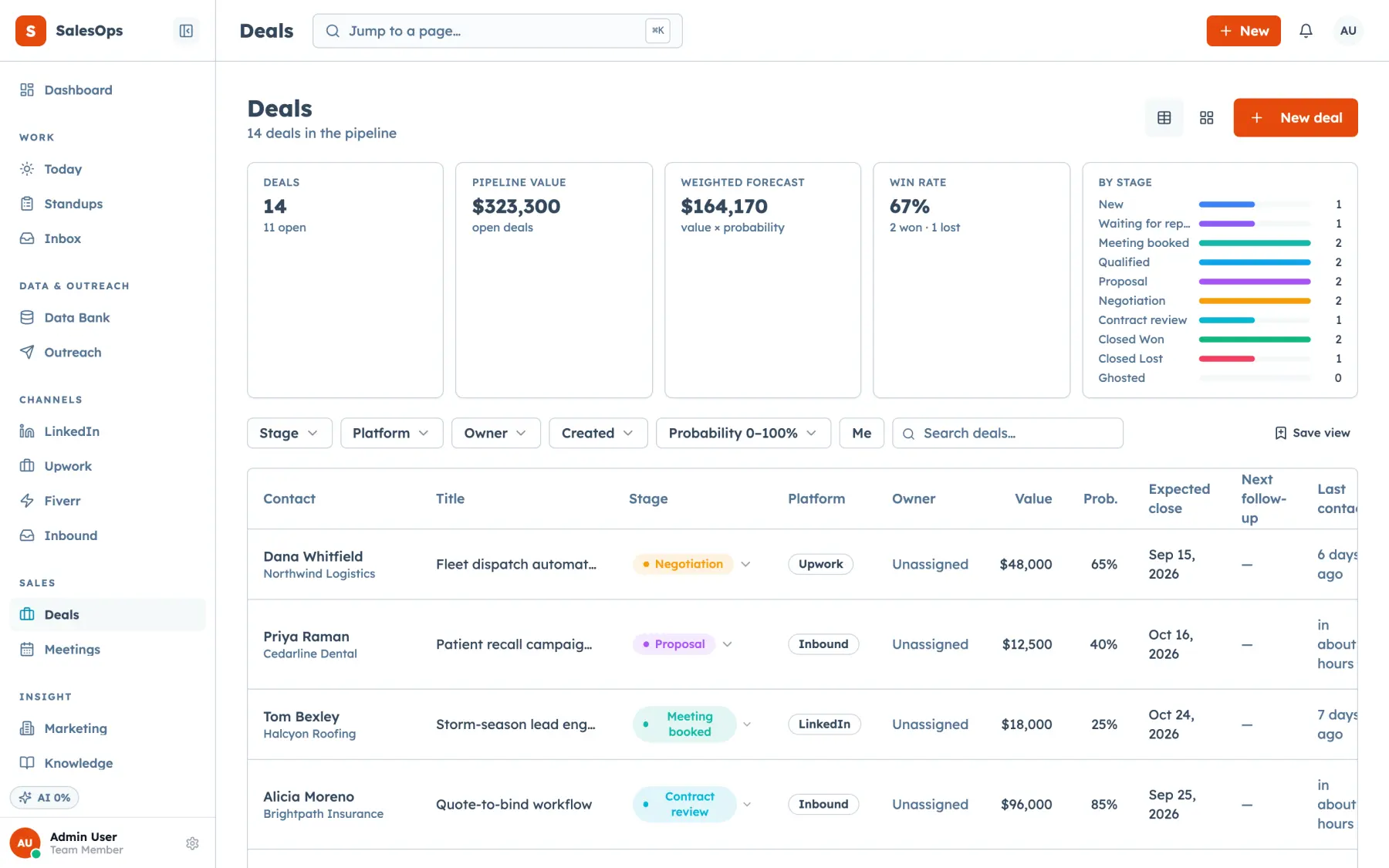
Every MSP has a professional services automation platform, and every MSP uses about a fifth of its CRM module. The tickets, the contracts and the time entries are in there because they have to be. The sales pipeline is in there because it came free, and it shows: prospecting happens from four engineers' personal inboxes, and the quarterly review that was supposed to produce an upsell produces a document nobody opens again.
A quarter at a twenty-seat MSP
Three things every owner recognises, and what gets configured for each.
Outbound goes out from engineers' inboxes
The owner and two technical people each send a handful of prospecting emails a week from their own address, with no shared record and no volume control. Domain reputation is a coin flip. Configure a sender pool with per-mailbox daily caps and cooldowns, suppression enforced when the audience is frozen and again at send, and one shared inbox for replies.
The QBR produces actions nobody chases
You sat with the client, agreed that the aging firewall and the unmanaged backups need addressing, and wrote it down. Six weeks later the document is in SharePoint and the work is not booked. Configure the agreed actions as deals on an account-growth pipeline with a follow-up cadence, so the recommendation becomes a tracked opportunity rather than a slide.
Vendor-generated leads land nowhere in particular
A vendor programme runs a campaign with your logo on it and sends over a handful of names. They go into somebody's inbox and half are never called. Configure the inbound webhook with the campaign as the source, so vendor-funded activity is attributable and you can tell which programme is worth co-funding again.
The QBR is the sales motion, and it is the one that is never run properly
An MSP's growth comes from two places: new logos, which are slow and expensive, and existing accounts, which are neither. The mechanism for the second is the quarterly business review, and almost every MSP runs one badly, because the meeting is treated as a service ritual rather than as the top of a pipeline.
Configured properly it is both. The review produces a small number of recommendations, and each becomes a deal on an account-growth pipeline with a stage, an owner and a follow-up cadence. The next review then opens with the state of the last one, which changes the conversation from reporting uptime to discussing a roadmap the client already agreed to.
There is a second reason to hold that in a CRM rather than the PSA. The PSA thinks in tickets and contracts, so a recommendation with no ticket has nowhere to live. A deal record with a stage, a value and a next action is a different object, and it is the one a monthly pipeline review is run from.
What we configure for you
A working setup for a managed service provider, inside the first 14 days.
- 1
Pipeline stages
A new-business pipeline (Target, Contacted, Discovery, Assessment, Proposal, Agreement signed, Onboarding) and an account-growth pipeline (Identified at review, Scoped, Quoted, Approved, Scheduled), because a project upsell does not move like a new managed agreement.
- 2
Channels
A sender pool of mailboxes with per-account daily caps and cooldowns, your mailbox connected over IMAP for the shared inbox, the site enquiry form on the inbound webhook with the campaign source recorded, the LinkedIn queue, and Calendly discovery calls landing as meetings.
- 3
Cadences
A cold prospecting cadence to owners and office managers in your vertical, a post-review follow-up on agreed actions, a dormant-prospect re-engagement cadence, and a renewal cadence timed to agreement anniversaries.
- 4
Agent policy
The Inbox agent set to review, so it drafts a reply to a prospect and a person approves it. Guardrails cap touches per contact at three days apart, hold sends to business hours, and re-check suppression at send time.
- 5
Knowledge-base voice
Your stack, your service tiers, your onboarding process, your response targets and the verticals you serve loaded as knowledge, so a draft never promises a response time or a security posture you did not authorise.
Your stack, and what sits beside it
The PSA keeps the tickets and the contracts. We keep the pipeline in front of them. Read this row by row.
| What you run | What it keeps | What SalesCrew adds |
|---|---|---|
| ConnectWise PSA | Tickets, agreements, time entries, invoicing, the service record | Cold prospecting at volume, a sender pool, and an account-growth pipeline off the back of reviews |
| Autotask | Service desk, contracts, projects and billing | Campaign attribution, a shared sales inbox, and cadences that keep running |
| HaloPSA | Tickets, assets, contracts and reporting | The stages before an agreement exists, and the upsell pipeline after it |
| Datto and your RMM | Monitoring, patching, backup, alerts | Nothing. We never touch device data or alerts |
| IT Glue and documentation | Client documentation and passwords | Nothing. Credentials belong nowhere near a CRM |
| Vendor programmes | Co-marketing funds, campaign assets, lead lists | The lead lands with its campaign as the source, so co-funded activity is measurable |
These connections run through webhooks, CSV import and the API. There is no native ConnectWise, Autotask or HaloPSA app listing, and we would rather write that plainly than call it an integration it is not.
When your PSA's CRM module is enough
A configurable CRM (SalesCrew)
- New-business and account-growth pipelines that are actually separate, with a weighted forecast on each
- Cold outbound as a first-class channel: sender pool, per-mailbox caps, suppression at freeze and at send
- Every action is also an MCP tool, which is a real argument in a business full of technical people
- Unlimited seats, and one Postgres database per company that you can dump whenever you want
- No ticketing, no RMM, no contract billing, no time entries, no documentation
- No native PSA connector — ConnectWise, Autotask and HaloPSA connect by webhook, CSV or the API
- Quotes with e-sign and payment links are on the roadmap, and MSPs quote constantly
- New product with no MSP customers yet and no third-party reviews
The PSA's own CRM (ConnectWise, Autotask, HaloPSA)
- Already paid for, already deployed, already holding every client record you have
- Opportunities linked directly to agreements, tickets and the billing that follows them
- Quoting integrated with your distributor pricing, which is a real daily saving
- One system to administer instead of two
- Cold outbound at volume is not what it is for, and there is no sender pool or suppression discipline
- Sales follow-up is usually a task and an activity log rather than a cadence that runs and stops on a reply
- Per-seat pricing that makes giving a non-technical salesperson a login a budget item
- The pipeline view tends to be a report built for service delivery rather than for a sales meeting
The phone is a service line, and that is exactly the problem
Unlike most trades on this site, an MSP's phone is already answered, because it is a service desk with a number and a rota. The failure is the opposite one: a prospect who calls that number reaches a triage script designed for a client with a broken laptop, gets logged as a ticket, and never becomes a lead. The most valuable call of the month goes into a queue built for the least valuable ones.
Today SalesCrew captures the enquiry form with its source, drafts the first reply through the Inbox agent for a person to approve, books the discovery call through Calendly, runs cadences from the sender pool, and makes outbound calls through Vapi. It does not answer the phone, and for this trade that matters less than it does for a plumber.
What is worth planning for is separation. When numbers and inbound routing ship, the useful configuration for an MSP is a sales number that is not the service desk number, so a prospect never lands in a ticket queue, with the assistant capturing the company, the seat count and the current provider and booking the discovery call. That sits in the phone pack on the roadmap.
Two constraints to plan around now. Prospecting email to businesses is commercial email, so the federal rules that govern it in the United States, including a working opt-out and an accurate physical address, apply to every cadence you run, and suppression is enforced at audience freeze and again at send. The second is one MSPs appreciate immediately: client data segregation. Your instance is a single Postgres project, not a shared tenant, and if you resell CRM access to your own clients then each gets their own project rather than a filtered view of yours.
Where this gets used
Three jobs an MSP does every quarter, described as mechanism.
Running a cold campaign into a vertical
A segment is built in the data bank against a vertical and a size band, suppression is applied when the audience is frozen, and the cadence sends from the mailbox pool with per-account caps. Replies land in the shared inbox, get classified, and pause the cadence.
Turning a review into pipeline
Each agreed recommendation becomes a deal on the account-growth pipeline with a value, an owner and a next action. A follow-up cadence chases the ones that go quiet, and the next review opens with a board rather than a memory.
Attributing a vendor-funded campaign
Leads from a vendor programme arrive through the inbound webhook with the campaign recorded as the source. Because ad and analytics data land in the same database, the cost of a co-funded campaign and the agreements it produced can be joined rather than compared across two dashboards.
What MSP owners ask first
- Does it integrate with ConnectWise or Autotask?
- Not natively, and we will not claim otherwise. The mechanism is outbound webhooks, CSV import and the API, plus 140 or so MCP tools if you would rather have an agent do the moving. In practice MSPs push new companies and won deals into the PSA and keep prospecting and the growth pipeline here. If a bidirectional native sync is a hard requirement, your PSA's own CRM module is the better buy today.
- Why would we run two systems?
- Only for one reason: because outbound is how you grow and a PSA is not built for it. A sender pool with per-mailbox caps, a suppression list enforced at freeze and at send, a deliverability loop and cadences that stop on a reply are not features a ticketing platform has any reason to build. If your growth is referrals and your pipeline is a dozen opportunities, stay in the PSA and save the money.
- We resell services to our clients. Can we resell this?
- Yes, and that is a real model rather than a discount. Each client gets their own instance and their own database, which is exactly the separation you already promise them, and the agency tier exists for running several. The white-label pieces, including your name, your logo and your subdomain, are on the roadmap. The details are on the agencies page.
- Can an agent do things in the CRM from Claude or ChatGPT?
- That is the design. Every action in the app is also an MCP tool with the same permissions and the same approval queue as a person, tokens are scoped on the same three axes as the UI, and every call is written to an audit log with the actor recorded. For a business full of technical people this is usually the part that decides it.
- Does it quote?
- Not yet. Quotes with line items, a PDF, typed e-sign and a payment link on your own Stripe key are on the roadmap. Today the quote comes out of your distributor tooling or your PSA, and SalesCrew holds the stage, the value and the follow-up so it does not go quiet for three weeks.
- What does it cost for twenty people?
- The same as for five, because seats are unlimited on every tier. Most MSPs want Outbound at $699 a month for the sender pool, the Instantly send provider and the campaign agent. Core is $299, Local is $499 and Agency is $1,200 for reselling. The trial is 14 days and a card is required to start it. If you leave, you take a full Postgres dump plus CSVs.
Which tier fits an MSP
Outbound if you prospect. Agency if you resell to clients.
Outbound at $699 a month adds the sender pool, the Instantly send provider and the campaign agent to everything in Core, which is what running prospecting into a vertical actually needs. Core at $299 covers both pipelines, the shared inbox, cadences and the data bank with unlimited seats. Agency at $1,200 is the tier for an MSP running instances on behalf of its own clients, alongside the marketing module.
Related
Start with the recommendations from your last round of reviews
Import the actions nobody chased, and watch them become a pipeline with a follow-up in review.