The CRM for staffing agencies that sell and recruit at once
Client development and candidate outreach in the same database, with a separate pipeline and cadence for each side.
- Unlimited seats
- Your own database
- AI waits for your approval
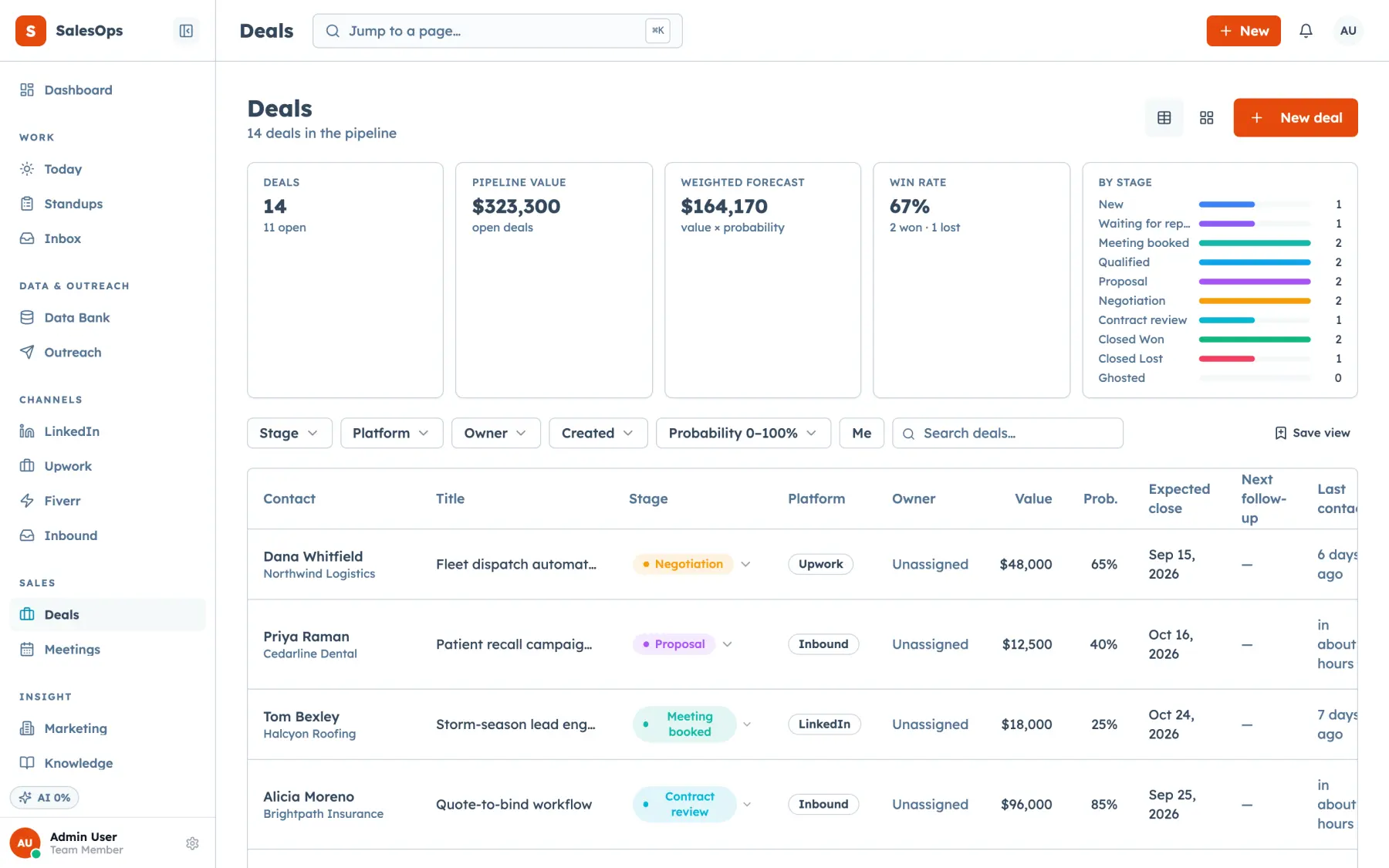
Staffing is the only business on this site with two pipelines that must both be full at the same time, or neither is worth anything. A job order with no candidates is a lost client. A bench with no job orders is payroll. Most agencies run the candidate side in an applicant tracking system and the client side in a spreadsheet and four personal inboxes. This page is about fixing the second one without disturbing the first.
A week in a fifteen-desk agency
Three things every owner recognises, and what gets configured for each.
Business development runs out of personal inboxes
Four recruiters are each emailing hiring managers from their own address, with no shared record of who was contacted, when, or what they said. The same prospect gets two different pitches in a week. Configure a sender pool with per-mailbox daily caps, one shared inbox, and cadences that stop the moment a hiring manager replies.
Job orders live in someone's head
A client sends three roles by email on Monday. By Thursday nobody can say which are still open, which are covered, and which the client filled internally. Configure job orders as a pipeline with Open, Sourcing, Submitted, Interviewing, Offer, Placed and Closed-lost with a reason, so the state of the desk is a board rather than a standup question.
Candidates go quiet between placements
The contractor who finished an assignment in March is exactly who you need in September, and nobody has contacted them since. Configure a candidate re-engagement cadence keyed to assignment end date, run as its own channel, so the bench stays warm without a recruiter remembering.
Two pipelines, one database, and why that matters
The reason a general CRM struggles here is that it assumes one funnel with one kind of record moving through it. In staffing there are two funnels moving in opposite directions and meeting in the middle. Client business development goes from a cold hiring manager to a signed agreement to a job order. Candidate recruitment goes from a sourced profile to a screen to a submission. A placement happens when the two touch.
Configured properly, they are separate pipelines with separate stages and owners, sitting in one database so the join is possible. That join is what an agency cannot get out of an ATS plus a spreadsheet: which clients produce job orders that fill, and which BD campaigns produce a first requisition rather than a polite meeting.
Client development in this industry is cold by nature. Almost nobody arrives at a staffing agency through inbound; someone contacted a hiring manager who did not ask to be contacted. That is why the sender pool, the suppression list and the deliverability loop matter more here than the record layout.
What we configure for you
A working two-sided setup for a staffing or recruiting agency, inside the first 14 days.
- 1
Pipeline stages
A client pipeline (Target, Contacted, Meeting, Agreement sent, Signed, First order) and a job-order pipeline (Open, Sourcing, Submitted, Interviewing, Offer, Placed, Closed with a reason), because the desk needs both boards to be true at once.
- 2
Channels
A sender pool of mailboxes with per-account daily caps and cooldowns for business development, the LinkedIn queue for the human-executed outreach recruiters do anyway, your careers-page form on the inbound webhook, and Calendly client meetings landing as meetings.
- 3
Cadences
A cold BD cadence to hiring managers, a re-engagement cadence for dormant clients, a candidate follow-up cadence after submission, and a bench cadence keyed to assignment end date.
- 4
Agent policy
The Inbox agent set to review, so it drafts a reply to a hiring manager and a person approves it. Guardrails cap touches per contact at three days apart, hold sends to business hours, and re-check suppression at send time.
- 5
Knowledge-base voice
Your specialisms, your fee structure, your contract-to-hire terms, your geographies and your service guarantees loaded as knowledge, so a draft never states a fee or a guarantee you did not authorise.
Your stack, and what sits beside it
The applicant tracking system owns candidates and submissions. We own the client side and the outreach on both. Read this row by row.
| What you run | What it keeps | What SalesCrew adds |
|---|---|---|
| Bullhorn | Candidates, submissions, placements, timesheets, back office, the record of the desk | Cold client development at volume, a sender pool, and campaign attribution on the BD side |
| Loxo | Sourcing, candidate database and recruiting workflow | Client pipeline and agreement stages, plus outbound to hiring managers as a first-class channel |
| JobAdder | Job posting, applications, candidate management | Job-order forecasting beside client development in one database |
| LinkedIn Recruiter | Sourcing and InMail inside LinkedIn | A queue and a ledger for the outreach a human executes; we never automate LinkedIn itself |
| Your job boards | Postings and applications | Nothing. Posting stays where it is; applications can arrive by webhook or CSV |
| Payroll and back office | Timesheets, invoicing, contractor pay | Nothing. We do not touch pay or invoicing |
These connections run through webhooks, CSV import and the API. There is no native Bullhorn, Loxo or JobAdder app listing, and we would rather write that plainly than call it an integration it is not.
We do not score, rank or screen candidates
When your ATS is the better answer
A configurable CRM (SalesCrew)
- Client and job-order pipelines that are actually separate, with a weighted forecast on each
- Cold outbound treated as a first-class channel: sender pool, suppression at freeze and at send, deliverability loop
- Unlimited seats, so every recruiter, resourcer and the owner all have access
- One Postgres database per agency, exportable whenever you ask for it
- No CV parsing, no candidate search, no submission workflow, no timesheets, no back office
- No native ATS connector — Bullhorn, Loxo and JobAdder connect by webhook, CSV or the API
- We do not score or rank candidates, by design, so this is not an ATS replacement
- New product with no staffing customers yet and no third-party reviews
The ATS (Bullhorn, Loxo, JobAdder)
- A candidate database with parsing, search and submission tracking built for this industry
- Timesheets, placements and back office connected to the same record
- Job board and LinkedIn integrations that already exist as connectors
- A CRM module included, which is enough for agencies whose BD is warm and low-volume
- Cold client development at volume is usually not what the built-in CRM module is for
- Per-seat pricing that makes giving everyone a login a budget conversation
- Your data lives in their system, and export is a report rather than a database dump
- The client pipeline is often an afterthought beside the candidate record
The phone in a staffing agency rings for two different reasons
A recruiter's phone is the tool of the trade, and the call pattern splits cleanly. Outbound calls to hiring managers happen in business hours as part of a cadence. Candidate calls happen whenever the candidate is free, which for anyone employed means lunch, after six or between shifts, and those are the calls most likely to be missed.
Today SalesCrew makes outbound calls through Vapi and logs them against the record, captures careers-page and contact-form submissions at any hour, runs email cadences from the sender pool, and holds the LinkedIn outreach queue that a recruiter executes by hand. It does not answer the phone.
What this trade actually asks for next is texting. A confirmation the night before an interview, a short message to a contractor about next week's shift, and a text-back when a candidate calls a recruiter who is on another line are the highest-value additions, and they are in the phone pack on the roadmap along with numbers, inbound routing and reminders that send.
Two constraints to plan around now. Business development email is commercial email, so the federal rules that apply to it in the United States, including a working opt-out and an accurate physical address, apply to every BD cadence you run, and suppression is enforced at audience freeze and again at send. If you recruit or sell into the European Union or the United Kingdom, the data protection rules there apply to candidate and prospect data alike: a lawful basis, a retention period and a real way to honour deletion. Your instance is a single Postgres project you can query and purge directly, and the region is chosen at provisioning. The lawful basis stays yours. This is not legal advice.
Where this gets used
Three jobs a desk does every week, described as mechanism.
Running a cold BD campaign to hiring managers
A segment is built in the data bank, suppression is applied when the audience is frozen, and the cadence sends from the mailbox pool with per-account caps and cooldowns. Replies land in the shared inbox, get classified, and pause the cadence for that contact.
Working a new job order
The order enters the job-order pipeline at Open with the client, the role and the fee on it. Submissions move it to Submitted and Interviewing, and a closed-lost reason records whether the client filled internally, went to a competitor, or cancelled the role.
Keeping the bench warm
A segment on assignment end date finds contractors coming free in the next month. The re-engagement cadence goes out, replies land in the same inbox, and every touch is logged against the person rather than sitting in a recruiter's sent items.
What agency owners ask first
- We already run Bullhorn. Does this replace it?
- No, and you should not want it to. Bullhorn owns candidates, submissions, placements and the back office, none of which we do. The overlap is the CRM module you use for client development, and the reason agencies add SalesCrew is volume outbound: a sender pool with per-mailbox caps, suppression at freeze and at send, and one shared inbox for the replies. If your BD is warm referrals and a handful of accounts, the module you already pay for is enough.
- How does it connect to the ATS?
- By webhook, CSV import and the API, and there is no native app listing for any ATS. In practice agencies push new clients and job orders in from the ATS, or import on a schedule, and keep the outbound and the client pipeline here. We say that plainly because a two-way sync you were promised and did not get is worse than no sync at all.
- Does it screen or rank candidates with AI?
- No. That is a deliberate product decision, not a missing feature. Scoring in this product is built for sales prospects, and no agent ranks, filters or rejects applicants. Automated employment decisions carry legal exposure that a general CRM has no business taking on. Assessment stays with your recruiters and your ATS.
- What about candidates and clients in the EU or UK?
- Those rules apply to prospect and candidate data alike, and the practical requirements are a lawful basis, a retention period and a real deletion path. Your instance is its own Postgres project, so a deletion request is a query rather than a support ticket, and the region is chosen at provisioning. The lawful basis stays yours. This is not legal advice.
- Will recruiters actually log anything?
- They log what the system gives back. The BD cadence tells them who to call today, the shared inbox means a reply is not lost in someone's personal mail, and the job-order board replaces the question everyone asks in the morning meeting. Nobody is asked to re-key candidate data that already exists in the ATS. There is no native mobile app, only responsive web.
- What does it cost for fifteen desks?
- The same as for three, because seats are unlimited on every tier. Most agencies want Outbound at $699 a month for the sender pool, the Instantly send provider and the campaign agent, since BD volume is the point. Core is $299, Local is $499 and Agency is $1,200. The trial is 14 days and a card is required to start it. If you leave, you take a full Postgres dump plus CSVs.
Which tier fits a staffing agency
Outbound is the honest recommendation, because client development is cold by nature.
Outbound at $699 a month adds the sender pool, the Instantly send provider and the campaign agent to everything in Core, and that is what running business development at volume needs. Core at $299 covers both pipelines, the shared inbox, cadences and the data bank with unlimited seats, and it is enough for an agency whose BD is warm. Agency at $1,200 adds the marketplace and marketing modules, which matters if you also win work on Upwork.
Start with the hiring managers nobody has contacted since spring
Import your client list and last quarter's dead job orders on day two, and watch the BD cadence line up in review.