The CRM for agencies that win work on Upwork and Fiverr
The job feed, proposals, outcomes and clients treated as a sales channel, beside email and LinkedIn in one pipeline.
- Unlimited seats
- Your own database
- AI waits for your approval
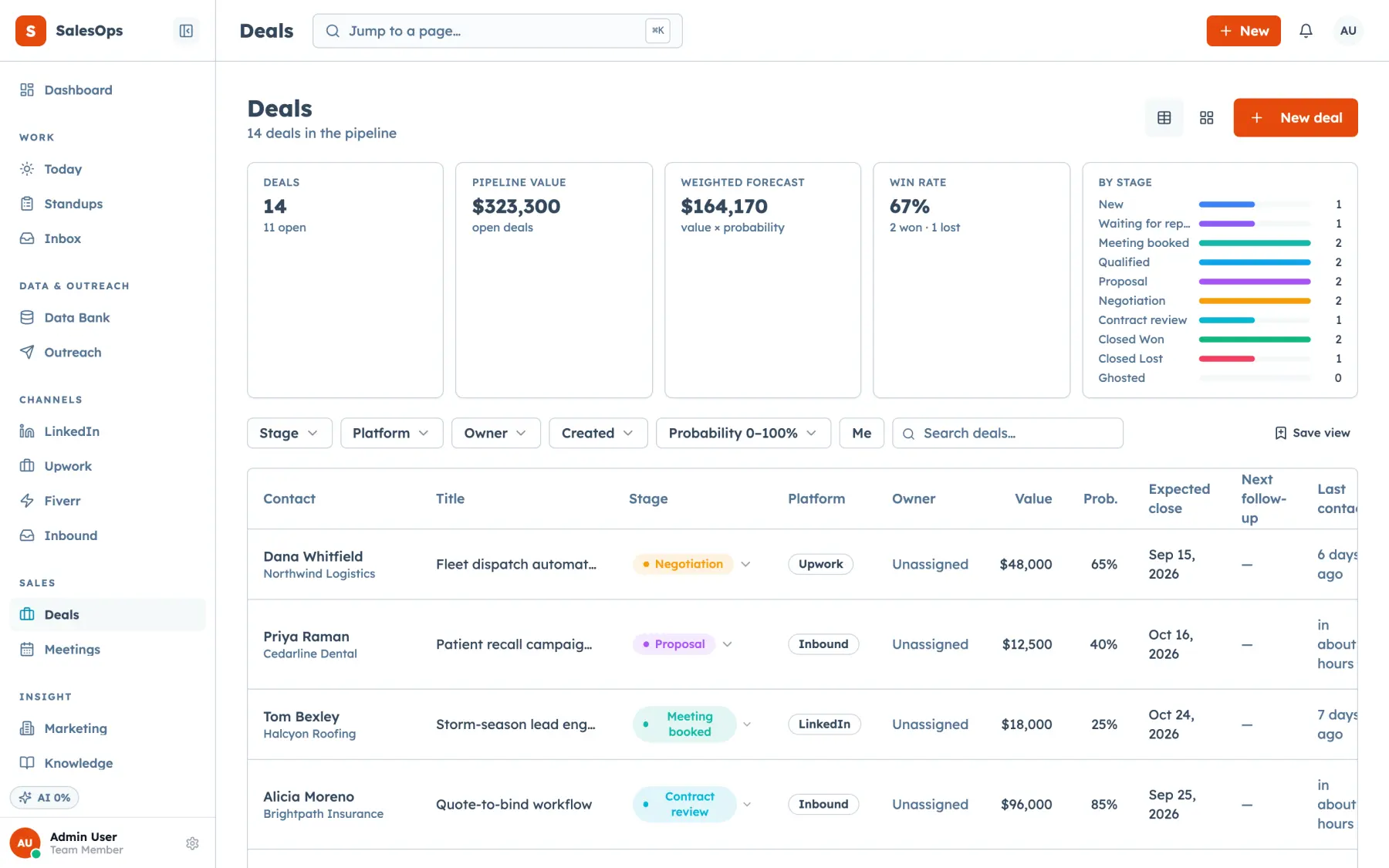
Every CRM on the market can tell you what happened to an email. None of them can tell you your win rate on fixed-price data engineering jobs posted by clients with under five hires, which is the number that decides whether an agency selling on marketplaces makes money. SalesCrew treats bids as pipeline, because on this channel they are the pipeline.
A month on a bidding desk
Three things every agency owner on this channel recognises, and what gets configured for each.
Proposals live in a spreadsheet nobody trusts
Somebody logs bids in a sheet for three weeks and then stops, so the only record of what you sent is the platform's own list, which is not joined to anything. Configure proposals as records against jobs and clients, with the outcome written back, so what you sent and what happened to it are in one table.
Clients who hired you once are never contacted again
A client pays for a project, the contract closes, and the relationship ends there because nobody moved them into the pipeline everyone else lives in. Configure marketplace clients as company and contact records, so the follow-up cadence you run for every other channel runs for them too.
Nobody can say which jobs are worth bidding on
Two people scroll the feed and bid on what looks interesting, and the spend on connects goes up while the win rate does not. Configure saved searches with a gate on the criteria that actually predict a win for you, so the feed arrives filtered rather than raw.
Connects are spend, so a human decides every time
Bidding on Upwork costs money. Connects are a currency you buy and burn, and a bid on a job you were never going to win is not a wasted email, it is a wasted purchase. That single fact shapes how automation works on this channel, and it is why this product refuses to do something that would demo well.
Anything that spends is human-only in the default policy table. Connects, credits and ad budgets sit outside what an agent may do, at any mode, and that is not a setting we encourage anyone to soften. The Bid agent on the roadmap drafts a proposal and queues it for approval; a person reads it and a person spends the connects.
What automation is good for here is the part before the spend. The feed gate is a set of rules against the job data itself, so postings that fail your criteria never reach a human, and the ones that pass arrive with the client's history attached. That is the decision that saves connects.
What we configure for you
A working marketplace setup for an agency, inside the first 14 days.
- 1
Pipeline stages
A marketplace pipeline (Job saved, Proposal sent, Viewed, Interviewing, Hired, Closed with a reason) and a client pipeline for the accounts that survive a first contract, because a repeat client is not a bid.
- 2
Channels
The Upwork module with saved searches, the feed gate and proposal records, the Fiverr queue, your mailbox over IMAP for the shared inbox, and the LinkedIn queue for the follow-up you do off-platform once a client relationship legitimately exists.
- 3
Cadences
A post-contract cadence for clients who hired you, a re-engagement cadence for clients who went quiet after a delivery, and email cadences on your own list, so the marketplace is one channel in a mix rather than the whole business.
- 4
Agent policy
The Inbox agent set to review. Spend stays human-only in the policy table, which covers connects, so no agent buys or bids. Guardrails cap touches per contact and hold sends to business hours.
- 5
Knowledge-base voice
Your specialisms, your rate bands, your case examples and the questions you always ask before quoting, loaded as knowledge, so a drafted proposal sounds like the person who usually writes them.
Your stack, and what sits beside it
The marketplace runs the marketplace. We run the pipeline and the memory around it.
| What you run | What it keeps | What SalesCrew adds |
|---|---|---|
| Upwork | The job feed, the contract, escrow, messaging, payments, and the platform rules | Saved searches with a gate, proposal and outcome records, client history and win rate by category |
| Fiverr | Gigs, orders, buyer messaging and payment | A queue for the work in flight and the buyer as a contact record in the same database |
| GigRadar and similar bid tools | Feed filtering and automated bidding on Upwork | Consider this an overlap on the feed. We do not automate bidding, and any spend stays human-only |
| Your spreadsheet of bids | Whatever someone remembered to type | The same information as records, joined to clients, outcomes and every other channel |
| Your own email and LinkedIn | The rest of your outbound, usually in a different tool | One database for both, so a marketplace client and a cold prospect sit in the same pipeline |
| Payments and contracts | Escrow, milestones and payouts on the platform | Nothing. We never touch platform payments |
The Upwork module uses the official Upwork API. Fiverr is a queue you work by hand. There is no scraping of either platform, and we do not automate actions the platforms reserve for people.
Two limits the platforms impose, stated plainly
When a bidding tool is the better choice
A configurable CRM (SalesCrew)
- Proposals, outcomes and clients as records, so win rate by category, budget band and proposal length is a query
- Marketplace work sits in the same database as email, LinkedIn and inbound, which is how you find out which channel actually pays
- Spend is human-only by policy, so no agent burns connects on your behalf
- Unlimited seats, and one Postgres database per agency you can dump whenever you want
- It does not bid for you, and it will not, which is the whole reason some people buy a bid tool
- No feed automation that submits proposals, and the Bid agent that drafts them is on the roadmap
- Client company names are unavailable through the API, so enrichment on that channel is limited
- New product with no marketplace agency customers yet and no third-party reviews
The bid tool (GigRadar, Upwex and similar)
- Built for one job, so the feed filtering and the alerting are usually sharper on day one
- Automated or semi-automated bidding, which some agencies genuinely want
- Cheap relative to a CRM, because the scope is narrow
- No configuration project: point it at the feed and it works
- The bids do not become a pipeline, and the clients do not become records
- Nothing joins marketplace outcomes to your email and LinkedIn effort
- Automated bidding spends your connects on a rule you wrote once and stopped reading
- You still need a CRM afterwards, and now the history lives in two places
Calls on this channel, and what the phone is actually for
The call pattern here is unlike every other trade on this site, because for the first part of the relationship there is no phone at all. Everything happens in platform messaging: the job posting, the questions, the interview. The phone appears only once a client has decided you are a real company, and by then it is a scoping call, not a first contact.
That means what matters on this channel is response time in messaging and the quality of the first written reply, not who picks up. Today SalesCrew records the proposal, the outcome and the client, holds the shared inbox for the email that follows, books the scoping call through Calendly, and makes outbound calls through Vapi.
Phone numbers, two-way SMS, missed-call text-back and the receptionist are in the phone pack on the roadmap. For an agency whose pipeline starts on a marketplace they are genuinely less urgent than they are for a plumber, and this page is not going to pretend otherwise.
One constraint to plan around now. Once you are emailing clients directly, you are doing commercial email, and the federal rules that govern it in the United States apply: a working opt-out, an accurate physical address, and honest headers. Suppression is enforced when an audience is frozen and again at send. The platform's own terms on off-platform contact are separate and stricter in places, and they are yours to read. This is not legal advice.
Where this gets used
Three jobs a bidding desk does every week, described as mechanism.
Filtering the feed before anyone spends a connect
Saved searches pull jobs through the Upwork API, and a gate applies your criteria, such as budget band, client hire history and payment verification. What fails never reaches a human. What passes arrives with the client's history attached.
Recording a proposal and its outcome
The proposal is a record against the job and the client. The outcome is written back when it lands, so win rate by category, by budget band and by who wrote the proposal is a report rather than a memory of a good month.
Turning a one-off contract into an account
A client who hired you becomes a company and a contact in the same database as every other channel. A post-delivery cadence runs, replies land in the shared inbox, and the second project stops depending on the client thinking of you first.
What agency owners ask first
- Does it bid for me?
- No, and it is not going to. The Bid agent on the roadmap drafts a proposal from the job and your knowledge base and queues it for approval; a person reads it and a person submits it. Connects are money, and spend is human-only in the default policy table alongside ad budgets. If what you want is a tool that submits bids while you sleep, buy one of those and know what you are buying.
- Why can I not see client company names?
- Because Upwork does not expose them through its API. A client record here carries the platform identity, the hiring and spend history the API does give, and whatever you learn in the conversation. We would rather say that than show you a company name we guessed at. If another tool shows you one, ask them where it came from before you rely on it.
- Is any of this against Upwork's terms?
- The module uses the official API, and there is no scraping and no automation of actions the platform reserves for people. The place agencies get themselves in trouble is off-platform contact before a contract exists, and this product does not help with that. The email and LinkedIn tools are for relationships you have a legitimate basis to pursue. Read the platform terms; they change, and they are yours to comply with.
- What can I actually measure that I cannot today?
- Win rate by category, by budget band, by client hire history and by who wrote the proposal, because proposals and outcomes are records joined to clients. Then the harder question: what a marketplace client is worth over a year compared to one from cold email, since both live in the same database. That comparison is the reason to put this channel in a CRM at all.
- We also do cold email and LinkedIn. Does that live here too?
- Yes, and that is the point of the tier this sits in. The data bank, segments, the sender pool with per-mailbox caps, the suppression list and the LinkedIn queue are the same system, so a prospect you emailed in March and a client who hired you in June are not in two different tools with two different definitions of a lead.
- What does it cost?
- The marketplace module sits in Agency at $1,200 a month, alongside the marketing module, the data sources and every agent. Seats are unlimited on every tier. The trial is 14 days and a card is required to start it, and you can cancel any time before it ends. If you leave, you take a full Postgres dump plus CSVs, because your agency's instance is a separate project.
Which tier fits a marketplace agency
Agency, because that is where the marketplace module lives.
Agency at $1,200 a month includes the Upwork and Fiverr modules, the data sources, the marketing module and every agent, on top of everything in Outbound. Lower tiers hold the pipeline, the inbox and the cadences with unlimited seats, but not the marketplace channel, and this page is about the marketplace channel. Selling to clients as instances of their own is a separate model, described on the agencies page.
Related
Start with last quarter's proposals and what happened to them
Import your bid history on day two, and see your win rate by category for the first time.