The CRM for veterinary clinics that miss the 8am rush
Practice software runs the patient. Nothing runs the enquiry that never became a patient.
- Unlimited seats
- Your own database
- AI waits for your approval
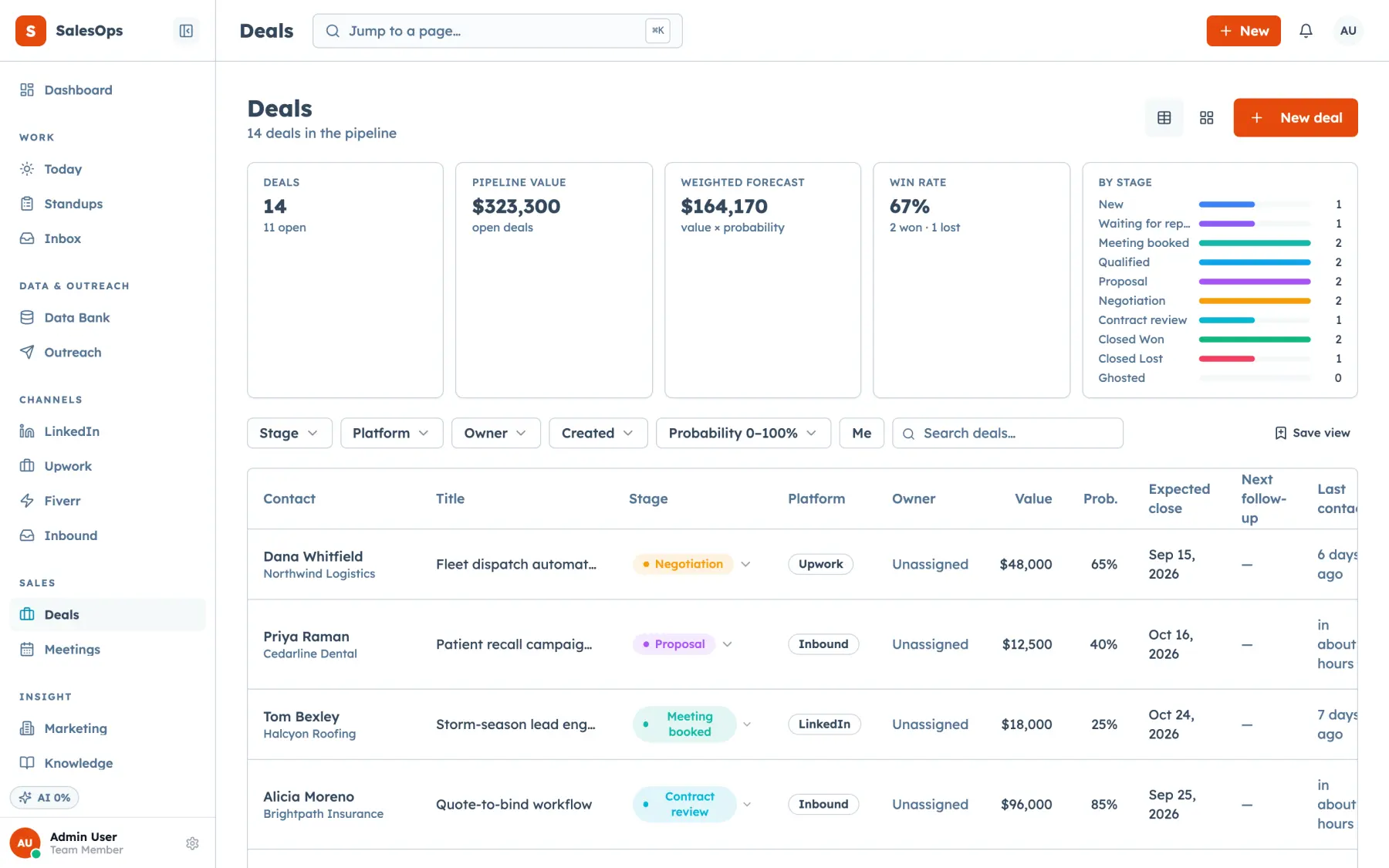
Veterinary practices have excellent software for the animals in front of them and almost none for the owners who called and did not book. Your practice information management system holds the medical record, the reminders and the invoicing. SalesCrew holds the new-client enquiry, the lapsed patient and the wellness plan conversation.
A week in a clinic reception
Three patterns practice managers recognise, and what gets configured for each.
Every phone in the practice rings between eight and half past nine
The morning surge is a structural feature of this business: owners call before work, before drop-off and after a bad night. Reception is simultaneously admitting patients and answering. Configure the website enquiry form and the online booking link into the inbound endpoint, so the written enquiries that do arrive are captured and queued rather than lost in the rush.
A new-client enquiry is not a patient record yet
Somebody new to the area rings for prices and vaccination policy, does not book, and leaves no trace because the practice system only creates records for actual patients. Configure a new-client enquiry pipeline so those conversations exist somewhere and can be followed up.
Lapsed patients stop appearing without anyone noticing
A dog that has not been seen in twenty months has usually gone elsewhere, and standard reminder systems stop chasing after a couple of attempts. Configure a lapsed-patient segment fed from your practice system and a reactivation cadence that reads as care rather than marketing.
Who is buying, and who is typing
The practice owner or practice manager buys. Reception and client care staff use it. Veterinarians and nurses do not, and nothing here asks them to leave the clinical system where the medical record belongs.
The boundary is the important configuration decision here. Enquiry, scheduling and client communication information belongs in this system. Clinical detail, diagnoses and treatment records belong in your practice information management system, and keeping that line explicit is a setup choice rather than a judgement someone makes under pressure at reception.
Seats are unlimited on every tier, which matters for a reception team of five on rotating shifts.
What we configure for you
A working setup for a companion animal practice.
- 1
Pipeline
New enquiry, information sent, first appointment booked, first appointment attended, registered client. Attended is separate from booked, because the gap between them is a number worth watching.
- 2
Segments
Enquiries with no appointment after five days, patients not seen in eighteen months, clients with no wellness plan, and enquiries by source so you can tell which channel produces registered clients.
- 3
Cadences
A new-client enquiry follow-up measured in days, a lapsed-patient reactivation written as care rather than a promotion, and a wellness plan conversation for eligible existing clients.
- 4
Channels
The practice mailbox over IMAP, the website enquiry form pointed at the inbound endpoint, and the booking link landing as a meeting with the source recorded.
- 5
Knowledge base
Your opening hours and out-of-hours arrangement, your consultation fee, which species you see, your wellness plan terms and your new-client registration process, so drafts state your actual policies.
Your stack, and what sits beside it
The clinical record never leaves your practice system.
| What you run | What it keeps | What SalesCrew adds |
|---|---|---|
| ezyVet | Medical records, appointments, clinical workflow, invoicing | The enquiry before a patient record exists, and the lapsed-patient segment |
| Cornerstone | Patient records, reminders, practice management | New-client enquiry follow-up and a source on every enquiry |
| AVImark | Clinical records, scheduling, inventory | A pipeline for enquiries that never became appointments |
| Vetstoria | Online booking that writes into the practice system | The enquiries that did not book, which the booking tool never sees |
| Your lab and imaging systems | Diagnostics and results | Nothing. Clinical data stays clinical |
| Your out-of-hours provider | Emergency cover overnight | Nothing today. Call routing is on the roadmap |
Connections run through webhooks, CSV import and the API rather than a native app listing. Lapsed-patient data comes across as an export you configure.
When a configurable CRM is wrong for you
A configurable CRM (SalesCrew)
- New-client enquiries exist as records rather than as remembered phone calls
- Lapsed patients become a worked segment after the standard reminders have stopped
- A source on every enquiry, so you can tell which channel produces registered clients
- Unlimited seats for a reception team on rotating shifts
- No medical records, no appointments, no clinical workflow of any kind
- No prescription, inventory or lab integration
- No call answering, which is precisely the 8am problem
- New product with no veterinary customers yet and no third-party reviews
The practice information management system
- The medical record, which is the heart of the practice and must stay there
- Appointments, reminders and invoicing built for veterinary work
- Lab, imaging and prescription integration
- Regulatory record keeping designed for the profession
- An enquiry that never became a patient usually leaves no record
- Reminder systems stop after a couple of attempts and lapsed patients fall out
- Enquiry source is rarely captured in a usable way
- Your data lives in their system rather than a database you can dump
The morning rush, and what a receptionist would and would not do
The 8am to 9.30am surge is the defining operational fact of a veterinary practice. Owners call before work about a dog that was unwell overnight, and reception is simultaneously admitting the day's inpatients. Calls go unanswered not because nobody cares but because there are three of them at once.
Where things stand today. SalesCrew captures forms and online bookings around the clock with the arrival time recorded, and places outbound calls through your own Vapi account. It does not answer an incoming call, does not text back a missed caller and has no front desk agent. Those are roadmap items, and for this practice pattern the gap is significant.
There is a limit worth stating even for when it ships. An assistant may take a name, a species and a reason for calling, and offer an available appointment. It must not assess whether an animal needs to be seen urgently. Any caller describing collapse, breathing difficulty, poisoning, seizure or trauma goes to a person immediately, and that belongs in the escalation rules as literal trigger words rather than as a judgement.
Two constraints to plan around now. Clients are consumers, so TCPA obligations attach to marketing texts and calls to their mobiles, and consent needs recording rather than assuming. Separately, state veterinary boards regulate how practices may advertise and what claims they may make, and those rules differ. Keep clinical detail out of this system and out of AI drafts, and check your own board's advertising rules. This is not legal advice.
Where this gets used
Three jobs a practice does every week, described as mechanism.
Following up a new-client enquiry
The enquiry becomes a record with its source. A short cadence measured in days sends the registration information and an appointment link, and pauses the moment the owner replies.
Reactivating a lapsed patient
A lapsed-patient export feeds a segment. A cadence written as care rather than promotion goes out after the standard reminders have stopped, with suppression applied at freeze.
Seeing which channel produces registered clients
Source on every enquiry plus a stage for first appointment attended means the conversion rate from each channel is a query, not an assumption about which advert works.
What practice managers ask first
- Does this replace ezyVet or Cornerstone?
- No, and it must not. The medical record, appointments and clinical workflow stay in your practice system. This holds enquiries that never became patients and clients who have stopped coming.
- Can it answer the phone at 8am?
- No. Inbound answering and an AI front desk are on the roadmap. If the morning surge is the whole problem you want solved, this does not solve it today.
- Is patient data safe here?
- Keep patient data out of it. Scope this to enquiry and scheduling information and leave clinical detail in the practice system. That is a configuration decision to make at setup rather than later.
- How do lapsed patients get in?
- By an export from your practice system, as a CSV or a webhook you configure. There is no native connector to any practice information management system and describing it as one would be untrue.
- Will vets and nurses have to use it?
- No. This is reception and client care software. Clinical staff stay in the clinical system, and there is no mobile app here anyway, only responsive web.
- What does it cost?
- Core is $299 a month, Local is $499, Outbound is $699 and Agency is $1,200, with unlimited seats on all four and a 14-day trial that requires a card.
Which tier fits a veterinary practice
Core covers enquiries and reactivation.
Core at $299 a month covers the pipeline, the segments, email cadences and the shared inbox with unlimited seats. Local at $499 is defined around phone numbers, the front desk agent and SMS reminders, which is what this trade actually wants, and it ships with the roadmap pack rather than today.
Start the trial with this month's unbooked enquiries
Import them on day two and see how many were never followed up at all.