The CRM for dental practices with 40 unscheduled plans
Unscheduled treatment, recall and new-patient enquiries in one queue the front desk can actually work through.
- Unlimited seats
- Your own database
- AI waits for your approval
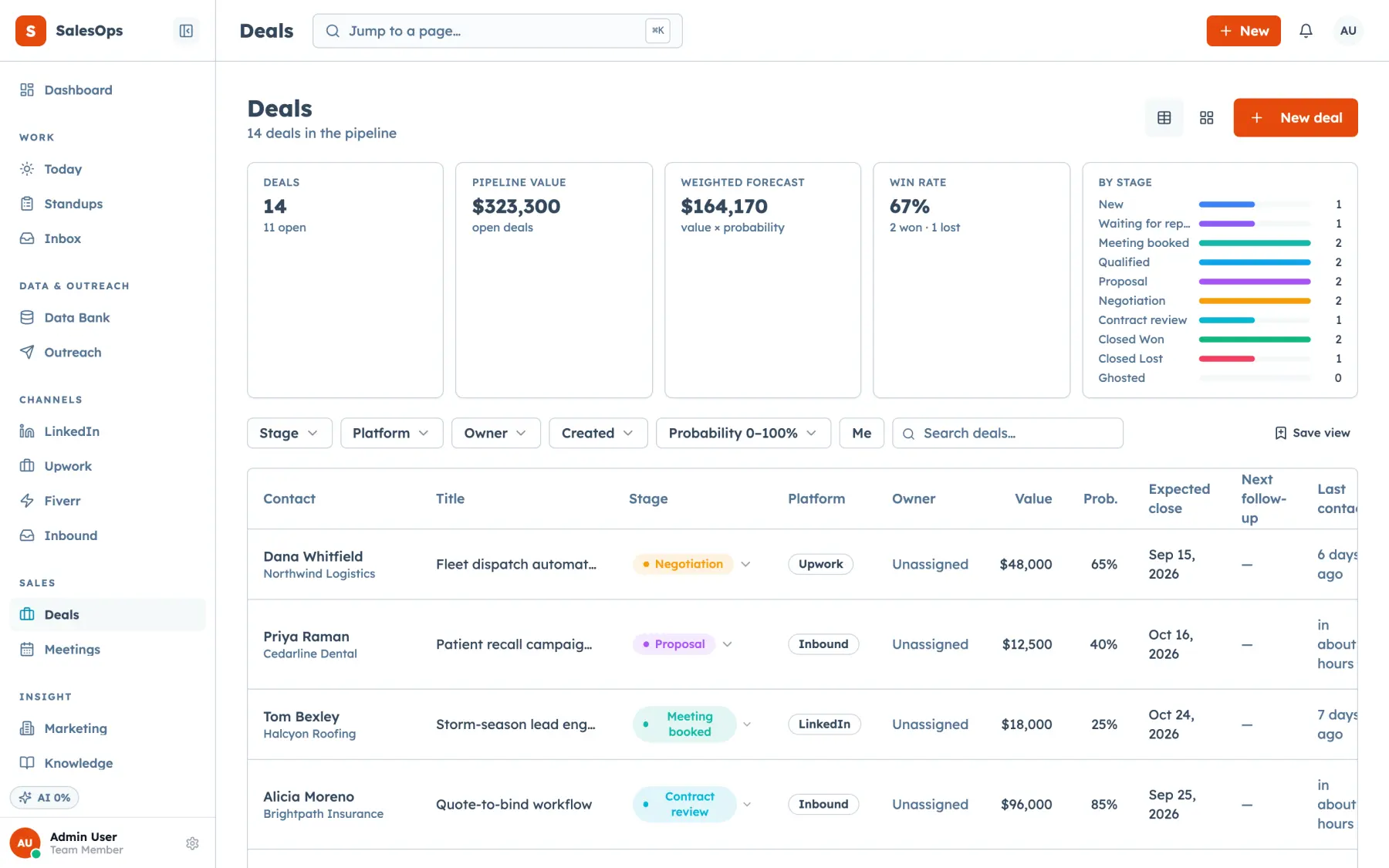
The largest untapped revenue in most practices is not new patients. It is treatment the dentist has already diagnosed, the patient has already agreed to in the chair, and nobody has ever booked. The practice management system knows those plans exist. What it does not do is run the follow-up, which is a sales job that lands on a front desk already answering the phone.
A week at the front desk
Three things every practice manager recognises, and what gets configured for each.
Treatment is presented and never scheduled
The crown was discussed on Tuesday, the patient said they would call after checking with their spouse, and that was in April. Configure unscheduled treatment as a pipeline with stages and an owner, and a follow-up cadence measured in weeks, so the conversation continues instead of ending in the car park.
New-patient calls come at lunch and get missed
The busiest hour on the phone is the hour the front desk is covering for each other. A new-patient call that goes to voicemail is usually a new patient at another practice by the afternoon. Configure the site enquiry form on the inbound webhook and a shared inbox, so every enquiry becomes a tracked record immediately.
Recall runs on postcards and hope
The six-month reminder goes out by post or not at all, and the patients who lapse quietly are the ones the practice never notices leaving. Configure a segment on months since last visit and a recall cadence that runs on a schedule, with any reply landing in the same inbox as everything else.
What belongs in this system, and what stays in the practice software
This is the most important paragraph on the page, so it comes before the features. SalesCrew is scoped here to enquiry and scheduling information: who contacted you, how they found you, which service they asked about, whether they have an appointment, and the history of your conversation about booking one.
Clinical information does not belong here. Diagnoses, charting, radiographs, treatment detail, insurance and claims data belong in your practice management system, which was built for them and carries the access controls and retention rules that go with them. That is a real constraint on what this product is for in a dental practice, and pretending otherwise would be worse than useless to you.
It also has a practical consequence for how the follow-up is written. An unscheduled treatment record here holds the fact that a plan exists, its value band if you want one, and the follow-up status. It does not hold what the treatment is. Your cadences and drafts are therefore about booking a time to talk, not about a clinical matter.
What we configure for you
A working front-desk setup for a general practice, inside the first 14 days.
- 1
Pipeline stages
Two pipelines. New patient: Enquiry, Contacted, Booked, Attended, Returning. Unscheduled treatment: Plan open, Contacted, Follow-up 1 and 2, Booked, Declined with a reason, so the front desk works a board rather than a printout.
- 2
Channels
The practice mailbox connected over IMAP, the website enquiry and new-patient forms posting to the inbound webhook with the service of interest and the source recorded, and Calendly consultations landing as meetings.
- 3
Cadences
A same-day new-patient response, an unscheduled-treatment follow-up over several weeks, a recall cadence by months since last visit, and a reactivation cadence for patients who have not attended in over two years.
- 4
Agent policy
The Inbox agent set to review, so it drafts a scheduling reply and a person approves it. Guardrails hold sends to business hours and cap touches per patient, and no draft discusses treatment, only appointments.
- 5
Knowledge-base voice
Your opening hours, your services, your new-patient process, your payment and finance options and your cancellation policy loaded as knowledge, so a draft answers what the front desk would answer and nothing more.
Your stack, and what sits beside it
The practice management system is the record. We hold the enquiry and the follow-up around it.
| What you run | What it keeps | What SalesCrew adds |
|---|---|---|
| Dentrix | Charting, treatment plans, the schedule, insurance and claims, the clinical record | Follow-up on plans that were never booked, and new-patient enquiries before a chart exists |
| Eaglesoft | Clinical records, scheduling, imaging and practice accounting | A shared inbox for enquiries and a recall cadence that runs without postcards |
| Open Dental | The open-source practice record: charting, scheduling, billing | The enquiry pipeline, cadences and source attribution on every new patient |
| Weave and similar phone systems | Practice phones, texting to patients, and reminders | Consider this a direct overlap on patient messaging. If Weave is working for you, keep it |
| Your insurance and claims tooling | Eligibility, claims, remittance | Nothing. Claims data does not belong in this system |
| Your website, Google and paid ads | Clicks, calls and directory listings | The enquiry lands with its source, so cost per new patient by channel is a query |
Connections above run through webhooks, CSV import and the API. There is no practice-management-system sync today, which is the honest limitation on this page: the unscheduled-treatment and recall lists start as exports you import.
Scope, and why this page makes no compliance claim
When a dental-specific tool is the better choice
A configurable CRM (SalesCrew)
- Unscheduled treatment as a pipeline with an owner, stages and a cadence, not a report nobody runs
- New-patient enquiries from the site, email and forms in one queue with the source on every record
- Unlimited seats, so the whole front desk and the practice manager have access
- One Postgres database per practice, exportable whenever you ask for it
- No charting, no scheduling, no imaging, no claims, and no connection to any of them
- No practice-management sync today, so the treatment and recall lists start as an import
- Patient texting and reminders that send are on the roadmap, and this trade wants them most
- We make no certification claim, and clinical data is out of scope by design
The dental tool (Dentrix, Eaglesoft, Open Dental, Weave)
- The schedule and the clinical record in one system, which is where the practice actually runs
- Treatment plan reports generated from the chart rather than an import
- Patient texting, reminders and recall built for practices and available today
- Vendors who work under the health-information rules of this industry as a matter of course
- Follow-up is usually a report and a call list, not a sequence that runs and stops on a reply
- New-patient marketing and source attribution are thin or absent
- Per-seat or per-provider pricing, and the front desk is rarely the design centre
- Your data lives in their system, and export is a report rather than a database dump
The lunchtime call, and the toothache that decides your afternoon
A dental practice's phone has two peaks and one of them is lunch, when the front desk is thinnest and callers are ringing during their own break. Two kinds of call arrive in that hour. One is a new patient shopping, who will call the next practice within a minute of hearing a voicemail greeting. The other is someone in pain who needs a same-day slot.
Today SalesCrew captures web enquiries at any hour with the source recorded, drafts the first scheduling reply through the Inbox agent for the front desk to approve, books consultations through Calendly, and makes outbound calls through Vapi. It does not answer the phone.
When the receptionist ships, the design for this trade is narrow on purpose. Capture the caller, ask whether they are in pain, book into the emergency slot you keep, and transfer to a person the moment anything sounds like trauma or bleeding. No triage advice, and it will say it is an assistant. That sits in the phone pack on the roadmap.
One constraint to plan around now. Patient mobile numbers are consumer numbers, so the TCPA governs marketing texts and calls to them, and a number given to book an appointment is not consent for a whitening promotion. Appointment reminders and marketing are treated differently under those rules, which is exactly why practices should keep the two separate rather than folding a promotion into a reminder. SalesCrew enforces suppression and opt-out today, and DNC scrub at audience freeze plus a consent gate on call start are on the roadmap. This is not legal advice.
Where this gets used
Three jobs a front desk does every week, described as mechanism.
Working the unscheduled treatment list
Plans imported from the practice system become records on a pipeline with an owner. A cadence runs over several weeks, pauses the moment the patient replies, and the reply lands in the shared inbox. A declined plan records a reason, so cost and timing become a report.
Answering a new-patient enquiry the same day
The web form hits the inbound webhook and becomes a lead with the service of interest and the source. The Inbox agent drafts a scheduling reply from your knowledge base, and the front desk approves it. Nothing sends on its own.
Reactivating patients who quietly lapsed
A segment on months since last visit finds the patients nobody noticed leaving. Suppression is applied when the audience is frozen, the cadence runs, and anyone who books drops out of it.
What practice managers ask first
- We handle protected health information. Can we use this?
- That is a decision for your practice and your compliance advice, and we will not answer it on a web page. What we can tell you is the scope and the controls. The scope is enquiry and scheduling data: contact details, source, service asked about, appointment status and the conversation about booking. Clinical, diagnostic and insurance information stays in your practice management system. The controls are a separate Postgres project per practice, credentials in a secrets vault, an audit log of every tool call with the actor recorded, three-axis access scoping, and agents in review mode. We make no certification claim of any kind.
- Does it sync with Dentrix or Open Dental?
- Not today, and that is the honest limitation of this page. Practice-management sync is on the roadmap. Until it ships, the unscheduled-treatment and recall lists arrive as an export you import, or through the webhook if your system can post one. If a live two-way sync is a hard requirement, a dental-specific tool is the better buy right now.
- Can it text patients their recall reminders?
- Not yet. Two-way SMS, reminders that send and missed-call text-back are in the phone pack on the roadmap. Today recall runs by email and by the calls your team makes, with every touch recorded. If patient texting is the reason you are shopping, a practice phone system that does it today is the better answer, and we would rather say that than take the money.
- Will the front desk actually use another system?
- They use it if it replaces something worse, which here is a printed report and a sticky note. The two things that earn it are a queue of who to contact today and a shared inbox where an enquiry cannot be lost. Unlimited seats mean everyone on the desk has a login. There is no native mobile app, only responsive web.
- Will an AI message our patients on its own?
- No. Every agent ships in review mode, so it drafts and a person approves. Any external send is set to review by default in the policy table, there is a kill switch that stops every agent at once, and your knowledge base sets what a draft may say. Drafts here are about appointments, not treatment, by design.
- What does it cost, and what happens if we leave?
- Core is $299 a month with unlimited seats, Local is $499, Outbound is $699 and Agency is $1,200. Most practices would want Local for the phone and SMS pack, which ships with the roadmap items above, so Core is the honest starting point today. The trial is 14 days and a card is required to start it. If you leave, you take a full Postgres dump plus CSVs, because your practice's instance is a separate project.
Which tier fits a dental practice
Core today. Local is the tier this trade actually wants, once the phone pack ships.
Core at $299 a month covers both pipelines, the shared inbox, email cadences and the data bank, with unlimited seats for the whole front desk. Local at $499 adds phone numbers, SMS recall, missed-call text-back and reminders that send, and it ships with the roadmap pack described above, so a practice whose main gap is patient texting should look hard at that timing before switching anything.
Related
Start with the treatment nobody booked
Import last year's unscheduled plans on day two, and watch the follow-up cadence line up in review.