The CRM for construction firms that win work by bid
Every invitation becomes a tracked bid, and a follow-up runs until the GC or owner replies.
- Unlimited seats
- Your own database
- AI waits for your approval
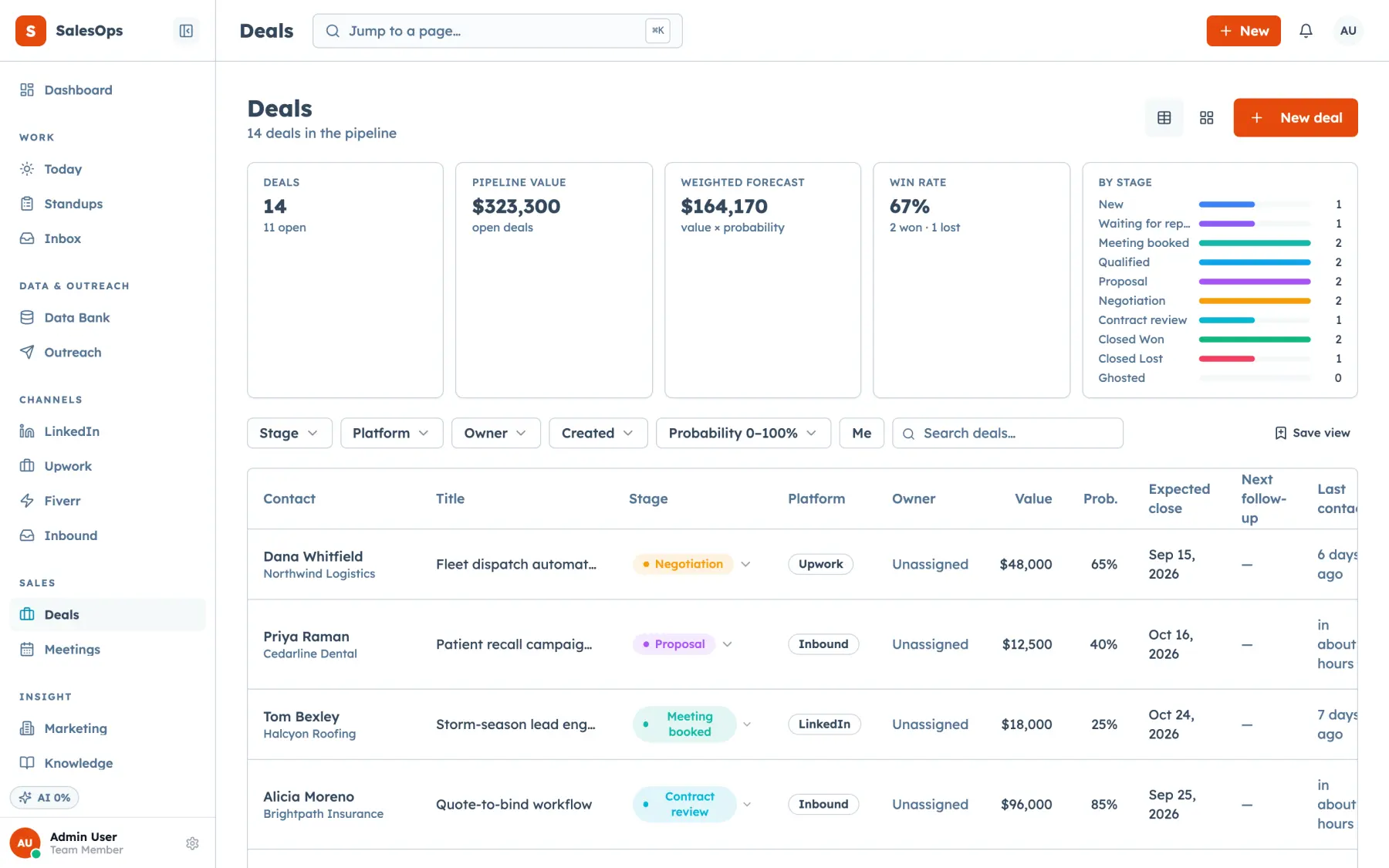
SalesCrew gives a construction firm a bid pipeline, not a sales funnel borrowed from software sales. Three things make this trade different. You answer invitations from many general contractors at once. Your buyer is often another contractor, a developer or an owner's rep. And a bid that nobody follows up is lost on silence rather than price. SalesCrew tracks each bid from invitation to award, follows up until someone replies, and keeps every architect and developer relationship in one database you own.
A week in a preconstruction office
Three moments every chief estimator knows, and what gets set up for each.
Nine invitations to bid arrive on a Monday
They come from six GCs, through three plan rooms and a pile of forwarded emails. Your estimator has to decide by Wednesday which ones are worth a takeoff. In SalesCrew each invitation becomes a bid with its due date and GC, and a go/no-go stage forces the decision onto the record.
A bid goes in, then nothing for three weeks
You submitted a clean number and heard nothing back. Was it price, scope or a preferred sub? A post-bid cadence sends a receipt check on day 2, a scope question on day 7 and a decision-date question on day 14. It stops the moment anyone replies.
The developer you built for in 2023 is starting again
Repeat owners and architects send the best work a firm ever gets. They're usually in someone's phone, not in a system. A relationship cadence keeps them on a quarterly touch, with the LinkedIn step done by a person and logged against the contact.
Who sells in a construction firm, and who never logs in
Sales in construction is spread across people who don't call themselves salespeople. The owner signs and keeps the big relationships. A business development manager chases developers, architects and owner's reps. The preconstruction manager or chief estimator decides what to bid and prices it. Superintendents and crews build the job and never open the CRM.
That split shapes the setup. SalesCrew scopes access on three axes (channel, profile and area), so an estimator on the concrete division sees their bids and nobody else's. Your BD manager sees every relationship. Seats are unlimited on every tier, so you never leave an estimator out to save a licence.
Subcontractors have the mirror problem. An electrical or glazing sub may bid the same project to four GCs. You'll want one record for the project and a bid per GC, so a win with one GC closes the others with a clear lost reason. Your win rate by GC then becomes a report you run, not a guess.
What we configure for a construction firm
A bid pipeline, the follow-up and the inbox, set up for how your firm actually wins work.
- 1
Bid pipeline
Invitation received, Go / no-go, Site walk, Estimating, Bid submitted, Bid follow-up, Scope review, Awarded, Handed to operations. Residential builders get a second pipeline: Enquiry, Discovery call, Site visit, Preliminary estimate, Proposal, Contract signed.
- 2
Lost reasons
Price, scope gap, schedule, preferred sub, no-bid by us and project shelved. Your owner reads them each quarter and sees which GCs are worth the takeoff hours.
- 3
Bid fields
Bid due date, bid value, GC or owner, trade, project type and plan room, as custom fields on the deal. Your pipeline sorts by due date, so Friday's bids sit at the top on Monday.
- 4
Shared estimating inbox
Your estimating@ mailbox connects over IMAP/SMTP. Replies are labelled by rules first: bid question, addendum, request to re-price, award notice, not awarded. An AI label covers anything the rules can't place.
- 5
Cadences
Post-bid follow-up at day 2, 7 and 14. A quarterly GC relationship touch for subcontractors. A monthly architect and developer touch, and a completion-anniversary note to past clients.
- 6
Agent policy
The Inbox agent drafts replies to bid questions and waits in review. A person approves every external send. Guardrails keep touches at least three days apart and inside business hours.
Your stack, and where SalesCrew fits
SalesCrew owns everything before the contract. Delivery stays in the tools your field team already runs.
| System | What it keeps | How SalesCrew connects |
|---|---|---|
| Gmail, Outlook or cPanel mail | Your estimating and BD mailboxes | IMAP/SMTP mailbox connect; threads, drafts and replies live in the SalesCrew inbox |
| Calendly | Site walks, pre-bid meetings and discovery calls | Webhook: each booking lands as a meeting on the contact |
| Apollo | Developer, owner and architect contact data | Data-source provider: import and enrich target lists into the data bank |
| Zapier, Make or n8n | Your glue between systems | Via outbound webhooks and the API or MCP |
| Procore, Buildertrend, takeoff software | Drawings, RFIs, schedules and the job after award | Project delivery stays in your project management tool; the won bid moves to a handoff stage |
Mechanisms as listed on the SalesCrew integrations pages, September 2026.
The rules on your bid email, and what SalesCrew does about them
What the rules ask of your firm
- California B&P Code §7030.5: your licence number in all construction contracts, subcontracts, calls for bid and advertising
- CAN-SPAM: a physical postal address and a clear opt-out in commercial email, with opt-outs honoured within 10 business days
- CAN-SPAM covers business email too, so bid marketing to developers and GCs counts
- TCPA (47 U.S.C. §227): residential builders calling homeowner mobiles need consent and a do-not-call check first
What SalesCrew does
- Holds your licence line and address in templates and the knowledge base, so every draft carries them
- Suppresses a contact on unsubscribe or bounce, and re-checks suppression at send time
- Applies suppression when an audience is frozen, so an opted-out developer never re-enters a list
- Queues every external send for a person to approve before it leaves
What one bad bid email costs
The FTC's CAN-SPAM guide puts the penalty at up to $53,088 for each email that breaks the rules (checked on ftc.gov, September 2026). That is per message, not per campaign. A BD manager who blasts a stale list of 400 developers without an opt-out has a real problem.
So the setup starts with the list. You import contacts from a CSV or pull them from Apollo into the data bank, and SalesCrew fills in existing contacts by email without overwriting them. You build a segment by trade, region or project type, and suppression applies the moment the audience freezes. Your consent obligations stay yours, and SalesCrew enforces suppression and opt-out on every send. This is not legal advice.
What estimators and owners ask first
- What does a CRM do for a construction company?
- It tracks every bid from the invitation to the award, and it keeps the people who send you work in one place. In SalesCrew that means a bid pipeline with go/no-go and lost reasons, a follow-up cadence after each bid, and one shared estimating inbox. Core is $299 a month with unlimited seats.
- We bid to a dozen general contractors. Can one estimator keep up?
- Yes. Every invitation lands in one shared mailbox, and each one becomes a bid with its GC and due date on the record. Your estimator works the list in due-date order. Replies pause the follow-up, so no GC gets a chaser after they've already answered.
- Does it replace Procore or Buildertrend?
- SalesCrew sits beside it. SalesCrew owns the work before the contract: leads, bids, follow-up and relationships. Project delivery stays in your project management tool. A won bid moves to a handoff stage, and webhooks can pass it on through Zapier, Make or n8n.
- How do we keep our licence number on every email?
- Put it in your templates and in the knowledge base once. Every AI draft pulls from that knowledge, and every external send waits in the approval queue by default, so a person sees the licence line before anything leaves. California's Business and Professions Code §7030.5 asks for it in all advertising and calls for bid.
- What does it cost for a firm with 20 people who need access?
- The same as a firm with three, because seats are unlimited on every tier. Core is $299 a month, or $2,990 a year. The 14-day trial needs a card to start, and you can cancel any time before it ends.
Which plan fits a construction firm
Core covers the bid pipeline, the estimating inbox and the follow-up.
Core is $299 a month with unlimited seats, so your owner, BD manager and every estimator log in for the same price. It includes the CRM, the shared inbox, email cadences on your own mailboxes, the data bank and AI drafts with an allowance of about 5,000 model calls a month. The agents pack adds in-product agents for $199 a month. You can also run everything from Claude or ChatGPT over MCP. See the full breakdown on the pricing page.
Bring last quarter's unanswered bids
Import them on day one and watch the first follow-ups line up in review.