The CRM for electricians who quote panels and lose them
Service calls, panel upgrades and commercial bids are three different sales. One board cannot run all three.
- Unlimited seats
- Your own database
- AI waits for your approval
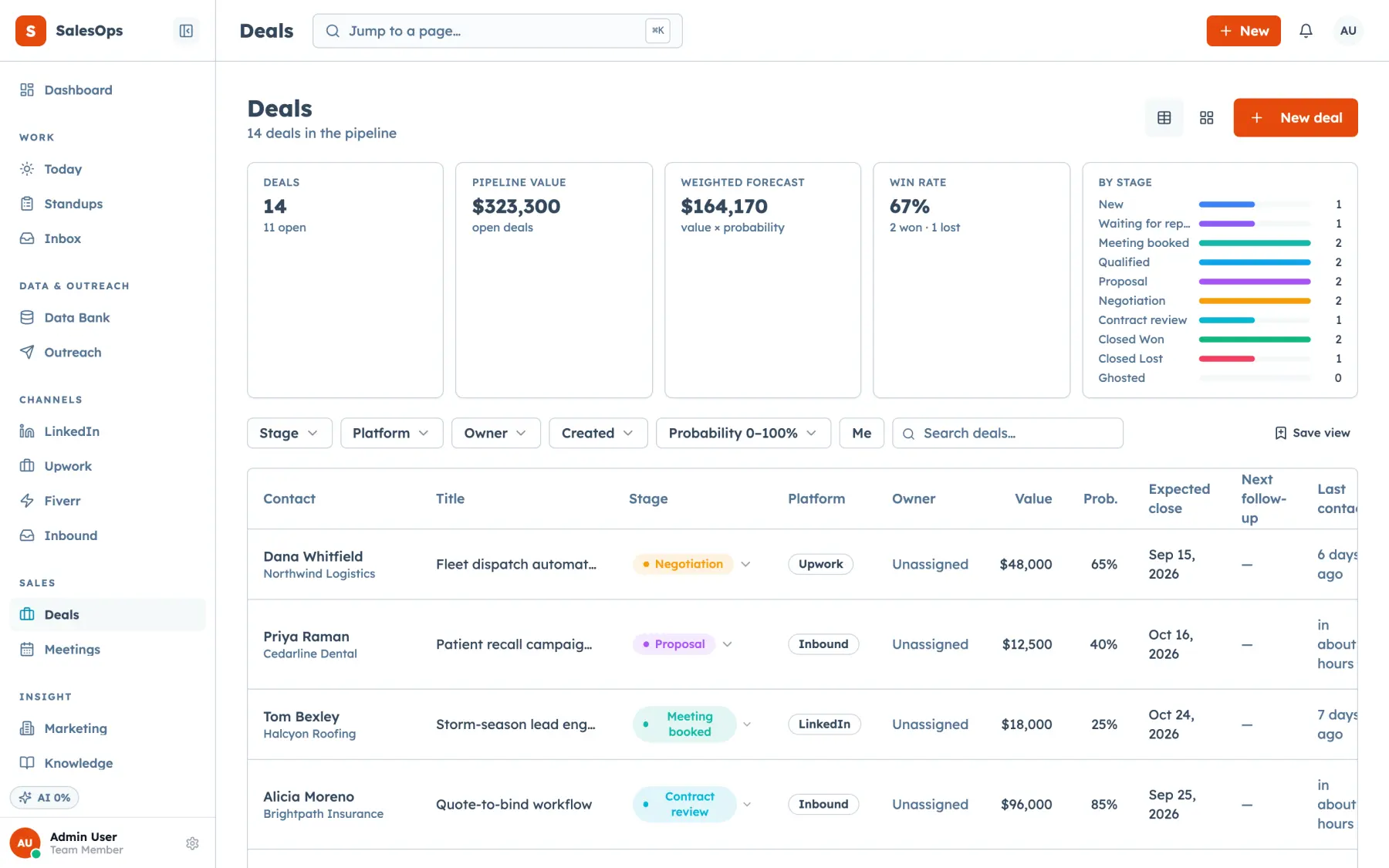
The thing that makes this trade unusual is that one company runs three unrelated sales motions at once: a same-day service call, a several-thousand-dollar panel or EV charger quote to a homeowner, and a commercial bid with a general contractor and a permit schedule. Your dispatch software handles the first. SalesCrew owns the other two.
A week in an electrical contractor's office
Three patterns owners recognise, and what gets configured for each.
Panel and service upgrade quotes go quiet
A homeowner asks about a panel upgrade because their insurer, their inspector or their new EV told them to. The quote is four figures, they think about it, and nobody follows up. Configure a quote pipeline with stages for quoted, followed up and scheduled, and a cadence timed over three weeks rather than three days.
EV charger enquiries arrive from a different world
These leads often come through a vehicle manufacturer's installer network, a dealership referral or a rebate programme, and they behave nothing like a service call. Configure the source on every lead so you can see which of those channels actually produces installs rather than enquiries.
Commercial bids sit in a spreadsheet with permit dates
A commercial job has a bid date, an award, a permit, an inspection and a schedule that all move independently of your invoicing. Configure a bid pipeline with those as stages, so an unawarded bid is visibly stuck instead of assumed lost.
Who is buying, and who is typing
The buyer is the owner or the estimator, and the person living in the software is whoever handles the office. Electricians in the field are not the users, and asking them to be one is how this fails.
What is distinctive about the access question here is the split between residential and commercial. An estimator working commercial bids does not need to see every homeowner service enquiry, and the person handling residential quotes does not need the bid board. The three-axis access model, by channel, profile and area, is what keeps those separate without buying two systems.
Seats are unlimited on every tier, so the estimator, the office manager and the owner all have logins without anyone doing arithmetic about it.
What we configure for you
A working setup for a residential and light commercial electrical contractor.
- 1
Three pipelines
A service pipeline that closes in a day, a residential quote pipeline for panels, rewires and EV chargers, and a commercial bid pipeline with bid submitted, awarded, permitted and inspected as stages.
- 2
Segments
Quotes over two weeks old with no answer, EV enquiries by referral source, and commercial bids awaiting an award decision past their expected date.
- 3
Cadences
A three-week residential quote cadence, a bid follow-up cadence pitched at a general contractor rather than a homeowner, and a reactivation cadence for past customers when a code change makes an upgrade relevant.
- 4
Channels
The office mailbox over IMAP, the website form pointed at the inbound endpoint, and bookings landing as meetings with the source recorded.
- 5
Knowledge base
Your licence number and the jurisdictions you work in, which manufacturers you are certified to install, your service area and your standard warranty, so drafts do not promise work outside your ticket.
Your stack, and what sits beside it
Dispatch stays where it is.
| What you run | What it keeps | What SalesCrew adds |
|---|---|---|
| ServiceTitan | Dispatch, technician scheduling, price book, invoicing | The residential quote pipeline and the commercial bid board, plus follow-up cadences on both |
| Housecall Pro | Scheduling, payments, the technician app | Multi-step follow-up on panel and EV quotes, and a source on every lead |
| Jobber | Quotes, jobs and invoicing for smaller shops | Cadences that keep running after the quote is sent, plus outbound to general contractors |
| Your estimating spreadsheet | Take-offs and material pricing | The bid as a tracked deal with a date, rather than a row somebody remembers |
| QuickBooks | Books and payroll | Nothing. We do not touch accounting |
| Manufacturer installer networks | Lead referrals from a programme | The lead lands with its source, so you can tell which network actually converts |
Connections run through webhooks, CSV import and the API rather than a native app listing.
When a configurable CRM is wrong for you
A configurable CRM (SalesCrew)
- Three separate pipelines for three genuinely different sales motions
- Commercial bids tracked with award and permit stages rather than in a spreadsheet
- Access scoped so the estimator and the residential office see different boards
- Unlimited seats and one Postgres database per company
- No dispatch board, no technician routing, no price book
- No estimating or take-off tools of any kind
- No permit tracking beyond a stage you name yourself
- New product with no electrical customers yet and no third-party reviews
The field service platform
- Dispatch, routing and technician time built for this trade
- Flat-rate price books your electricians already work from
- A field app that works on a job site
- Invoicing and payment at the door
- Commercial bidding is rarely modelled at all
- Quote follow-up is a task list rather than a running cadence
- Per-seat pricing discourages giving the estimator a login
- Your data lives in their multi-tenant system rather than a database you can dump
The after-hours call, and what it actually is here
The out-of-hours call in this trade is usually a partial outage: half the house has no power, a breaker will not reset, or something smells hot. Unlike a no-cool call in July, a proportion of these are genuinely dangerous, and the correct handling is a person rather than a booking script.
Where things stand today. SalesCrew captures forms and bookings around the clock and can place outbound calls through your own Vapi account. It does not answer an incoming call, does not text back a missed caller, and cannot triage an outage at 10pm. Those are roadmap items.
When the receptionist ships, the escalation rule for electrical work should be written as literal trigger words. Smoke, burning, sparks, shock and hot to touch all mean transfer immediately, not book an appointment. That is a prompt decision rather than a technology one, and the prompt pack publishes a structure for it.
Two constraints to plan around now. Homeowner mobiles are consumer numbers, so TCPA obligations attach to marketing texts and calls, and consent has to be recorded rather than assumed. Separately, most jurisdictions require a licensed contractor to display a licence number in advertising, and the rules differ by state, so put yours in the knowledge base and in your templates. SalesCrew enforces suppression and opt-out; the rest is yours, and this is not legal advice.
Where this gets used
Three jobs an electrical office does every week, described as mechanism.
Chasing a panel upgrade quote
The quote moves to followed up the day after it is sent. A three-week cadence runs, pauses the moment the homeowner replies, and the reply lands in the same inbox as everything else.
Following a commercial bid to an award
The bid sits in its own pipeline with an expected award date. When that date passes with no decision, the deal surfaces as stalled and a follow-up goes to the general contractor rather than to a homeowner.
Telling which EV lead source actually converts
Every lead carries its source. Installer network, dealership referral, rebate programme and organic all land in the same table, so the conversion rate of each is a query rather than an impression.
What electrical contractors ask first
- We have ServiceTitan. What does this add?
- Two things it does not do: a commercial bid board with award and permit stages, and a three-week follow-up cadence on residential quotes that runs without anyone remembering. Keep ServiceTitan for dispatch and the price book.
- Can we keep residential and commercial separate?
- Yes, and that is the main configuration decision here. Separate pipelines plus access scoped by area means the estimator sees bids and the residential office sees quotes, without two systems.
- Will our electricians have to log in?
- No. This is office and estimator software. Field staff stay in the field app you already run, and there is no mobile app here anyway, only responsive web.
- Does it track permits and inspections?
- Only as stages you name on the bid pipeline. There is no permit integration and no jurisdiction lookup, and custom fields are on the roadmap, so a permit-heavy data model will not map fully today.
- Is the AI going to contact customers by itself?
- No. Every agent ships in review, meaning it drafts and a person approves. Any external send is review by default in the policy table, and a kill switch stops every agent at once.
- What does it cost?
- Core is $299 a month, Local is $499, Outbound is $699 and Agency is $1,200, with unlimited seats on all four. AI usage is the meter, with a hard stop at the cap that never stops manual work.
Which tier fits an electrical contractor
Core for the quote and bid boards; Outbound if you chase commercial work.
Core at $299 a month covers the three pipelines, segments, email cadences and the shared inbox with unlimited seats. Outbound at $699 adds the sender pool and campaign agents, which is the tier that suits a contractor doing genuine cold outreach to general contractors and property managers.
Start the trial with your open quotes and bids
Two boards on day two, and the first follow-up cadence waiting in review by day three.