The CRM for mortgage brokers whose pipeline lives in the LOS
Pre-approval to funded as a pipeline you can forecast, beside the loan origination system that holds the file.
- Unlimited seats
- Your own database
- AI waits for your approval
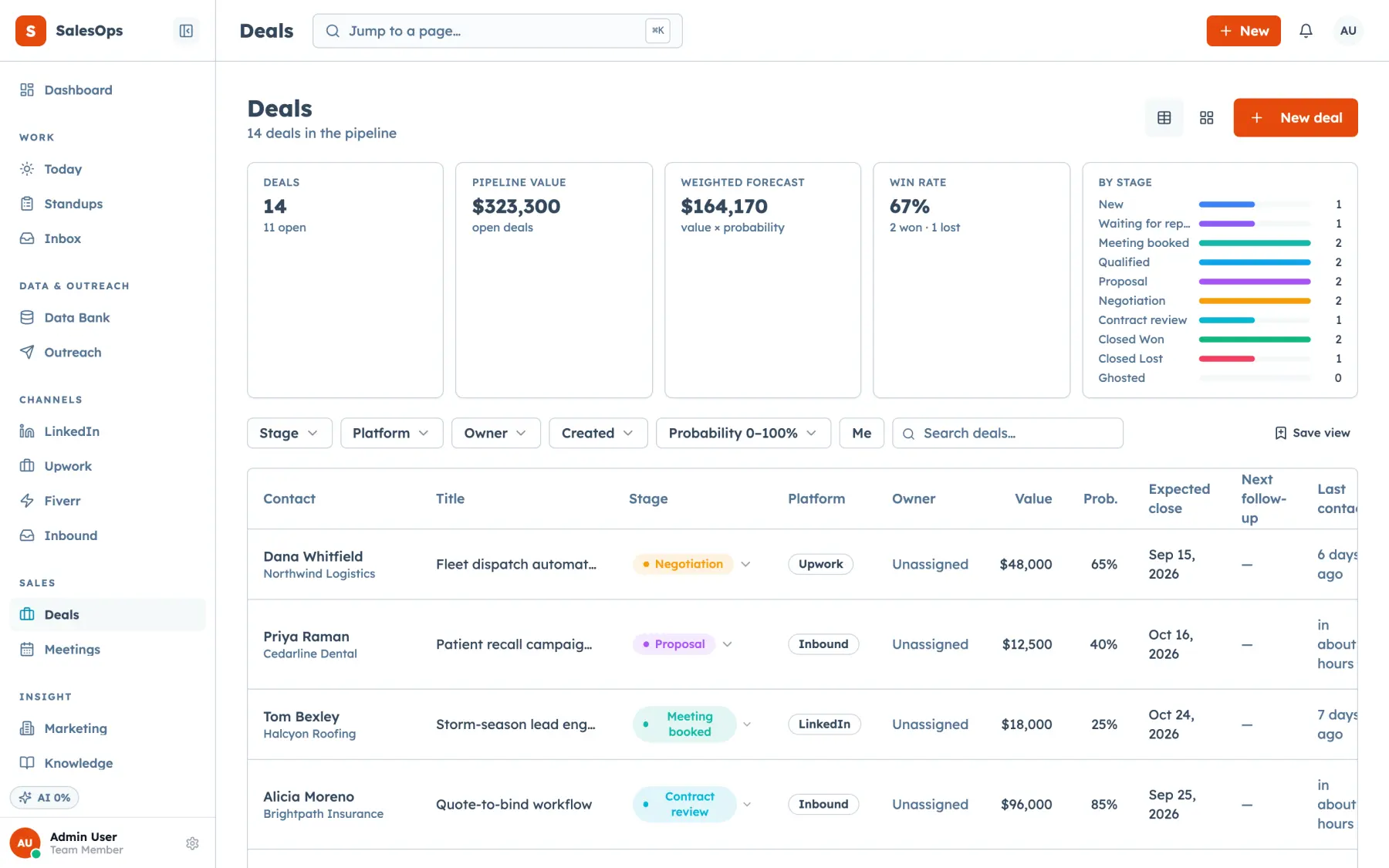
The loan origination system holds the file. It knows the loan number, the conditions, the underwriting decision and the closing date. What it does not hold is the relationship: the borrower who is rate-shopping and not yet an application, the realtor who sent you three files last year and none this year, and the pre-approval that quietly expired in April. SalesCrew is configured for that half, and it never touches the file.
A month in a broker shop with four loan officers
Three things every branch manager recognises, and what gets configured for each.
Borrowers chase you for an update
Between application and clear-to-close a borrower will call three times asking where it is, and each call takes a loan officer out of origination. Configure milestone stages that mirror the LOS (Application, Processing, Underwriting, Conditions, Clear to close, Funded) with an update touch attached to each move, so the borrower hears from you before they think to ask.
Realtor partners are a pipeline nobody works
Referral partners are a second, entirely separate sales motion, and it is the one that gets dropped whenever volume picks up. Configure agents and builders as companies and contacts with a partner cadence, so the quarterly check-in happens on the calendar rather than in the month the pipeline empties.
Pre-approvals expire and nobody notices
A pre-approval letter has a shelf life, and the credit report behind it has a shorter one. Configure a field for the issue date, a segment for letters approaching expiry, and a cadence that reaches the borrower before the letter goes stale rather than after the offer is rejected.
Rate moves are the demand signal, and they arrive without warning
Almost every other trade on this site has a seasonal shape you can plan around. Mortgage has a shape too, but it is set outside the business. When rates fall far enough, a slice of your past borrowers becomes refinance-eligible in the same week, and the shops that capture that slice are the ones who could already answer the question of who is holding what rate.
That is a database problem before it is a marketing problem. Configure the closed-loan record with the note rate, the loan amount, the closing date and the loan type as fields, and a refinance wave becomes a segment query rather than a fire drill. Suppression is applied when the audience is frozen, and the cadence pauses the moment a borrower replies.
The other half of that record is the past-client cadence you run when rates are not moving. A borrower who closed three years ago is a purchase lead, a refinance lead and a referral source at once, and hears from you never. An anniversary cadence keyed to the closing date fixes that.
What we configure for you
A working setup for a broker shop or a branch, inside the first 14 days.
- 1
Pipeline stages
Two pipelines. Borrower: Lead, Pre-approval issued, Application, Processing, Underwriting, Conditions, Clear to close, Funded, with a lost stage carrying a reason. Partner: Identified, First meeting, Sending files, Dormant.
- 2
Channels
Your mailbox connected over IMAP, the rate-quote and pre-approval forms on the site posting to the inbound webhook, Calendly consultations landing as meetings, and the LinkedIn queue for the realtor and builder side.
- 3
Cadences
A rate-enquiry follow-up, a milestone update sequence tied to stage moves, a pre-approval expiry cadence at 90 days, a quarterly partner cadence, and an anniversary cadence on the closing date.
- 4
Agent policy
The Inbox agent set to review, so it drafts a status update or a document request and a licensed person approves it. Guardrails cap touches per contact and hold sends to business hours.
- 5
Knowledge-base voice
Your loan products, your lender panel, your document checklist, your company NMLS identifier and the disclosure line your compliance officer approved, loaded as knowledge, so no draft ever states a rate, an APR or a term you did not authorise.
Your stack, and what sits beside it
The LOS keeps the file. We keep the relationship. That line is the whole point of this page.
| What you run | What it keeps | What SalesCrew adds |
|---|---|---|
| Encompass | The loan file, conditions, disclosures, compliance record, the audit trail regulators care about | The pipeline before the application and the relationship after funding, plus partner development |
| Arive | Loan files, lender pricing and submission for broker shops | Rate-enquiry follow-up, pre-approval expiry segments and past-client campaigns |
| Jungo | A mortgage CRM built on Salesforce, sitting beside the LOS | Consider this a direct overlap. If Jungo is working for you, keep it |
| Your pricing engine | Eligibility and pricing from the lender panel | Nothing. We never quote a rate and never price a loan |
| Credit and verification vendors | Reports, verification of employment and assets | Nothing. That data belongs in the file, not in a marketing database |
| Your website and lead sources | Rate-table clicks, paid leads, referral form fills | The lead lands in your pipeline with its source, so cost per funded loan by channel is a query |
These connections run through webhooks, CSV import and the API. There is no native connector to any LOS, and we would rather write that plainly than call it an integration it is not.
What belongs in a CRM, and what belongs in the file
When a mortgage-specific tool is the better choice
A configurable CRM (SalesCrew)
- Borrower and partner pipelines with the stages your shop actually uses, and a weighted forecast
- Segments on note rate, loan type and closing date, so a refinance wave is a query
- Unlimited seats, so loan officers, processors and the marketing person all have access
- One Postgres database per company, exportable whenever you ask for it
- No native LOS connector — Encompass and Arive connect by webhook, CSV or the API
- No pricing engine, no document collection portal, no compliance archive
- Two-way SMS for milestone updates is on the roadmap, and this trade wants it
- New product with no mortgage customers yet and no third-party reviews
The mortgage tool (Jungo, or your LOS's own CRM module)
- Built around loan data, with fields and reports that already speak your vocabulary
- Tighter coupling to the file, so milestone triggers do not depend on a webhook
- Vendors who already understand the disclosure and record-keeping expectations of this industry
- Co-marketing templates and compliance review workflows built for loan officers
- Per-seat pricing that makes processors and assistants an expense to argue over
- Partner development is usually a task list rather than a running cadence
- Your data lives in their system, and export is a report rather than a database dump
- Little room to reshape the pipeline when your shop does not originate the way the template assumes
The call pattern, and why texting is the thing you are waiting for
Mortgage does not have a 3am emergency call. It has a steady stream of short, anxious in-hours calls, almost all of them the same question in different words: where is my loan, and what do you still need from me. Every one is a loan officer not originating.
Today SalesCrew captures the rate enquiry and the pre-approval request the moment they arrive, records the milestone stages, drafts the update email through the Inbox agent for a person to approve, and makes outbound calls through Vapi. The Calendly consultation lands as a meeting with the lead source attached.
The part that matters most for this trade is not here yet. A short text when the file moves to underwriting, another when conditions clear, and a text-back when a borrower calls during a closing meeting are what actually stop the update calls. Two-way SMS with consent handling and STOP keywords, phone numbers with inbound routing, and reminders that send are in the phone pack on the roadmap.
Three constraints to plan around now. Borrower mobile numbers are consumer numbers, so the TCPA applies to marketing texts and calls, and a borrower who gave you a number to process a loan has not thereby consented to a rate-drop campaign. Advertising a rate, a term or a payment pulls in federal advertising rules and usually requires accompanying disclosures, so no draft here should state a number your compliance officer has not approved. Arrangements with realtor partners where value moves in exchange for referrals are governed by federal rules, so co-marketing spend stays a human decision made with your counsel. State licensing rules govern how a licensee is identified in solicitation and they vary, so keep your NMLS line in your templates. Suppression and opt-out are enforced today. This is not legal advice.
Where this gets used
Three jobs a broker shop does every week, described as mechanism.
Keeping a borrower informed between milestones
A stage move to Underwriting triggers the next step of the update cadence. The Inbox agent drafts the message from the stage and the knowledge base, a licensed person approves it, and any reply pauses the sequence and lands in the shared inbox.
Working a refinance wave
A segment finds closed loans above a note-rate threshold with a closing date over a year old. Suppression is applied at freeze, the cadence runs, and anyone who books a call drops out of it.
Keeping realtor partners warm
Agents and builders are companies and contacts with a quarterly cadence and a dormant stage. Every touch is logged against the partner, so which relationships actually produce funded files is a report rather than a hunch.
What broker shops ask first
- Our compliance officer will ask what an AI writes and who reads it.
- Every agent ships in review mode, so the model produces a draft and a person approves it before anything sends. Any external send is review by default in the policy table, there is a kill switch that stops every agent at once, and every tool call is audited with the actor recorded. Your knowledge base sets what a draft may say, so rates, APRs and terms only appear if you put them there.
- Does it connect to Encompass or Arive?
- Not natively. The mechanism is webhooks, CSV import and the API, and we say that plainly rather than listing a connector we do not have. In practice shops post stage changes from the LOS to the inbound webhook, or import on a schedule. The LOS remains the system of record for the file; this is the pipeline and the relationship beside it.
- Can it send milestone texts to borrowers?
- Not yet. Two-way SMS with consent handling and STOP keywords is in the phone pack on the roadmap. Today the milestone update goes out by email, drafted by the Inbox agent and approved by a person, and the stage move is what triggers it.
- What about co-marketing with realtor partners?
- SalesCrew tracks partners, cadences and which files came from whom. It does not decide what you may or may not pay for jointly, and it does not draft co-marketing agreements. Any spend is human-only by policy in this product, and the rules around paying for referrals in this industry are the sort of thing you settle with counsel before the campaign, not after.
- Will loan officers actually use it?
- The honest answer is that they use the parts that save them calls. Milestone updates, the partner cadence and the shared inbox get used; nobody logs data entry twice. Processors and assistants tend to live in it more than originators do, which is why unlimited seats matter. There is no native mobile app, only responsive web.
- What does it cost, and what happens if we leave?
- Core is $299 a month with unlimited seats, Local is $499, Outbound is $699 and Agency is $1,200. The trial is 14 days and a card is required to start it, and you can cancel any time before it ends. If you leave, you take a full Postgres dump plus CSVs, because your shop's instance is a separate project. It goes read-only with export available, and a person deprovisions it after 90 days.
Which tier fits a broker shop
Core for the pipeline. Outbound when partner development is the growth plan.
Core at $299 a month covers both pipelines, the shared inbox, email cadences and the data bank, with unlimited seats for loan officers and processors. Outbound at $699 adds the sender pool and the campaign agent, which is what a shop building a realtor partner network from cold actually needs. Local at $499 is the phone and SMS tier, and it ships with the roadmap pack described above.
Start with the pre-approvals that expired last quarter
Import your closed loans and your dead rate enquiries on day two, and see the first segment build itself.