SalesCrew vs a Spreadsheet
A spreadsheet costs almost nothing, has no learning curve and locks you into nothing. SalesCrew costs $299 a month and exists to enforce suppression, gate AI actions and stop follow-ups from slipping through at real volume.
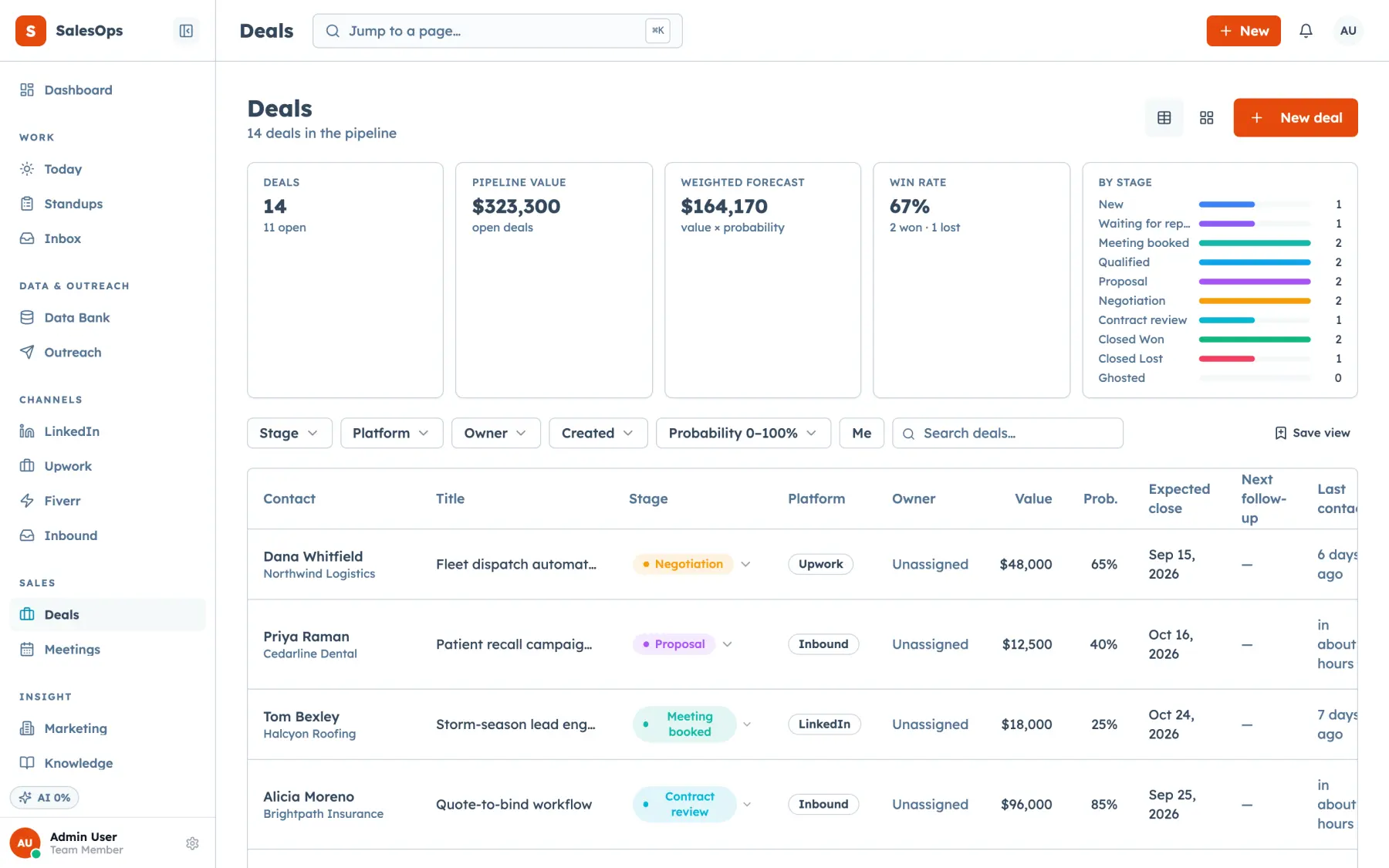
Choose a spreadsheet when the list is genuinely small, the team is one or two people, and nobody needs suppression enforcement or a shared record of who's been touched. Choose SalesCrew once volume, multiple channels or consent tracking make manual upkeep in a sheet the thing that actually breaks.
The short answer
- A spreadsheet is close to free, has zero learning curve and locks in nothing; for a very small list run by one or two people, it's a genuinely good answer, not a lesser one.
- SalesCrew costs $299 to $1,200 a month and earns that cost through suppression enforcement, an AI approval queue and multi-step cadences a sheet has no mechanism to run.
- The honest dividing line is volume and consent risk, not sophistication: a two-person team with twenty leads a month should stay on a sheet.
SalesCrew vs a spreadsheet at a glance
| Dimension | SalesCrew | A spreadsheet |
|---|---|---|
| Price | $299–$1,200/mo, unlimited seats on every tier | Free to roughly $12–$18/user/mo for Google Workspace or Microsoft 365, if not already owned |
| Seats | Unlimited on every tier | Effectively unlimited via sharing, though concurrent editing gets messy past a handful of people |
| Cold outbound policy | Suppression enforced at audience freeze and rechecked at send | No enforcement mechanism; relies entirely on the person sending to remember who opted out |
| Data ownership / export | One Supabase project per client; full Postgres + CSV export | Full ownership by default; export is just downloading the file |
| AI approval controls | One queue for AI-drafted external sends; per-agent modes off/draft/review/auto | None; a spreadsheet has no concept of an AI action or an approval step |
| Agent API / MCP | 145 registered MCP tools with a UI twin for each | None natively; some spreadsheet tools support scripting or third-party AI add-ons, not a structured tool API |
| Voice / SMS | On the roadmap, not shipped | Not applicable; a spreadsheet is not a communication channel |
| White-label | Not published as a feature at this fact sheet's date | Not applicable |
| Integrations breadth | Fewer native listings; most connections via webhooks, API and MCP | Broad via Zapier/Make when paired with a spreadsheet API, though nothing native to the sheet itself |
| Mobile app | None; responsive web only | Native mobile apps for Google Sheets and Excel, though editing a large sheet on a phone is still awkward |
| Best for | Teams past the point where suppression, cadences or an AI approval queue matter | A very small team or a very short list where manual tracking is still manageable |
SalesCrew figures from the product fact sheet, September 2026. Spreadsheet cost figures are approximate Google Workspace/Microsoft 365 list prices, checked September 2026, and assume the tool isn't already owned for other reasons.
Where each option holds up, and where it doesn't
SalesCrew
- Suppression is enforced automatically at audience freeze and rechecked at send, not left to memory
- Multi-step cadences run and pause themselves on a reply; a sheet has no equivalent automation
- Every AI-drafted send sits in one approval queue before it goes out, with an audit log of what happened
- Costs real money every month, where a spreadsheet a team already has access to costs nothing extra
- Takes real setup, importing data, configuring cadences and suppression rules, that a blank sheet doesn't require
- Overkill for a genuinely small list; the fixed monthly cost isn't justified below a certain volume
- A new product: no customers yet and no third-party reviews to check
A spreadsheet
- Near-zero cost if the tool is already owned, with no separate subscription to justify
- No learning curve; everyone on a sales team already knows how to use one
- Total flexibility to add a column, reshape a view or hand a filtered export to someone else instantly
- No suppression enforcement; opt-outs and bounces are tracked only if someone remembers to mark them
- No cadence engine; multi-step follow-up sequences have to be tracked and triggered by hand
- Breaks down as a shared system past a handful of concurrent editors or a few hundred active rows
How to choose
Start with the honest size of the operation. A two-person team sending to twenty leads a month, or a founder tracking a short target list before a first hire, does not need suppression enforcement, an approval queue or a cadence engine. A shared spreadsheet, free or already included in whatever office suite is in use, does that job with zero learning curve and total flexibility to reshape however the team wants.
The case for SalesCrew shows up once that stops being true, once the list is large enough, or the channels are varied enough, email, LinkedIn and eventually more, that a human can no longer reliably remember who opted out last week or which contact is three days into a five-step cadence. Suppression enforced at audience freeze and rechecked at send, and a cadence engine that pauses on a reply automatically, are mechanisms a spreadsheet simply doesn't have, no matter how well it's organized.
Weigh the $299-a-month starting cost, and the setup work of importing data and configuring suppression rules, against what a spreadsheet already gives for free: total flexibility, zero lock-in and a tool everyone already knows. If the risk of a missed suppression or a dropped follow-up is still low at current volume, staying on the sheet is the more honest answer, not a consolation prize.
Questions
- Can you use a spreadsheet alongside SalesCrew?
- Yes, and it's common in practice. A spreadsheet is a fine place to draft a target list, sketch an ICP, or hand a one-off export to someone outside the CRM before it's imported. SalesCrew's data bank and CSV import are built to take a spreadsheet in as a starting point. What doesn't work well long-term is running the live pipeline in the sheet and the CRM in parallel, because the two will drift out of sync the first time someone updates one and forgets the other.
- How do you move from a spreadsheet to SalesCrew?
- Export the sheet to CSV and import it into SalesCrew's contacts, companies or deals, mapping columns to fields on the way in. Because SalesCrew's data lives in a dedicated Supabase project per client from day one, there's no further lock-in step after that, the export tools that get data out are the same tools available on day one.
- Isn't a spreadsheet just better for a very small team?
- For a genuinely small list, often yes, and it's worth saying plainly. A two-person team tracking twenty leads a month doesn't need suppression enforcement, a cadence engine or an approval queue, and a shared sheet with a few tabs does that job at zero incremental cost with no learning curve. The case for a CRM at all, SalesCrew or otherwise, shows up once volume, multiple channels or compliance obligations like consent tracking make manual upkeep the actual bottleneck.
- Why does cold outbound break down in a spreadsheet?
- A spreadsheet has no mechanism to prevent someone from emailing a contact who unsubscribed last week, no shared record of who was already touched today across email and LinkedIn, and no automatic stop when a lead replies to a cadence still queued to send the next step. Those are consent and suppression problems, not organization problems, and they get worse, not better, as the list and the team both grow. SalesCrew enforces suppression at audience freeze and rechecks it again at send time specifically because a spreadsheet has no equivalent gate.