SalesCrew vs SuiteDash
SuiteDash is a white-label client portal with CRM, invoicing and project management built for agencies and freelancers. SalesCrew is an agent-operable CRM for the sales pipeline.
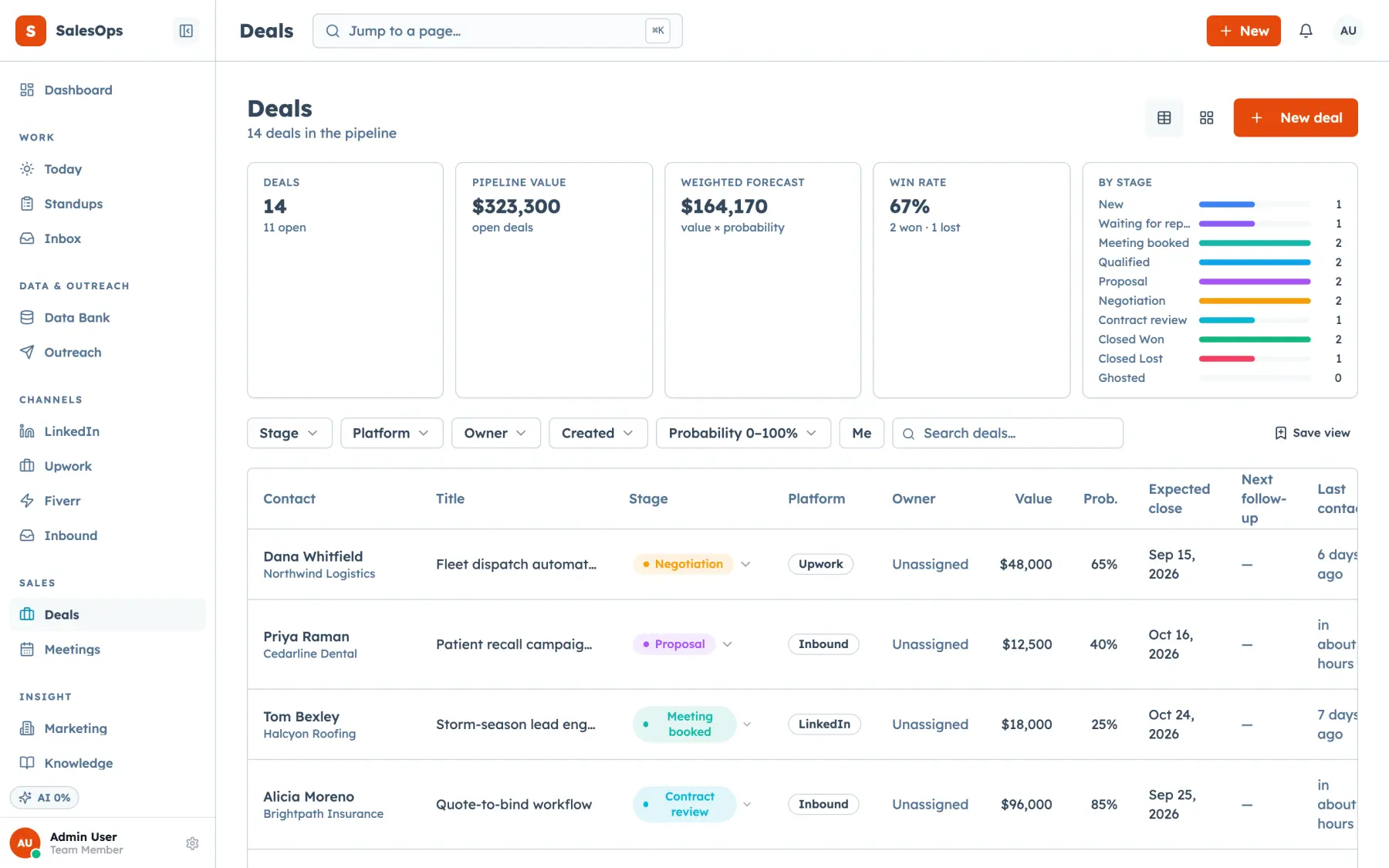
SuiteDash suits a single branded hub for client portals, invoicing and project delivery. Choose SalesCrew when the job is agent-operable outbound with an MCP server, an approval queue and each client's data in its own database.
The short answer
- SuiteDash bundles a white-label client portal, CRM, invoicing and project management in one flat-priced, unlimited-user product, a genuinely different scope than a sales CRM.
- SalesCrew is built for the sales pipeline, inbox, cadences and an AI approval queue, with 140+ MCP tools an agent can call.
- These solve different problems more than competing ones: SuiteDash is built for client-facing delivery after the sale, SalesCrew for agent-operable outbound before it.
SalesCrew vs SuiteDash at a glance
| Dimension | SalesCrew | SuiteDash |
|---|---|---|
| Price | $299–$1,200/mo, unlimited seats on every tier | From $19/mo across three tiers (Start, Thrive, Pinnacle), flat price not per user |
| Seats | Unlimited on every tier | Unlimited users on every tier |
| Cold outbound policy | Allowed; suppression enforced at audience freeze, sender/domain caps, opt-out handling | Not built around cold outbound; positioned as a client portal and delivery platform |
| Data ownership / export | One Supabase project per client; full Postgres + CSV export | Data exportable from the platform; not positioned around a dedicated database per client |
| AI approval controls | One queue for AI-drafted external sends; per-agent modes off/draft/review/auto | Not a core feature at this fact sheet's date |
| Agent API / MCP | 140+ MCP tools, each with a UI twin | API access alongside the portal |
| Voice / SMS | Outbound calls through Vapi, phone numbers and two-way SMS, logged on the contact timeline | Not a core feature; product is portal, CRM, invoicing and project management |
| White-label | Branding per workspace: name, logo, theme and subdomain | Core feature: full white-label branding including a custom-branded mobile app |
| Integrations breadth | Connects via webhooks, API and 140+ MCP tools | Integration breadth not detailed on the pricing page; portal and delivery tools are the focus |
| Mobile app | Responsive web | Custom-branded mobile app included as part of white-label offering |
| Best for | Teams that want an agent to operate the CRM directly and own their database | Agencies and freelancers that want one branded hub for client portals, invoicing and delivery |
SalesCrew figures from the product fact sheet, September 2026. SuiteDash figures from suitedash.com/pricing, checked September 2026.
What each one does well
SalesCrew
- Every action in the app is also an MCP tool an agent can call, with an identical effect to the UI
- Cold outbound is a first-class feature: data bank, suppression at freeze, multi-step cadences and a sender pool
- One Supabase project per client; full export on churn
SuiteDash
- Full white-label branding, including a custom-branded mobile app, on every plan
- One flat price with unlimited users, rather than per-seat or per-tool pricing
- Client portal, invoicing and project management bundled with its CRM in one product
- A broad product; teams that only need a sales CRM take on more surface area than they use
How to choose
The scope difference matters more than any single feature row here. SuiteDash is built to be the one branded system a client sees after they sign: a portal, invoicing, project delivery and a CRM underneath it, all white-labeled and priced flat regardless of how many people on the team use it. If that's the actual job, one hub for client-facing delivery, it's a strong, purpose-built fit.
SalesCrew is built for the sales side: a pipeline, an inbox, cold outbound with suppression enforcement, and an approval queue that gates anything an AI agent drafts before it sends. An agency that wants an AI agent drafting cadence steps and inbox replies, with a human clearing the risky ones, gets that from SalesCrew.
An agency doesn't have to pick only one. Some run SuiteDash for the branded client experience post-sale and SalesCrew for the pipeline that feeds it. A webhook moves a won client from one to the other.
Questions
- Can you use SalesCrew and SuiteDash together?
- It's plausible for a specific split: SuiteDash as the branded client-facing hub for project delivery, invoicing and client portals, with SalesCrew running the outbound pipeline that fills that hub with new clients in the first place. That's two products doing two different jobs rather than one CRM in each. Running both as the primary place deals live would duplicate the pipeline and isn't a setup either product is designed around.
- How do you migrate from SuiteDash to SalesCrew?
- SuiteDash's CRM contacts and deal data can be exported, and SalesCrew imports contacts, companies and deals from CSV into a dedicated Supabase project per client. The pipeline then runs in SalesCrew, while client delivery can stay wherever the team runs it today.
- What does SalesCrew give an agency?
- Agent-operable outbound: an MCP server with 140+ tools, an approval queue over every AI send, and suppression enforced at audience freeze. Each client gets its own database. The Agency tier, at $1,200 a month, adds marketplaces, data sources, the marketing module and all agents.
- Does SalesCrew charge per user like most CRMs?
- No. Like SuiteDash, SalesCrew includes unlimited seats on every tier. SalesCrew is $299, $699 or $1,200 a month. A 14-day trial is available, with a card required to start it.