SalesCrew vs Smartlead
Smartlead is a dedicated cold email sending platform built for deliverability at volume. SalesCrew is a full CRM with a mailbox-pool sender built in, alongside a pipeline, inbox and approval queue.
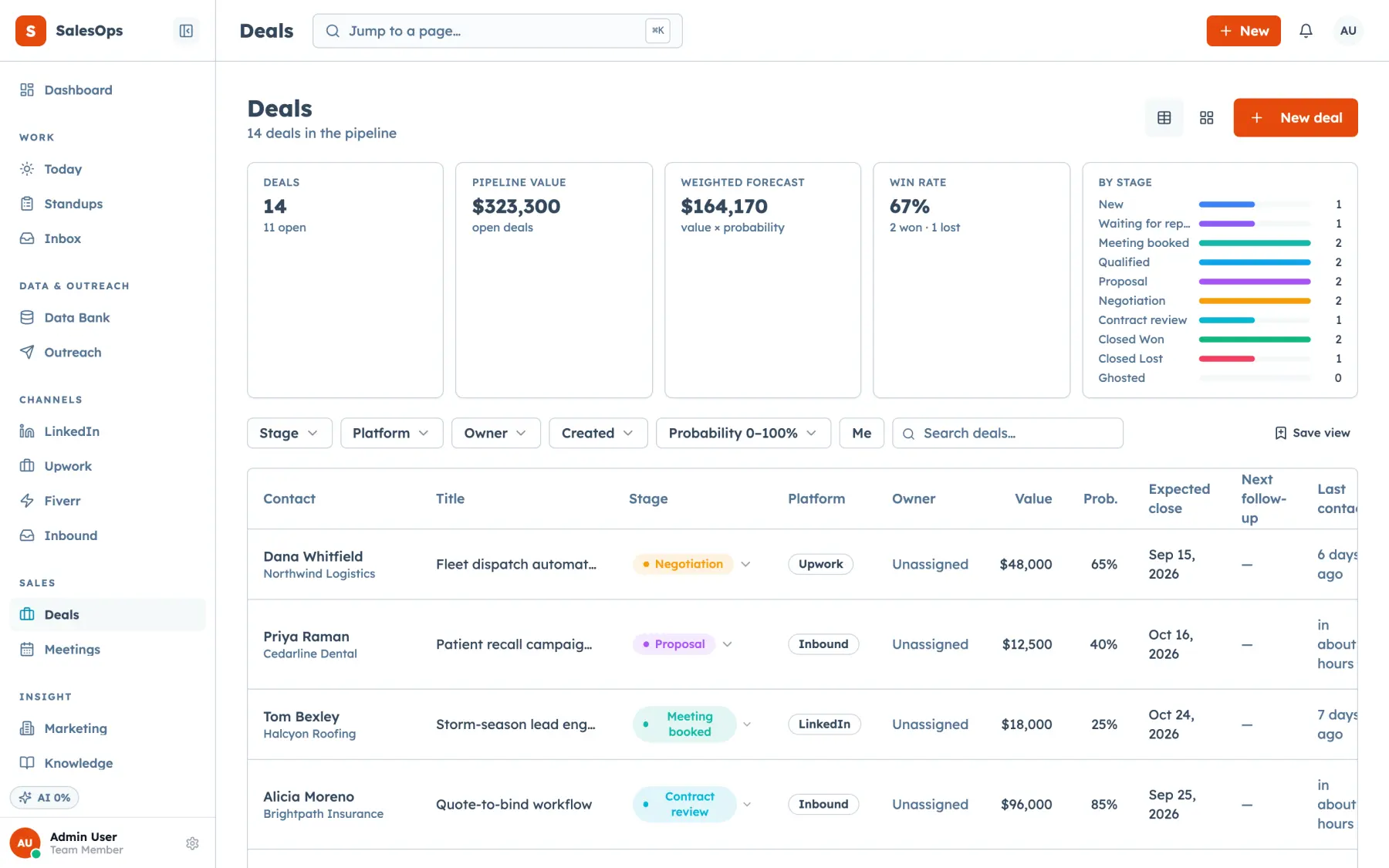
Choose Smartlead when cold email volume and deliverability infrastructure are the whole problem and you already have, or don't need, a separate CRM. Choose SalesCrew when you want the sender, the pipeline, the inbox and an AI approval queue in one database, and can accept a sending engine that isn't as deep as a dedicated specialist's.
The short answer
- Smartlead is a specialist built around cold email sending and deliverability at scale, with dedicated-tenant infrastructure most general CRMs don't try to match.
- SalesCrew's mailbox-pool sender is native to a full CRM, so sends are tied to the same pipeline, suppression list and approval queue as the rest of the product, but it isn't purpose-built sending infrastructure.
- These solve different problems more than competing ones: Smartlead depth-first on one function, SalesCrew breadth-first across the whole funnel with sending as one native piece of it.
SalesCrew vs Smartlead at a glance
| Dimension | SalesCrew | Smartlead |
|---|---|---|
| Price | $299–$1,200/mo, unlimited seats on every tier | $39–$379/mo by send volume (Base through Unlimited Prime) |
| Seats | Unlimited on every tier | Not the primary pricing axis; plans scale by send/verified-email volume |
| Cold outbound policy | Allowed; suppression enforced at audience freeze, sender/domain caps, opt-out handling | Built specifically for cold email at volume; unlimited mailboxes with warmup and rotation on every plan |
| Data ownership / export | One Supabase project per client; full Postgres + CSV export | Campaign and lead data exportable from the platform; not a dedicated CRM database |
| AI approval controls | One queue for AI-drafted external sends; per-agent modes off/draft/review/auto | AI agents can draft and send campaign emails; not built around a cross-product human approval queue |
| Agent API / MCP | 145 registered MCP tools with a UI twin for each | API and webhooks available; no MCP server |
| Voice / SMS | On the roadmap, not shipped | SmartDialer add-on offers voice calling credits; not a core CRM voice feature |
| White-label | Not published as a feature at this fact sheet's date | Workspace/client management on higher tiers; not marketed as a white-label product |
| Integrations breadth | Fewer native listings; most connections via webhooks, API and MCP | API and webhook access; integrates as a sending layer alongside other tools |
| Mobile app | None; responsive web only | Not confirmed as a native mobile app on Smartlead's own site |
| Best for | Teams that want the sender, pipeline and approval queue in one CRM | Teams whose primary need is cold email volume and deliverability infrastructure |
SalesCrew figures from the product fact sheet, September 2026. Smartlead figures from smartlead.ai/pricing, checked September 2026.
Where each product holds up, and where it doesn't
SalesCrew
- One database holds the pipeline, inbox, cadences and sender together, so a reply updates the same record the campaign touched
- External sends, including cadence steps an agent drafts, sit in one approval queue by default
- Suppression is enforced at audience freeze and rechecked at send time across every channel, not only email
- Its mailbox-pool sender is not purpose-built deliverability infrastructure the way Smartlead's dedicated-tenant setup is
- No native mobile app; the product is responsive web only
- Fewer native integrations than a specialist tool typically ships with; most connections go through webhooks, the API or MCP
- A new product: no customers yet and no third-party reviews to check
- Voice and SMS are on the roadmap, not available today
Smartlead
- Dedicated-tenant infrastructure and proactive deliverability monitoring built specifically for cold email at volume
- Unlimited mailboxes with warmup and rotation on every plan, priced by send volume rather than seats
- A narrower, deeper focus that specialist deliverability teams tend to prefer
- Not a full CRM; pipeline and deal features exist but the product's core strength is the sending layer, not the system of record
- No MCP server, so an agent can't operate campaign, pipeline and inbox actions through one consistent tool set
- Pricing scales with send volume, which can climb quickly for a team running large campaigns
How to choose
If cold email is the whole motion and the volume is high enough that inbox placement and warmup infrastructure decide whether the campaign works at all, Smartlead's specialization is the right tool for that specific job. It's built around exactly that problem, with dedicated infrastructure most general CRMs, SalesCrew included, don't try to match.
If the goal is one system that holds the pipeline, the inbox, the cadence logic and an approval queue for anything an AI agent drafts, SalesCrew's case is that the sender doesn't need to be the deepest tool in its category to be the right one, because it sits next to the pipeline and suppression list rather than beside them in a separate product. A reply lands in the same record the campaign touched, and the next step in the cadence reads that same data.
The honest tradeoff: SalesCrew's built-in sender is not purpose-built deliverability infrastructure at Smartlead's depth, and it's a new product with no reviews to check yet. A team running high-volume cold email as its core motion, with deliverability as the deciding factor, may still be better served running Smartlead as the sending layer, whatever CRM sits behind it.
Questions
- Can you use SalesCrew and Smartlead together?
- Some teams do run a dedicated sending tool like Smartlead for the highest-volume cold email campaigns while keeping the CRM as the system of record for replies, deals and follow-up. SalesCrew's own mailbox-pool sender is native to the product rather than a connected sending tool, so pairing the two means choosing which product actually dispatches each campaign's mail, which is a real operational decision, not a default setup.
- How do you migrate from Smartlead to SalesCrew?
- Smartlead exports leads and campaign data; contacts move into SalesCrew's data bank the same way any CSV import does, mapped to contact and company fields. What doesn't migrate automatically is Smartlead's deliverability infrastructure itself, warmup pools, dedicated-tenant IPs, and inbox rotation built specifically for cold-email volume. SalesCrew's own mailbox pool has its own cooldown stamps, per-account daily caps and bounce-to-suppression handling, but it is a different sending engine, not a drop-in replacement for Smartlead's specialized infrastructure.
- Why choose SalesCrew over a dedicated sending specialist like Smartlead?
- If cold email volume and deliverability are the entire problem, a specialist built around that one job, with dedicated-tenant infrastructure and email-specific tooling, is a legitimate reason to pick Smartlead over a general CRM's built-in sender. SalesCrew's case is different: the sending is one part of a CRM that also holds the pipeline, the inbox, the cadences and the approval queue an AI agent's drafts sit in before anything goes out, so the tradeoff is depth in one function versus one system holding the whole funnel.
- Does SalesCrew match Smartlead's deliverability depth?
- No, and that's a fair limitation to state directly. Smartlead is built specifically around deliverability at scale: dedicated-tenant infrastructure, proactive inbox placement monitoring and infrastructure-level tooling that a general CRM's sender doesn't try to replicate. SalesCrew's mailbox-pool sender handles cooldowns, suppression at send time and per-account caps, which covers deliverability hygiene for a CRM-native sender, but it isn't purpose-built infrastructure at Smartlead's depth.