Instantly alternatives
Instantly is a tool we run. Here is the field around it, compared on sending limits, API gating and the question that actually decides it: where the reply lands.
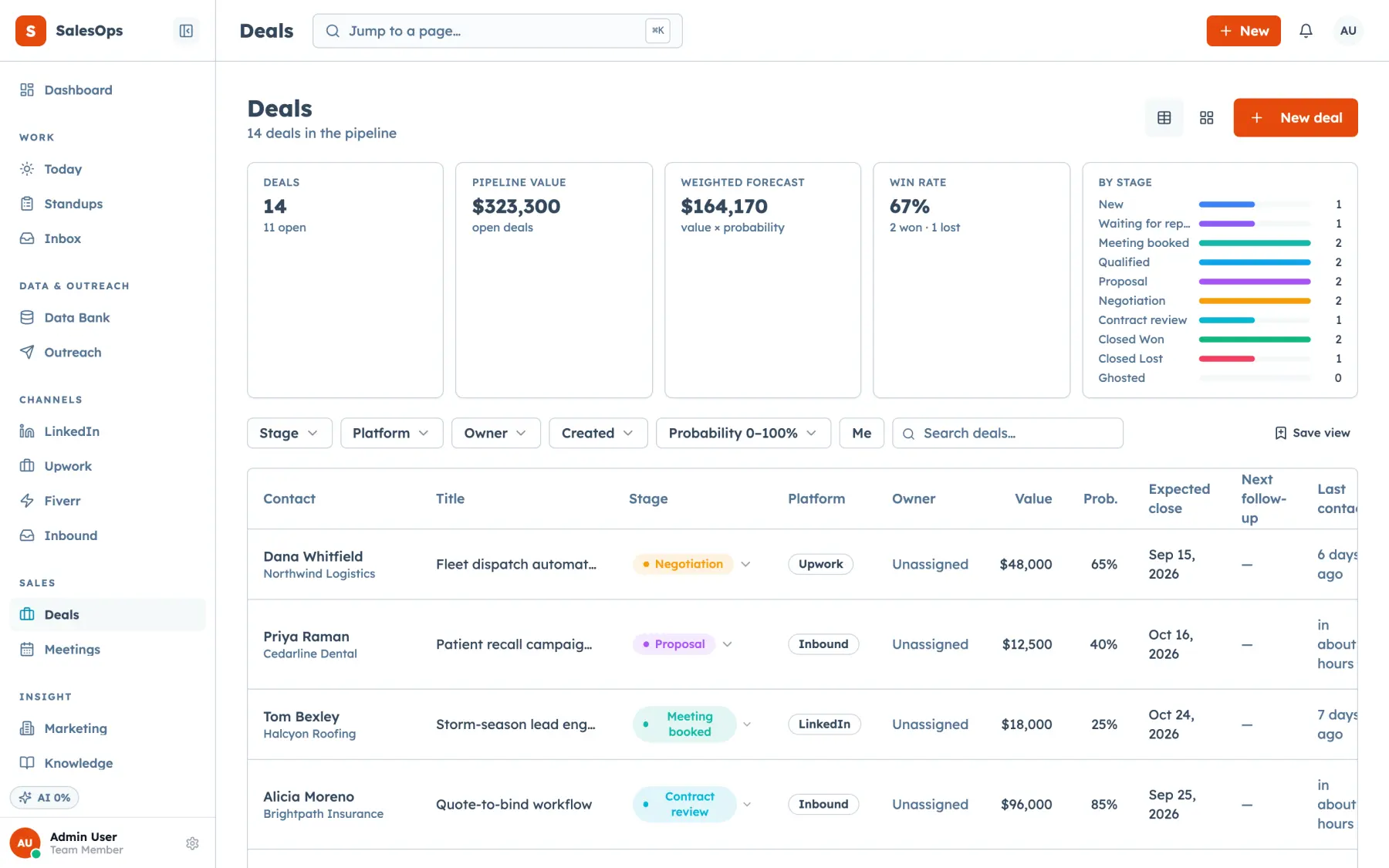
Move off Instantly if the replies need to become deals in the same place they arrive, or if you need the API on an entry plan. Stay if sending volume is the whole job and your pipeline already lives somewhere you are happy with.
The short answer
- Instantly prices by email volume and contacts rather than by mailbox, and advertises unlimited email accounts on its outreach plans. Growth is $47 a month for 5,000 emails and 1,000 uploaded contacts. If your strategy is many small senders, that shape is hard to beat.
- The real comparison in this category is not features, it is what happens after a reply. Every sending tool produces conversations it is not the system of record for, and the sync between the two is where teams lose time.
- Check API gating before price. Smartlead puts API and webhooks on its $174 tier and above; lemlist advertises an MCP server on every plan. Those gates change the total cost more than the headline number does.
How we compared these
Instantly is a tool SalesCrew runs. The product mirrors Instantly's sender and domain registry, so the sending accounts and domains configured there stay in sync with what the CRM knows about. That integration exists because of the exact problem this page is about: we wanted the sending infrastructure and the pipeline to agree with each other without a person copying details between two tabs.
What pushed us past it was the reply. A cold email produces a conversation, the conversation produces a deal, and until the send history, the suppression list and the deal record sit in one database, somebody is maintaining a bridge between systems. Building the pipeline in the same Postgres project as the cadences and the mailbox pool was the design decision that came out of that.
The alternatives are evaluated from each vendor's own documentation and pricing, September 2026. We have not run them in production. Where a vendor does not state a trial length or a card requirement on its own pricing page, this page leaves it out rather than filling it in.
Instantly and its alternatives, on sending shape and access
| Instantly | Smartlead | lemlist | Apollo | Salesforce | SalesCrew | |
|---|---|---|---|---|---|---|
| Entry paid price | $47/mo Growth, outreach only; $94/mo monthly for the Starter bundle | $39/mo monthly, $32.50/mo annual | $69/mo monthly, $55/mo annual, per user | $49 per seat/mo billed annually | Starter Suite $25 per user/mo | $299/mo, unlimited seats |
| How it scales | By email volume and contacts. Unlimited email accounts on outreach plans | By contacts and sends | Per user | Per seat, credits per seat | Per user | By tier. Seats are free on every tier |
| Entry sending allowance | 5,000 emails/mo, 1,000 uploaded contacts | 2,000 contacts, 6,000 sends/mo | 50,000 emails/mo on the Email plan | 250 sends a day, 1 mailbox per user | Not a cold-email tool; its own list policies apply | Your own mailbox pool, with per-account and per-domain daily caps |
| API on the entry plan | API and webhooks advertised; per-tier gating not stated | No. Unlimited Smart ($174/mo) and above | Yes, on all plans | No. Custom plans only | Web Services API listed; per-edition inclusion not marked | Yes, on every tier |
| An AI client can operate it | Not advertised | Not advertised | Yes. MCP server on all plans | Not advertised | Not advertised on the pricing page | Yes. Every action is also an MCP tool |
| Where the reply becomes a deal | Elsewhere. You sync it | Elsewhere | Elsewhere | In Apollo, within its caps | In Salesforce | In the same database the send came from |
| Free entry | Free tier, no card | Free trial, no card | 14-day trial, no card | Free plan, 900 credits per seat per year | 30-day trial, no card | 14-day trial, card required |
Figures checked on vendor pricing pages, September 2026.
The field, ranked for a team leaving Instantly
1. Smartlead
The closest like-for-like and cheaper at the entry point: $39 a month for 2,000 contacts and 6,000 sends. Best for: teams who want the same job done for less. Not for: anyone who needs API access, which starts at the $174 tier.
Read more2. Stay on Instantly
The unlimited email accounts model is genuinely differentiated. If your deliverability approach spreads volume across many sending accounts, paying by volume rather than by mailbox is the cheaper shape and switching gives it up. Best for: high-volume senders. Not for: teams whose pipeline needs to live with the sends.
3. lemlist
More expensive per user, and the only tool in this comparison advertising an MCP server on every plan. Multichannel adds LinkedIn steps beside email. Best for: teams who want an AI client driving the sequences. Not for: large teams, since the per-user price compounds.
Read more4. SalesCrew
Cadences, sender pool, data bank, suppression and the pipeline in one Postgres database you own, with unlimited seats at $299 a month. Suppression is enforced when an audience is frozen and re-checked at send. It is not a cheaper Instantly; it is the same send with the deal record attached. Best for: teams maintaining a sync between an outbound tool and a CRM. Not for: pure volume senders with no pipeline to speak of. New product, no third-party reviews, no mobile app, fewer native integrations. Disclosure: SalesCrew is our product.
Read more5. Apollo
If your list is the constraint rather than the send, Apollo bundles a B2B database with a sequencer at $49 a seat annually. Best for: teams sourcing and sending in one place. Not for: volume, given the 250-a-day send cap on Basic.
Read more6. Your existing CRM's email tool
Cheapest of all, since you already pay for it. Best for: warm follow-up to people who opted in. Not for: cold lists, where most CRM acceptable-use policies restrict you and the sending infrastructure was never built for it.
Read moreWhen to stay on Instantly
Stay if sending volume is the job and the pipeline is somebody else's problem. Instantly is built around one thing and priced for it: unlimited sending accounts, volume-based plans, and warmup and rotation as first-class features rather than add-ons. A CRM that also sends is not going to match a tool whose entire product surface is sending.
Stay if your deliverability is currently good. Reputation lives with your domains and your list, not with your vendor, but the operational habits that produced a good sender score are embedded in how you have configured the tool you are on. Rebuilding that configuration elsewhere risks the one number you cannot easily get back.
Stay if your team is large and the alternatives charge per user. lemlist at $69 per user and Apollo at $49 per seat both scale with headcount in a way Instantly's volume pricing does not. For a ten-person team, that difference is larger than any feature on this page.
Questions
- What does Instantly do that a CRM does not?
- Sending mechanics. Mailbox rotation, warmup, per-account daily caps, bounce and complaint handling, reply detection. A general CRM's email tool assumes you are writing to someone who already knows you, and it does not manage a pool of sending accounts. That gap is real and it is why the category exists.
- Why would anyone move off Instantly?
- Because the replies land in the wrong place. A cold sequence produces a conversation, the conversation should produce a deal, and the deal lives in a CRM. Every team running this stack ends up building or buying a sync between the two systems. Some decide they would rather the send and the pipeline were in one database in the first place.
- Is unlimited email accounts really unlimited?
- Instantly does advertise unlimited email accounts on its outreach plans, with the plan priced by email volume and contacts rather than by mailbox. That is a genuinely different shape from tools that charge per inbox, and it matters a lot if your deliverability strategy involves many small senders rather than a few large ones. The volume caps still apply.
- Does switching tools fix deliverability?
- No, and this is the most expensive misunderstanding in outbound. Deliverability is decided by your domain reputation, your authentication records, your list quality and your complaint rate. A new sending tool inherits all four. If your current numbers are bad, fix the list and the domains first, because a migration will reproduce the same problem on a new bill.