Keap alternatives
Keap bundles CRM, automation and payments from $299 a month. Six alternatives for businesses paying platform prices for one part of a platform.
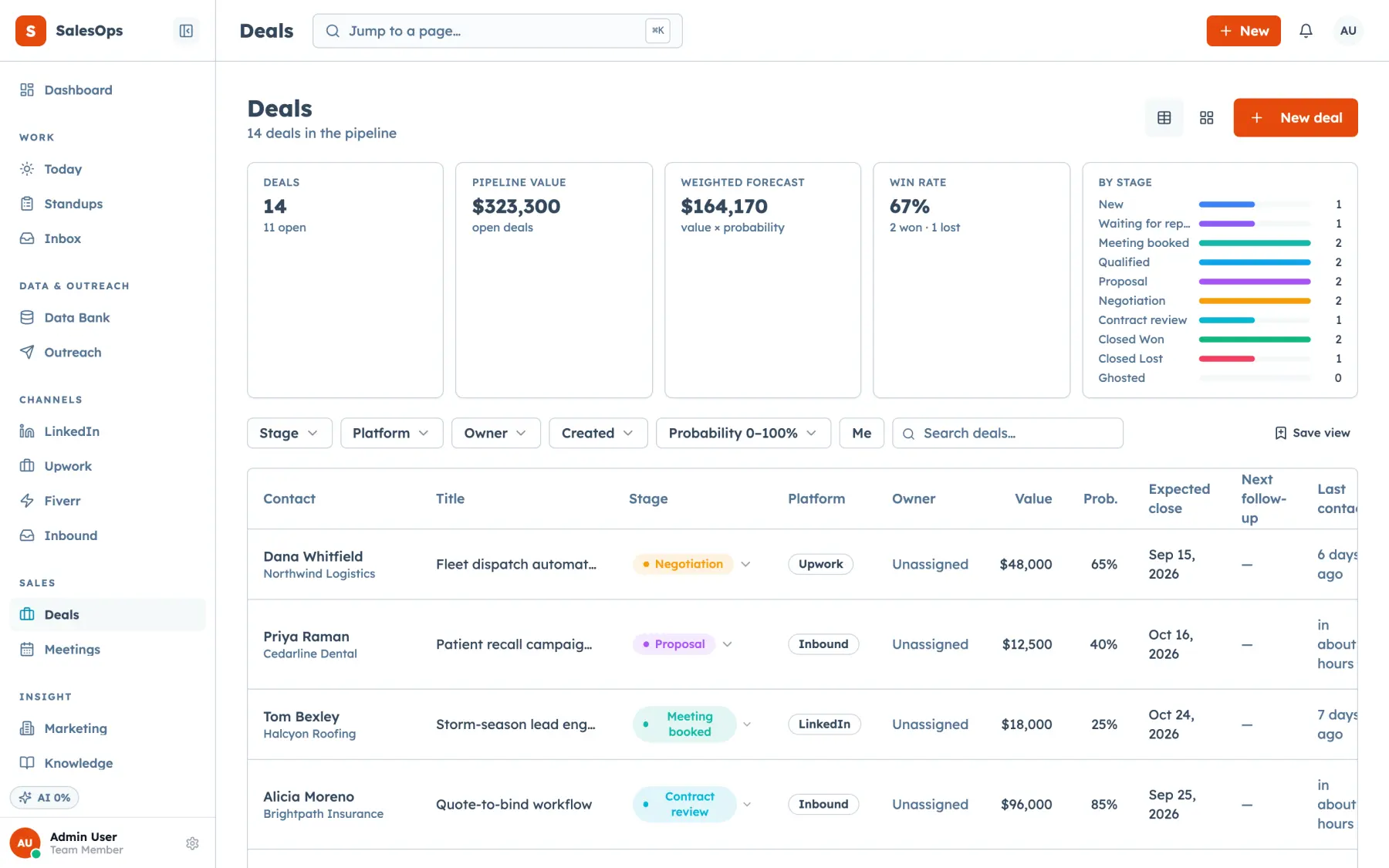
Switch if you use one part of Keap and pay for all of it, or if you want an AI assistant able to operate your CRM, which Keap does not support. Stay if the automation and payments bundle is genuinely replacing several tools.
The short answer
- Keap starts at $299 a month, or $2,988 a year, with two user licences included and further users at $39 each. The flat price reads as all-inclusive and the per-user charge above two is the part people miss.
- Keap ships no MCP server. Its own developer community confirms none exists and that people are building against the API themselves. Nine of the eleven CRMs we checked publish one.
- The price scales by contact tier, and the contact count at the $299 entry is not stated on its pricing page. Ask for that number before you compare against anything else.
How we compared these
Prices and inclusions come from each vendor's own pricing page, checked in September 2026, and the MCP finding comes from Keap's own developer community rather than a third party. Where a figure is not published, such as the contact count included at Keap's entry price, this page says so rather than estimating.
Evaluated from Keap's own documentation and pricing, September 2026. We have not run it in production. Everything below is checkable against Keap's own properties; nothing here is a report of daily use.
The table compares total cost for a real team, what the platform actually bundles, and whether an AI client can operate it. Feature counts are omitted because a bundled platform wins every feature count by definition, which tells you nothing about whether the bundle fits.
Keap and its alternatives, compared
| Keap | HubSpot | ActiveCampaign | GoHighLevel | Close | Zoho CRM | SalesCrew | |
|---|---|---|---|---|---|---|---|
| Entry price | From $299/mo, $2,988/yr, 2 licences | $20 per seat/mo annual, $7 monthly | Its own page renders prices client-side; no figure confirmable | $97/mo Starter, flat per agency | Solo $9 per user/mo annual | Its own page serves rupees only; no dollar figure confirmable | $299/mo flat, unlimited seats |
| Cost of a 6-person team | $299/mo plus 4 users at $39, so $455/mo | $120/mo annually billed | Not confirmable; priced by contacts, not seats | $97/mo. Flat | $54/mo annually billed | Not confirmable | $299/mo |
| What the price scales with | Contact tier, plus users above two | Seats | Contact count | Sub-accounts and tier | Users | Users | Tier only. Seats are free |
| Bundled beyond CRM | Automation, payments, landing pages | Marketing, forms, attribution | Marketing automation | Funnels, sites, automations, sub-accounts | Calling and sequences | A wide business suite | Outbound, data bank, agents; marketing module on Agency |
| Official MCP server | No. Its own community confirms none exists | Yes, read and write | Yes, remote server with connectors | Not advertised | Yes, three permission scopes | Yes, four servers | Yes. Every UI action has an MCP twin |
| Cold outbound on your own mailboxes | Within its own automation | Sequences, not on purchased lists | Built for opted-in audiences | Within its automations | Yes, with calling | Yes | Yes, with suppression enforced at freeze and at send |
| Free entry | No. Trial with no card | Free tier, 2 users | No free tier. 14-day trial, no card | 14-day trial | 14-day trial, no card | Free edition, 3 users | No. 14-day trial, card required |
Figures checked on vendor pricing pages, September 2026.
The field, ranked for a business leaving Keap
1. HubSpot
The obvious swap when the bundle is more than you use: $20 a seat annually, a free tier for two users, and marketing and CRM designed together with a proper MCP server. Best for: businesses wanting the same shape for less. Not for: cold outbound, which its acceptable-use policy restricts, or teams who need payments in the same tool.
Read more2. Close
$9 a user annually with calling and sequences, and no platform fee at all. A six-person team pays $54 a month against Keap's $455. Best for: businesses whose Keap usage was really the CRM. Not for: anyone using its automation or payments.
Read more3. ActiveCampaign
The most direct automation-for-automation comparison, priced by contact count rather than by seat, so a large team costs no more. We could not verify its dollar prices, since its page renders them client-side. Best for: businesses whose automations are the asset. Not for: anyone with a very large list.
Read more4. SalesCrew
The same $299 a month, but flat with unlimited seats rather than two licences plus $39 a head, and with every action available to an AI client through an MCP tool behind an approval queue. It has no payments, no landing pages and no visual automation builder, so it replaces Keap's CRM and outbound side only. Best for: businesses whose sales side outgrew the bundle. Not for: anyone relying on Keap's payments or pages. New product, no third-party reviews, no mobile app. Disclosure: SalesCrew is our product.
Read more5. GoHighLevel
Flat at $97 a month with funnels, sites and automations, which covers more of Keap's surface than most alternatives here for a third of the price. Best for: businesses who used the pages and automations most. Not for: anyone who needs the API on the entry tier, which starts at $297.
Read more6. Zoho CRM
A free edition for three users and a suite that covers books, campaigns and desk beside the CRM, with four MCP servers. Its dollar pricing could not be verified from its own page. Best for: cost-driven small businesses. Not for: anyone who wanted a simpler product than Keap.
Read moreWhen to stay on Keap
Stay if the bundle is actually replacing several tools. CRM, marketing automation, landing pages and payments in one product with one login and one bill is worth real money, and assembling the same coverage means three or four subscriptions plus the work of connecting them. If you use most of what Keap does, $299 is competitive rather than expensive.
Stay for the automations you have already built. Keap's automation engine is mature, and a small business that has encoded its follow-up, its invoicing triggers and its nurture sequences into it owns something that does not export. Rebuilding that logic elsewhere is the real cost of moving, and it is usually much larger than the monthly difference.
Stay if payments matter. Keap takes payments inside the same system that holds the contact and the automation, so a paid invoice can trigger the next step without an integration. That is genuinely uncommon at this price. SalesCrew has no payments today; quotes and payment links on a client's own Stripe key are on the roadmap, not shipped, and it would be dishonest to weigh a roadmap against a working feature.
Questions
- What does Keap cost?
- Its own page lists a single plan starting at $299 a month, or $2,988 a year, with two user licences included and extra users at $39 a month each, as of September 2026. The price scales by contact tier, and the contact count included at the $299 entry point is not stated on the page, so ask before assuming your list fits.
- Does Keap have an MCP server?
- No. Keap publishes no official Model Context Protocol server, and a thread on its own developer community from February 2026 confirms that developers are building their own against the API instead. Keap ships in-app AI writing assistance, which is a different thing from letting an outside assistant operate the CRM.
- Is $299 a month expensive for a small business?
- It depends what it replaces. Keap bundles CRM, marketing automation, payments and landing pages, so a business that would otherwise buy three tools may find it cheap. A business that only needed a CRM is paying platform prices for one component, and a per-seat tool at $9 to $35 a head will be far less.
- What is the usual trigger for leaving Keap?
- Two show up repeatedly. The flat $299 floor when only part of the platform is being used, and the extra-user charge at $39 a head, which surprises teams who read the flat price as covering everyone. Neither is a criticism of the product; both are a mismatch between what it costs and what a given business uses.