SalesCrew vs Salesforce
Salesforce is the enterprise CRM incumbent: AppExchange, deep customization, a large partner network and a mobile app. SalesCrew is a small new product built specifically for agent-operable outbound.
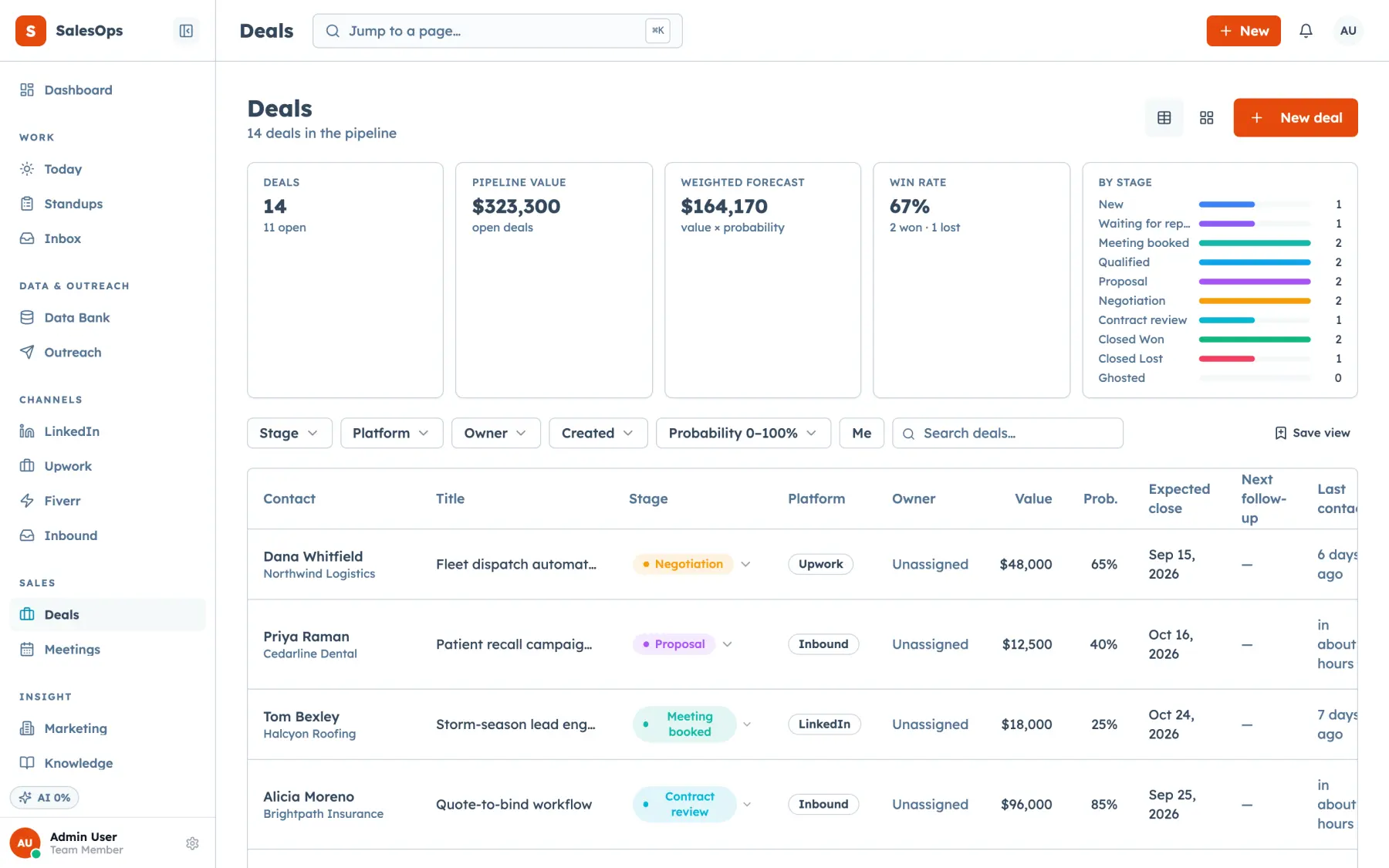
Choose Salesforce when you need enterprise-scale customization, a large partner and app ecosystem, and a mature product with years of reviews behind it, especially past a few hundred users. Choose SalesCrew when the job is a smaller team running agent-operable outbound with an approval queue and its own database, and you don't need AppExchange-level customization.
The short answer
- Salesforce is the established enterprise incumbent: AppExchange, a large partner network, deep click-and-code customization and years of reviewed usage. SalesCrew is a new product with none of that scale yet.
- SalesCrew's case is narrower: roughly 140 actions each exposed as an MCP tool, with external sends held in an approval queue by default, and one dedicated database per client rather than a shared multi-tenant org.
- These aren't really competing for the same buyer in most cases. Salesforce fits an organization that needs enterprise customization and scale; SalesCrew fits a smaller team that wants an agent to operate the CRM directly without that overhead.
SalesCrew vs Salesforce at a glance
| Dimension | SalesCrew | Salesforce |
|---|---|---|
| Price | $299–$1,200/mo, unlimited seats on every tier | Starter Suite from $25/user/mo; Pro Suite from $100/user/mo (annual); Enterprise/Unlimited by quote |
| Seats | Unlimited on every tier | Priced per user |
| Cold outbound policy | Allowed; suppression enforced at audience freeze, sender/domain caps, opt-out handling | Email campaigns available; cold-outbound-specific suppression/sender-pool tooling is not the product's core focus |
| Data ownership / export | One Supabase project per client; full Postgres + CSV export | Data lives in Salesforce's multi-tenant org; export via Salesforce's own data export/API tools |
| AI approval controls | One queue for AI-drafted external sends; per-agent modes off/draft/review/auto | Agentforce AI features exist; approval-queue design differs by configuration, not a single native queue at this fact sheet's date |
| Agent API / MCP | 145 registered MCP tools with a UI twin for each | Full REST/Apex API and AppExchange platform; no MCP server confirmed at this fact sheet's date |
| Voice / SMS | On the roadmap, not shipped | Available via connected partner apps and add-ons, not a core native feature at every tier |
| White-label | Not published as a feature at this fact sheet's date | Not a core consumer feature; Salesforce branding is standard |
| Integrations breadth | Fewer native listings; most connections via webhooks, API and MCP | AppExchange marketplace with a large catalog of listed apps and partner solutions |
| Mobile app | None; responsive web only | Native Salesforce mobile app |
| Best for | A smaller team that wants an agent to operate the CRM directly and own its database | Enterprises and larger sales orgs that need deep customization and an established ecosystem |
SalesCrew figures from the product fact sheet, September 2026. Salesforce figures from salesforce.com/crm/pricing, checked September 2026; exact AppExchange catalog size not independently confirmed and is not stated as a number here.
Where each product holds up, and where it doesn't
SalesCrew
- Every action in the app is also an MCP tool an agent can call, with an identical effect to the UI
- Cold outbound is a first-class feature: data bank, suppression at freeze, multi-step cadences and a sender pool
- One Supabase project per client rather than a shared multi-tenant org; full export on churn
- No native mobile app; the product is responsive web only
- No AppExchange-equivalent marketplace, no page/funnel builder
- Far fewer native integrations than Salesforce; most connections go through webhooks, the API or MCP
- A new, small product: no customers yet, no third-party reviews, and none of Salesforce's partner network
- Voice and SMS are on the roadmap, not available today
Salesforce
- AppExchange marketplace and a large partner and systems-integrator network
- Deep customization through declarative tools and Apex code, suited to complex enterprise processes
- Years of reviewed usage across a very large customer base, plus a native mobile app
- Pricing and implementation cost climb quickly at enterprise scale, and Enterprise/Unlimited tiers require a sales quote rather than a listed price
- That customization depth is also complexity a smaller team may not need and has to staff for
- Not built specifically around an MCP-style agent-operable model; agent access to the same actions a person uses is not the product's original design point
How to choose
Company size and process complexity are the honest deciding factors here. An organization that needs custom objects, approval chains across departments, a large partner ecosystem to build on, or has hundreds of users across sales, service and other clouds, is going to get more out of Salesforce's depth than a smaller product can match, and its price and complexity scale for a reason.
A smaller team, or one whose core problem is running outbound with an AI agent doing first drafts and a human approving the risky steps, is the case SalesCrew is built for. Its roughly 140 actions are each an MCP tool with an identical UI twin, so an agent operates the CRM the same way a person does, and one queue holds every external send until a human clears it. That is a narrower job than Salesforce solves, done with a dedicated database per client instead of a shared org.
Weigh that against what SalesCrew genuinely lacks next to Salesforce: no mobile app, no AppExchange-scale ecosystem, far fewer native integrations, and no track record yet. A team that needs deep, enterprise-scale customization or an established partner network to lean on should not expect SalesCrew to substitute for that today.
Questions
- Can you run SalesCrew alongside Salesforce?
- Some organizations already do something like this in spirit, running Salesforce as the enterprise system of record while a lighter tool handles a specific outbound motion. SalesCrew has a Salesforce send path today, used to push campaign sends through a connected Salesforce org, so the two can work together on outbound rather than compete for the same pipeline. Running both as the primary CRM for the same deals at once is not a configuration either product is built for.
- How do you migrate from Salesforce to SalesCrew?
- Salesforce supports data export through its own export tools and API, typically to CSV. SalesCrew imports contacts, companies and deals from CSV into a dedicated Supabase project for the client. There is no packaged Salesforce-to-SalesCrew migration tool; for an org with Salesforce's level of customization, custom objects, validation rules, Apex automations, a migration is a project in itself regardless of the destination CRM, not a one-click step.
- Why would a company choose a brand new product over Salesforce?
- Scale and maturity favor Salesforce heavily: it is the incumbent enterprise CRM with AppExchange, a large partner network, deep click-and-code customization, and years of reviews. SalesCrew is a small new product with no customers yet and no reviews to check. The case for it is narrow and specific: a company that wants every CRM action exposed as an MCP tool an AI agent can call directly, with one approval queue gating anything external, and does not need Salesforce's enterprise customization depth to get there.
- Does SalesCrew have Salesforce's customization and AppExchange?
- No. Salesforce's Apex code layer, declarative automation builder and AppExchange marketplace represent a different order of customizability than SalesCrew offers. SalesCrew's equivalent is its MCP server, roughly 140 tools that let an agent or a developer build custom behavior against the CRM's own actions, and outbound webhooks for connecting to Zapier, Make or n8n, but this is a narrower and different kind of extensibility, not a substitute for AppExchange.