Alternatives to running sales on a spreadsheet
A sheet is a fine pipeline until two people edit it, follow-ups depend on memory, and nobody can see what was actually sent. Here is what replaces it, and when.
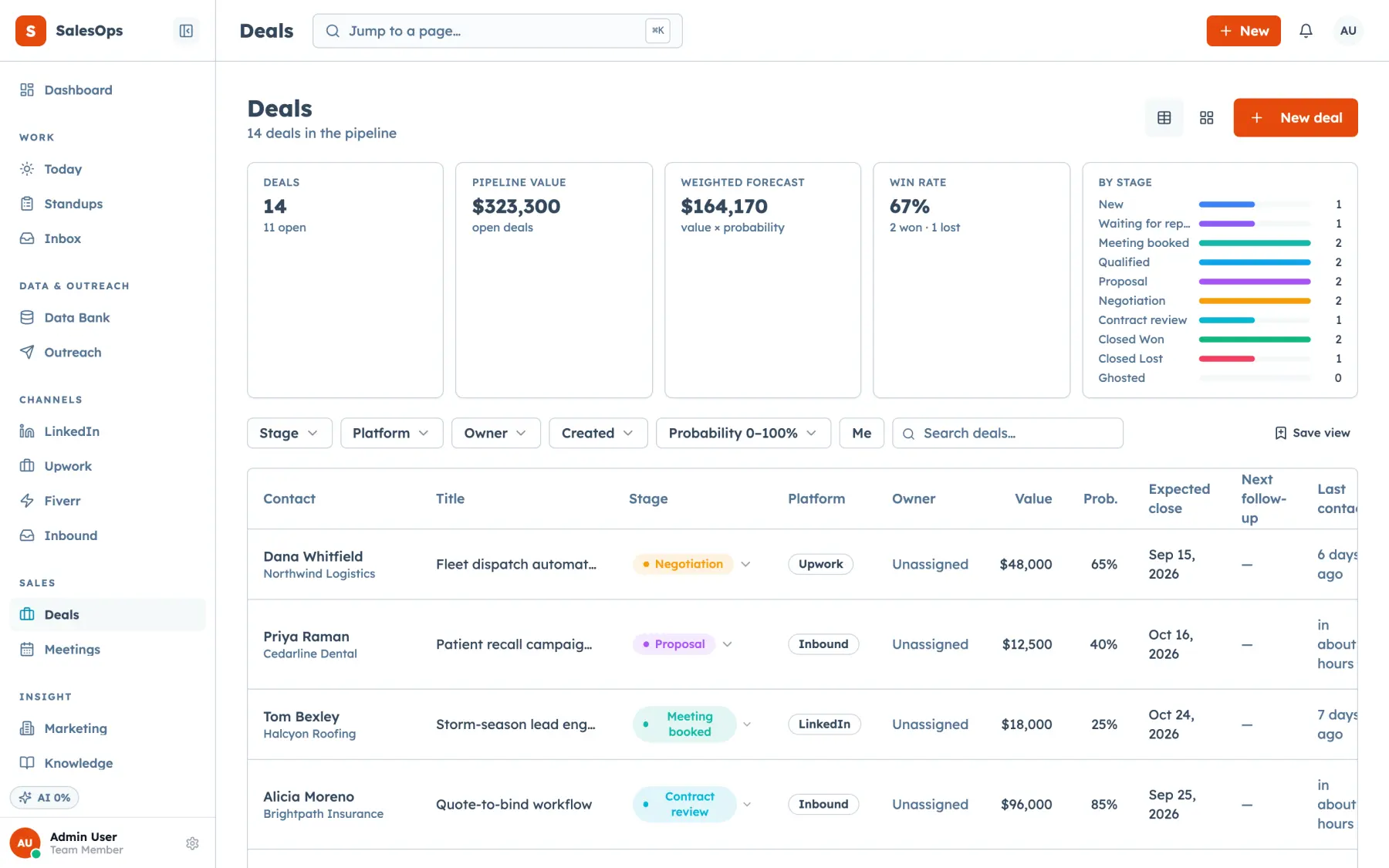
Move off the spreadsheet when more than one person edits it, when follow-ups are being missed because a cell cannot remind anyone, or when you need to know what was sent and when. Stay on it if one person is tracking a short list and nothing needs to send.
The short answer
- A spreadsheet is a record of what you decided, not a record of what happened. It has no idea whether an email went out, whether it bounced, or whether the person replied. That gap is what every replacement here is really selling.
- The three failures that end a sales spreadsheet are concurrent editing, missed follow-ups and no send history. Match your replacement to whichever one is actually hurting, because a tool that fixes reminders may do nothing for sending.
- The migration cost is not the tool. It is deduplicating your rows and turning text dates into real dates. Do that work in the sheet first, before you pick anything, because you need it either way.
How we compared these
We ran sales on spreadsheets ourselves before building SalesCrew, and the sheet is where a lot of this product's shape came from: a pipeline you can see at a glance, columns you can add without asking anyone, and an export that is never held hostage. The failures below are the ones we hit, not hypotheticals.
The replacements are evaluated from each vendor's own documentation and pricing pages, September 2026. We have not run them in production. The table compares the specific capabilities a spreadsheet lacks rather than feature counts, because feature counts are how you end up paying for a marketing suite when what you needed was a reminder.
One category note. Several tools in this space are spreadsheets with better plumbing, not CRMs: Airtable and Notion both fall here. They fix concurrent editing and structure, and they do not fix sending or follow-up automation on their own. That is a real answer for some teams and a trap for others, so they are listed separately below rather than mixed in.
What a spreadsheet cannot do, and which replacements can
| Spreadsheet | Airtable / Notion | Pipedrive-class CRM | Outbound tool (Instantly, Smartlead) | SalesCrew | |
|---|---|---|---|---|---|
| Two people editing safely | Row conflicts and overwrites in shared sheets | Yes, record-level with revision history | Yes | Yes | Yes, with row-level security per user |
| Knows an email was sent | No. You type that it was | No, unless you build a sync | Yes, if the mailbox is connected | Yes, that is the core job | Yes, multi-mailbox IMAP and SMTP with threads |
| Reminds you to follow up | No | Reminders on records; no send | Yes, tasks and activity reminders | Yes, as automated sequence steps | Yes, tasks plus multi-step cadences |
| Suppression and opt-out handling | A tab you maintain by hand | A table you maintain by hand | Varies; often marketing-suite only | Yes, built in | Yes, enforced when an audience is frozen and again at send |
| Cost of adding a person | Nothing | Per editor | Per seat, usually | Per seat or per mailbox | Nothing. Seats are unlimited on every tier |
| Your data leaves easily | It is already a file | CSV export | CSV export | CSV export | Full Postgres dump plus CSV; the database is yours |
| An AI assistant can operate it | Only if you write the script | Via their APIs | Via API; MCP support varies by vendor | Via API | Yes. Every UI action is also an MCP tool |
Figures checked on vendor pricing pages, September 2026.
The field, ranked by how well each replaces a sales spreadsheet
1. A standard sales CRM (Pipedrive, Close, folk)
The default answer, and correct for most teams leaving a sheet. You get records, a pipeline board, tasks that nag you, and a connected mailbox so the history is real rather than typed. Best for: a team that lost track of follow-ups. Not for: teams whose actual problem is sending volume.
Read more2. Airtable or Notion
The smallest step. You keep the grid, gain real records, views, permissions and revision history, and lose the overwrite problem. Best for: a sheet that is structurally fine but breaking under multiple editors. Not for: anyone who needs follow-ups to send themselves.
Read more3. SalesCrew
Pipeline, inbox, data bank and cadences in one Postgres database that belongs to you, with unlimited seats at $299 a month and every action also available as an MCP tool. Best for: teams whose spreadsheet was both the pipeline and the outbound list. Not for: anyone needing a mobile app, a page builder, or a long list of native integrations. It is new, has no third-party reviews, and voice features are on the roadmap. Disclosure: SalesCrew is our product.
Read more4. A dedicated outbound tool (Instantly, Smartlead)
If the spreadsheet was really a prospect list, this replaces it directly: sequences, mailbox rotation, suppression, reply detection. Best for: cold outbound at volume. Not for: managing deals after someone replies, which is a different job and needs a second tool.
Read more5. HubSpot free tier
Free to start, familiar to everyone, and it will hold contacts and deals without a bill. Best for: teams who want to stop paying attention to the tool decision. Not for: cold outbound, which its acceptable-use policy restricts, or teams who will resent the upgrade prices later.
Read more6. Stay on the spreadsheet, deliberately
One person, one short list, no sending. Add a date column and a filter for what is overdue and you have solved the only real problem you had. Best for: solo founders before repeatable sales. Not for: anything with two editors.
When to stay on a spreadsheet
A spreadsheet is genuinely better than a CRM in a few situations, and moving early costs you real time. Stay if one person owns the pipeline and nobody else edits it. Stay if your deal count is small enough that you can read the whole thing in one screen. Stay while you are still changing what you track every week, because a sheet takes a new column in two seconds and most CRMs make custom fields a small project.
Spreadsheets also win on things nothing else does well. Arbitrary formulas, instant restructuring, pivot tables, and zero cost per person. If your finance team lives in Excel and the pipeline needs to sit next to a model, a sheet that feeds that model may be worth more than a CRM that cannot. Plenty of teams run a CRM and still export to a sheet every Monday for exactly this reason.
The honest test is not sophistication, it is whether anything is being dropped. If nothing is falling through and nobody is overwriting anyone, the spreadsheet is doing its job and a migration is a cost with no return. Revisit when the second person joins.
Questions
- At what point does a spreadsheet stop being enough?
- Three signals, usually together. Two people edit the same row and one overwrites the other. Nobody can answer 'what did we last say to this person' without opening an inbox. And follow-ups only happen when someone remembers, because a cell cannot remind you. A single person tracking twenty deals rarely hits any of these. Three people tracking three hundred hit all three within a month.
- Can I keep the spreadsheet alongside a CRM?
- For reporting, yes, and many teams do: export from the CRM into a sheet, then pivot it however finance wants. The failure mode is keeping the spreadsheet as a second system of record, where reps update one and not the other. Pick one place where the truth lives. Everything else reads from it.
- What actually breaks first when I migrate?
- Duplicates and dates. Spreadsheets tolerate three rows for the same company and a 'last contacted' column holding 'last week'. A CRM does not. Deduplicate on email before you import and convert every date to a real date. That work has to happen regardless of which tool you pick, so do it in the sheet first, while it is still easy to sort and filter.
- Does moving off a spreadsheet mean paying per seat?
- Not necessarily, though most CRMs are priced that way, which is why teams stay on sheets longer than they should. Check whether a tool charges per user before you compare headline prices. A $29 per user tool is $290 a month for a team of ten, which is a very different number than it first looks.