Notion-as-a-CRM alternatives
Notion is where a lot of pipelines start and where a lot of them quietly go stale. Six alternatives for teams whose CRM needs to do something rather than hold something.
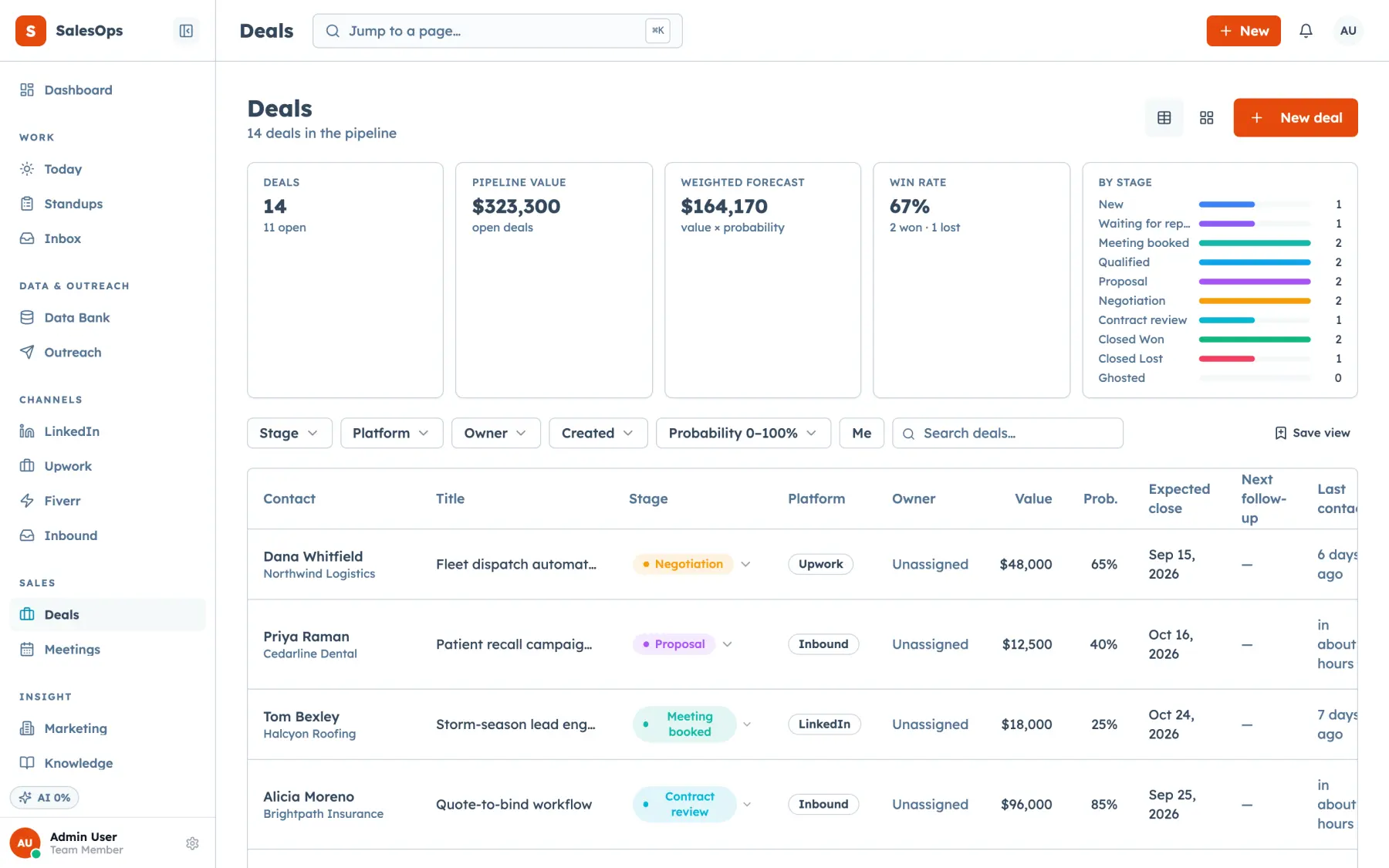
Switch when nobody is updating the database and follow-ups depend on memory. Stay if the pipeline is small, one person owns it, and it lives next to the notes and docs that give it meaning.
The short answer
- Notion Plus is $10 per member per month and Business is $20, which undercuts nearly every purpose-built CRM in this comparison. The saving stops being real once you add an automation tool and a sending tool beside it.
- Notion ships an official hosted MCP server with OAuth, plus an open-source one you can run yourself. If AI access is why you are shopping, you may already have it.
- The failure mode is not a crash, it is drift. A Notion database never tells you a deal has gone quiet, so records fall out of date invisibly and nobody notices until a deal is lost.
How we compared these
Prices come from each vendor's own pricing page, checked in September 2026. Notion's exact annual per-tier figures did not render on its page when we checked, so only the monthly numbers appear here. Nothing is drawn from a review site.
Evaluated from Notion's own documentation and pricing, September 2026. We have not run it as a CRM in production. The pricing, the MCP endpoints and the credit-based agent pricing below are all checkable on Notion's site; nothing here reports on operating a pipeline in it.
The table separates holding information from acting on it, because that is the whole question with a Notion CRM. Notion is excellent at the first and does not attempt the second, and no feature comparison that blurs the two is useful.
Notion and its alternatives, compared
| Notion | Airtable | Close | HubSpot | Attio | folk | SalesCrew | |
|---|---|---|---|---|---|---|---|
| Entry paid price | Plus $10 per member/mo | Team $20 per user/mo annual | Solo $9 per user/mo annual, $19 monthly | $20 per seat/mo annual, $7 monthly | Plus $35 per seat/mo annual, $44 monthly | Standard $24 per member/mo annual | $299/mo flat, unlimited seats |
| Who gets billed | Every member | Only users who can edit a base | Every user | Every seat | Every seat; Plus caps at 10 | Every member | Nobody. Seats are unlimited |
| Holds deals and notes together | Yes, its real strength | Yes, as structured records | Notes on records | Notes on records | Notes on records | Notes on records | Notes, tasks, meetings and timeline on the record |
| Sends email | No | No | Yes, with calling | Sequences, not on purchased lists | No | Message quotas per member | Yes, cadences on your own mailbox pool |
| Tells you a deal has gone quiet | No | No | Yes, through tasks and sequences | Yes | No | Reminders on records | Yes, tasks, stalled-deal views and cadence steps |
| Suppression and bounce handling | A page you maintain by hand | A table you maintain by hand | For its own sends | Within its own policy | Not its job | Not its job | Enforced at audience freeze and re-checked at send |
| Official MCP server | Yes, hosted with OAuth, plus open source | Yes, all plans, no extra cost | Yes, three permission scopes | Yes, read and write | Yes, hosted with OAuth | Yes, hosted with OAuth | Yes. Every UI action has an MCP twin |
Figures checked on vendor pricing pages, September 2026.
The field, ranked for a team leaving a Notion CRM
1. Close
The cheapest real CRM here at $9 a user annually, near enough Notion's price, with calling and sequences included and a well-scoped MCP server. Best for: teams whose Notion pipeline went stale because nothing chased anything. Not for: teams who wanted the notes and docs alongside.
Read more2. HubSpot
$20 a seat annually, a free tier for two users, and everything a Notion database cannot do: sequences, forms, attribution and a real activity timeline. Best for: teams ready to stop assembling. Not for: cold outbound, which its policy restricts.
Read more3. Attio
The closest thing to Notion's flexibility with sales built in, at $35 a seat annually, with a free tier holding 50,000 records. Best for: teams who liked shaping their own structure. Not for: teams over ten seats on Plus, and it does not send either.
Read more4. SalesCrew
Pipeline, inbox, data bank and cadences in one Postgres project you own, with tasks and stalled-deal views that surface what Notion silently lets drift, plus unlimited seats. Best for: teams whose Notion CRM had an automation tool and a sending tool growing beside it. Not for: teams whose CRM value is that it sits next to their docs, which we do not replace. New product, no third-party reviews, no mobile app, custom fields on the roadmap. Disclosure: SalesCrew is our product.
Read more5. Airtable
The stronger database if structure rather than documents was the point, at $20 a user annually and billing only editors, with free MCP on every plan. Best for: teams whose Notion tables were straining. Not for: anyone who needs sending, which it also does not do.
Read more6. folk
$24 a member annually with no seat cap, built for relationship-led selling with light structure. Best for: teams whose Notion CRM was really a list of people they know. Not for: volume sending, given its per-member message quotas.
Read moreWhen to stay on Notion
Stay if the pipeline lives next to the thinking. Notion's genuine advantage over every CRM on this page is that a deal record sits beside the meeting notes, the proposal draft, the research and the internal debate about whether to pursue it. In a purpose-built CRM those things live in four places, and something is always missing when you need it.
Stay if one person owns the pipeline. The drift problem is a multi-person problem: a database goes stale when everybody assumes somebody else updated it. A founder or single seller working their own list in Notion has none of that, and a CRM would add process without adding information.
Stay if you already have the MCP server working. Notion's official hosted server with OAuth means an assistant can read and write your databases today, which is often the exact capability people go shopping for. If your complaint about Notion is that it cannot send email, buying a sending tool costs a fraction of replacing the system where all your context lives.
Questions
- Can Notion work as a CRM?
- As a place to record deals, notes and next steps, yes, and for a small team it is often enough. Plus is listed at $10 per member per month as of September 2026, which is cheaper than every purpose-built CRM here. What it cannot do is send an email, run a follow-up sequence, hold a suppression list, or tell you a message bounced.
- How does a Notion CRM usually fail?
- Quietly. Nothing breaks; things simply stop being updated. A database in Notion has no opinion about whether a deal has gone stale, so the record drifts from reality one week at a time. By the time anyone notices, the pipeline in Notion and the pipeline in people's heads are two different pipelines.
- Does Notion have an MCP server?
- Yes, an official hosted one with OAuth authorisation, plus an open-source server you can run yourself. So an AI assistant can already read and write your Notion databases, which is worth knowing before you switch tools specifically to get that capability.
- Is Notion cheaper than a real CRM?
- At $10 a member, cheaper than nearly all of them, though Close at $9 a user annually is comparable and is an actual CRM. The saving is real only if you are not also paying for an automation tool and a sending tool to make up the difference, which is where most Notion CRMs end up.