Attio alternatives
Attio is the modern CRM most teams shortlist. Six alternatives compared on the two things that actually catch people out: the seat cap and the missing outbound layer.
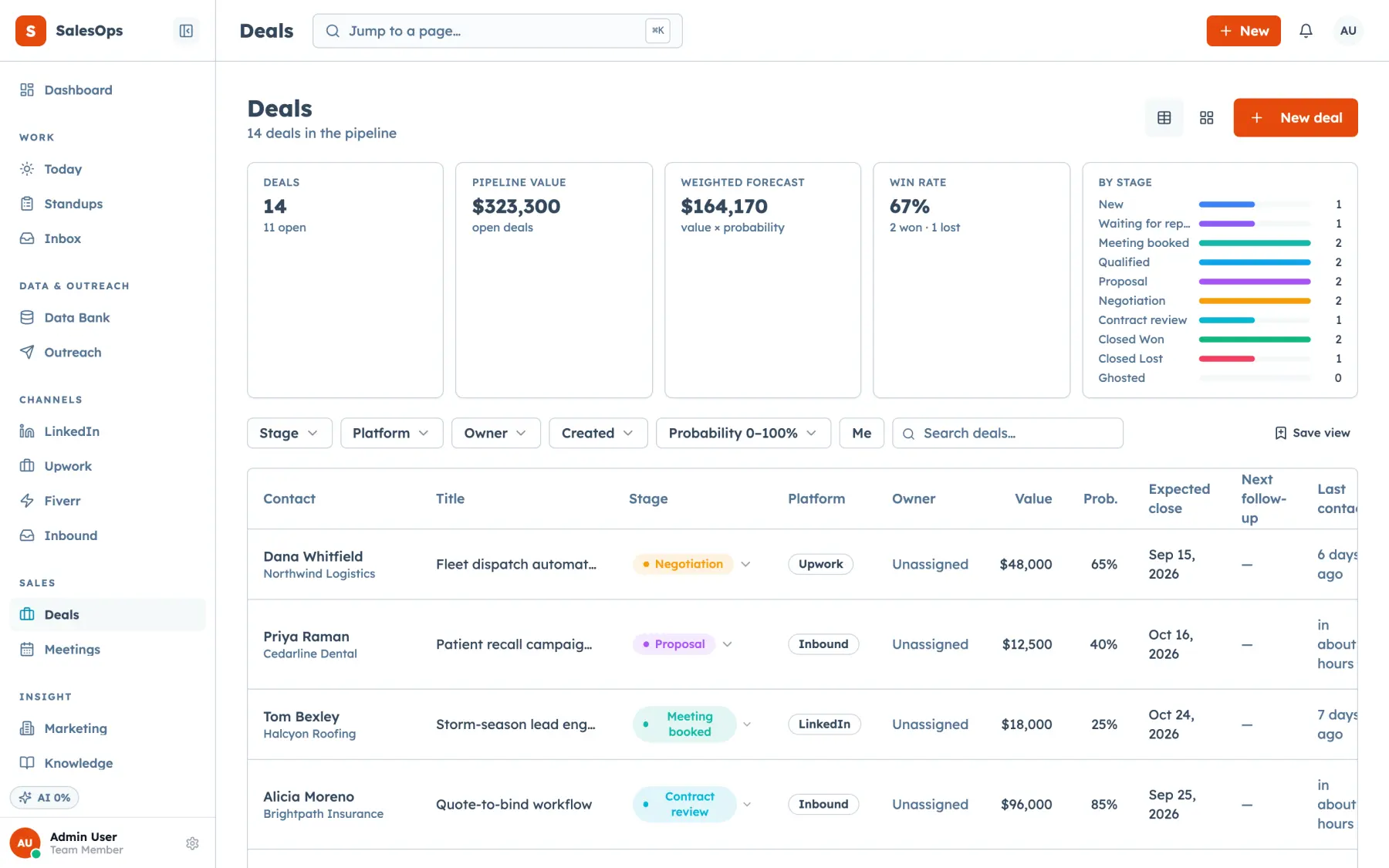
Switch if you are heading past ten seats on Plus, or if cold outbound needs to live in the same system as the pipeline. Stay if your team is under ten, your database is large, and the CRM is the whole job.
The short answer
- Attio Plus is $35 per seat per month billed annually and caps at ten seats. The eleventh person is a tier move to Pro, not an extra line on the invoice, which is the single most common surprise here.
- Record ceilings are Attio's strongest number: 50,000 on the free tier with three seats, 250,000 on Plus, a million on Pro. Most CRMs at this price cap the entry tier far lower.
- Attio does not send outbound at volume. That is a design choice, not a gap, but it means an outbound team runs two systems and maintains the sync between them.
How we compared these
Every price, cap and limit below is taken from the vendor's own pricing page in September 2026. Review sites and comparison directories were not used, because their numbers go stale and their sources are rarely traceable. Where a vendor does not publish something, the cell says so.
Evaluated from Attio's own documentation and pricing, September 2026. We have not run it in production. Everything here is checkable against Attio's site; there is no first-hand account of daily use, because we do not have one to offer.
The comparison focuses on seat economics, record ceilings, whether outbound is included and how an AI client connects. Those four decide most Attio replacements. Design quality, which is a large part of why teams choose Attio in the first place, is not something a table can settle and it is not attempted here.
Attio and its alternatives, compared
| Attio | folk | HubSpot | Close | Pipedrive | Airtable | SalesCrew | |
|---|---|---|---|---|---|---|---|
| Entry paid price | Plus $35 per seat/mo annual, $44 monthly | Standard $24 per member/mo annual, $30 monthly | $20 per seat/mo annual, $7 monthly | Solo $9 per user/mo annual, $19 monthly | Not published to automated checks; pages return 403 | Team $20 per user/mo annual | $299/mo flat, unlimited seats |
| Seat cap on the entry tier | 10 seats on Plus | None stated | None stated | None stated | Not confirmable | None stated; only editors are billed | None. Seats are unlimited on every tier |
| Record ceiling | Free 50,000, Plus 250,000, Pro 1 million | No stated cap; quotas on enrichment and messages | Free tier 1,000 contacts; Starter not stated | Solo caps at 10,000 leads | Not confirmable | Free-plan limits did not render on its page | Your own Postgres project. No vendor row cap |
| Outbound cadences included | No | Messaging quotas per member | Sequences, but not on purchased lists | Yes, with calling | Not confirmable | No | Yes, multi-step, on your own mailbox pool |
| Suppression and opt-out handling | Not its job | Not its job | Marketing tools handle it within its policy | Handled for its own sends | Not confirmable | A table you maintain by hand | Enforced at audience freeze and re-checked at send |
| Official MCP server | Yes, hosted with OAuth | Yes, hosted with OAuth | Yes, read and write | Yes, three permission scopes | Yes, native since June 2026 | Yes, on all plans at no extra cost | Yes. Every UI action has an MCP twin |
| Free entry | Free tier, 3 seats, no card | 2-week trial, no card | Free tier, 2 users | 14-day trial, no card | Not confirmable | Free plan for individuals | 14-day trial, card required |
Figures checked on vendor pricing pages, September 2026.
The field, ranked for a team leaving Attio
1. folk
The closest peer in feel and the cheaper one: $24 a member annually with no seat cap, and a two-week trial that does not ask for a card. Quotas sit on enrichment and messages rather than on records. Best for: relationship-led teams growing past ten people. Not for: high-volume sending.
Read more2. HubSpot
Cheaper per seat at $20 annually, far broader, and with a free tier for two users. It buys you marketing depth and an integration catalogue nothing else here matches. Best for: teams where marketing and sales share a funnel. Not for: cold outbound, which its policy restricts.
Read more3. SalesCrew
The answer if the seat cap is the problem and outbound is the other problem: one flat price with unlimited seats, cadences and suppression beside the pipeline in a Postgres project you own, and every action available to an AI client behind an approval queue. Best for: teams running two systems who want one. Not for: anyone who chose Attio for its interface, since ours is plainer, or who needs a mobile app or many native integrations. New product, no third-party reviews. Disclosure: SalesCrew is our product.
Read more4. Close
$9 a user annually, built around calling and email, with the most carefully scoped MCP server in this group. Best for: small teams whose day is phone calls. Not for: large databases, since Solo caps at 10,000 leads.
Read more5. Airtable
If what you liked about Attio was the flexible data model rather than the CRM, Airtable is the more honest version of that at $20 a user annually, billing only editors and shipping MCP on every plan. Best for: teams whose real need is a shaped database. Not for: anyone who wants sales workflow out of the box.
Read more6. Pipedrive
The conventional pipeline CRM, with a native MCP server in Claude's connector marketplace. Its pricing could not be verified because its pages return 403 to automated requests, so check the number before comparing. Best for: deal-stage discipline. Not for: flexible data modelling.
Read moreWhen to stay on Attio
Stay if you have a large database and a small team. Fifty thousand records on a free tier with three seats, and 250,000 on a $35 plan, is genuinely better than most of this market offers. A CRM that caps the entry tier at a few thousand contacts will cost you more the moment your list is real, and several here do exactly that.
Stay for the data model. Attio lets you shape objects and relationships to match how your business actually works, without the administrator that a heavier platform requires. That combination is rare. Most tools give you either flexibility with a specialist attached or simplicity with someone else's assumptions baked in.
Stay if the interface is why you chose it. This is not a soft reason. A CRM people avoid opening produces bad data, and bad data makes every downstream decision worse. If your team actually updates records in Attio, that habit is worth more than any feature on this page, and it does not survive a migration to something they like less.
Questions
- What is the ten-seat cap on Attio Plus?
- Attio's Plus plan is listed at $35 per seat per month billed annually and is capped at ten seats, as of September 2026. Growing past ten means moving to Pro rather than adding a seat, so the eleventh person is a tier change rather than an incremental cost. Worth modelling before you pick the plan.
- Does Attio do outbound sending?
- It is a CRM rather than a sending platform. Teams running cold outbound at volume generally pair a CRM like Attio with a dedicated tool such as Instantly or Smartlead, and then maintain a sync between the two. If that sync is the thing bothering you, the answer is not a different CRM, it is a different architecture.
- How good is Attio's record ceiling?
- Generous, and one of its better arguments. The free tier holds 50,000 records with three seats, Plus holds 250,000 and Pro holds a million. Compared with CRMs that cap the entry tier at a few thousand contacts, that is a real difference for anyone with a large database.
- Is Attio's MCP server worth choosing it for?
- On its own, no longer. Attio ships a hosted MCP server with OAuth, which was a differentiator a year ago and is close to standard now: HubSpot, Close, Pipedrive, Zoho, Monday, folk and Streak all publish one too. What still varies is permission granularity and whether the server is available on every tier.