What is an agent-operable CRM?
Ask your AI to move six deals and queue the follow-ups. A read-only CRM hands back a to-do list you still click through.
Want to see it first? Book a demo
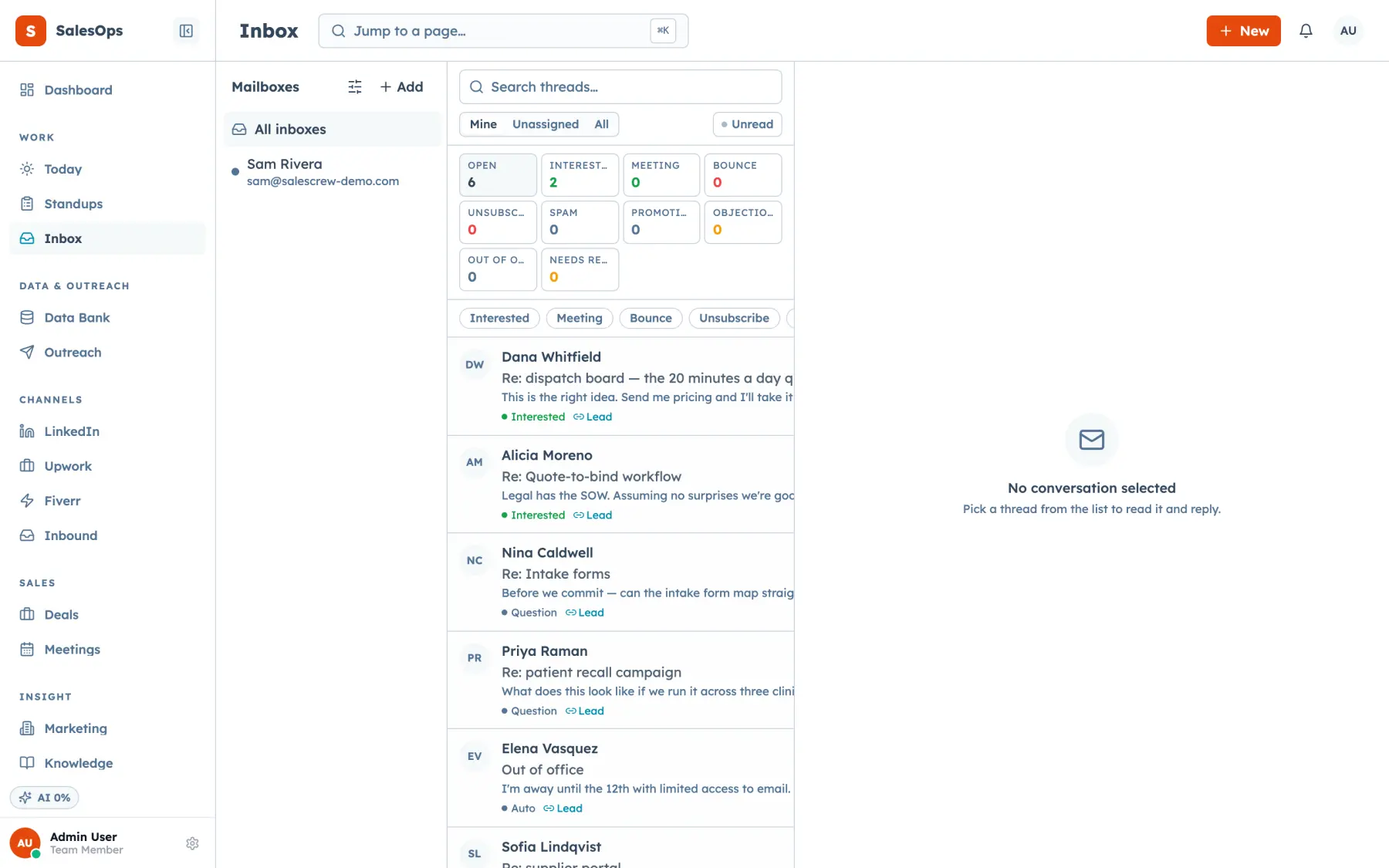
Agent-operable CRM — An agent-operable CRM is a CRM in which every action a person can take in the app is also a tool an AI agent can call, with the same permissions, the same result and a line in the same audit log. It lets an agent in Claude, ChatGPT or Cursor run the pipeline instead of only reading and summarising it.
Why the write path decides it
Most CRMs now let a chatbot answer questions about your records. Reading is the easy half. An agent-operable CRM also lets the agent write: create a deal, change a stage, enrol a contact in a cadence, draft a reply and put it up for approval. If an agent can only describe your pipeline, you still do the work.
The term describes a mechanism, so you can test for it. Pick any button in the app and look for a matching tool with the same effect. Most CRMs expose those tools through an MCP server, the open standard that Claude, ChatGPT and Cursor speak. The parity has a name, dual control: every action exists once in the interface and once as a tool.
Two readers care for different reasons. An operator wants an agent to clear the admin that eats a rep's afternoon. An agency owner running many client CRMs wants one set of agent tools in every instance. A workflow built once then runs everywhere.
Agent-readable vs agent-operable
Same agent, same question. What changes is whether the CRM gives it tools that write.
| What you ask the agent | Agent-readable CRM | Agent-operable CRM |
|---|---|---|
| Which deals stalled this week? | Lists them | Lists them |
| Move them to follow-up and set a task | Tells you which buttons to click | Changes the stage and creates the task |
| Draft a reply to this lead | Writes text you copy and paste | Saves the draft on the thread and queues it for approval |
| Who did what yesterday? | Summarises what it can see | Shows each tool call in the audit log, with the actor |
How to check if a CRM is agent-operable
Five checks, in the order a buyer can run them during a trial.
- 1
Pick five buttons
Create deal, change stage, send reply, add note, stop a cadence.
- 2
Find each tool
Every button needs a callable twin with the same effect.
- 3
Check the scope
An agent's token should carry the user's own permissions.
- 4
Send something risky
An outside email should wait for a person first.
- 5
Read the log
Each call should show who acted, when and on what.
The mistake to watch for
What the definition looks like in a live CRM
SalesCrew exposes 140+ MCP tools, each with a twin in the app that has the identical effect. Tokens are scoped by channel, profile and area, the same three axes the interface uses. Any outside send waits in one approval queue by default. Every tool call lands in the audit log with the user, token or agent that made it. The full list is on the MCP tools page.
Questions
- Is agent-operable the same as agentic?
- No. An agentic CRM runs its own agents inside the product. An agent-operable CRM gives any outside agent, in Claude, ChatGPT, Cursor or your own code, the same tools a person has in the app. A CRM can be both, and the two terms answer different buying questions.
- Does agent-operable mean an agent can act without a human?
- No. Agent-operable describes what an agent is able to call, not how much runs unattended. A well-run setup still holds outside sends, stage changes and deletes for a person to approve. Research, tagging and scoring usually run on their own.
- What makes a CRM agent-readable but not agent-operable?
- A connection that lets an agent search and summarise records, with no tool that creates, updates or sends anything. The agent can describe your pipeline but can't change it, so a person still does every click.
- How many tools does an agent-operable CRM need?
- One per action a user can take, so the count follows the size of the app. A CRM that covers records, inbox, cadences and approvals lands above 100 tools. The number matters less than parity: no button without a tool, and no tool without a button.