What is an AI-native CRM?
A term for who keeps the database current: a person typing, or a model acting under review.
AI-native CRM — An AI-native CRM is a customer relationship system designed so that models read, write and maintain the records as a matter of course, rather than a conventional CRM with an assistant bolted on. Its purpose is a database that stays current and acts on itself, with people approving what matters.
Why it matters
Most CRMs still assume a human updates every field. Someone logs the call, writes the note, moves the stage. An AI-native CRM turns that around: a model drafts the summary, proposes the stage change and prepares the reply, and a person reviews the parts that carry risk. The database stops going stale between logins.
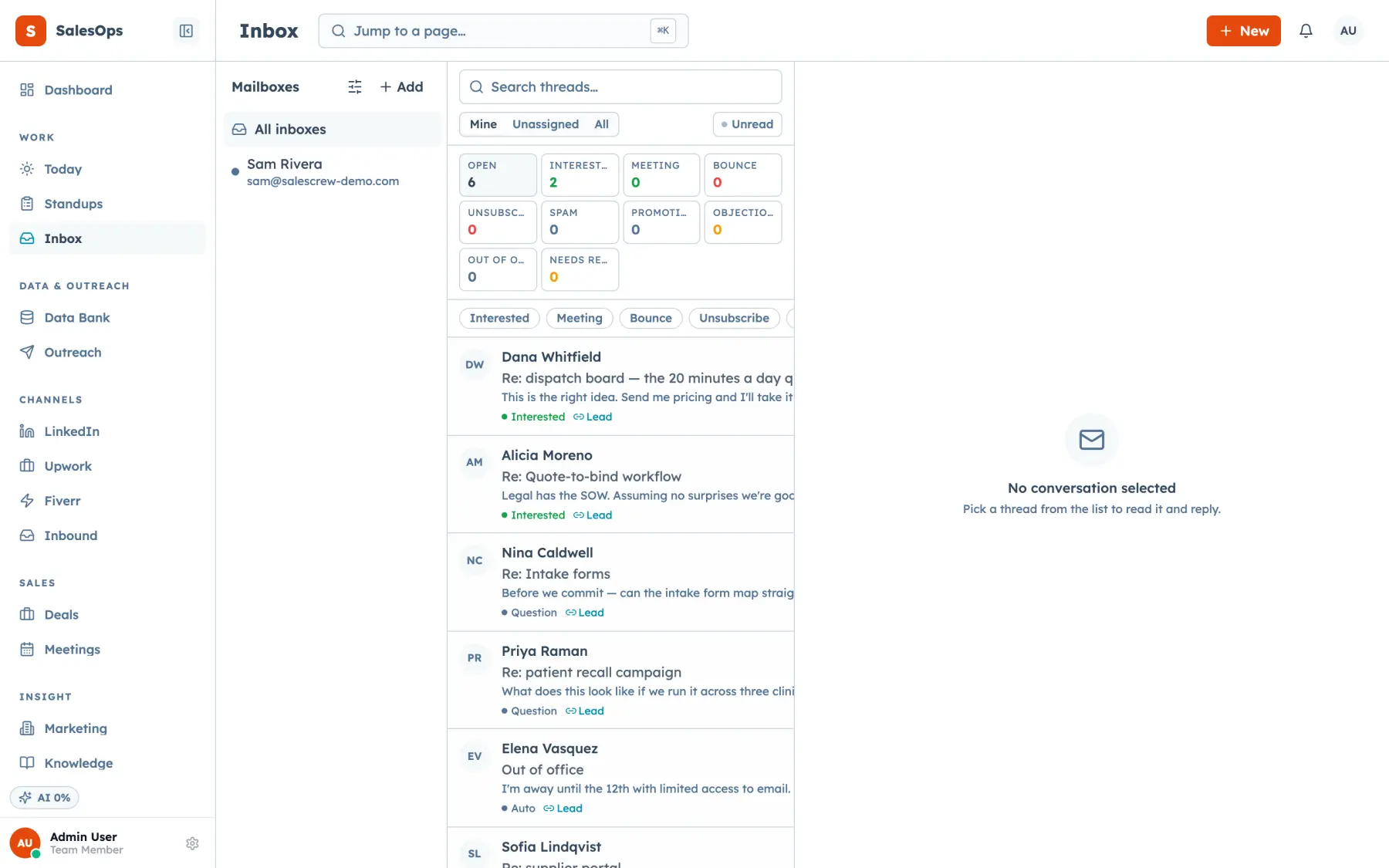
For a sales team, this changes what the job looks like. Instead of typing notes after every call, a rep spends time on the five decisions in the approval queue that morning. For an agency running several client instances, it means each client's records update themselves as activity happens, rather than during a monthly cleanup pass. The test is not whether the product has a chat box, but whether an agent can take the same actions a person can, through the same interface, with the same audit trail. In SalesCrew this is implemented as an approval queue that sits over every AI-proposed action across contacts, deals and the inbox.
How it works, step by step
- 1
Activity happens
A reply arrives, a call ends, a form is submitted, and an event lands in the database.
- 2
A model reads the record
It pulls the contact's history and the new event to work out what changed.
- 3
It proposes an update
A summary, a stage move, a scored lead, or a drafted reply, written but not sent.
- 4
A person reviews it
Low-risk updates apply automatically; anything external or costly waits for approval.
- 5
The record and the log both update
The change lands on the record, and who or what made it is written to the audit trail.
The mistake to watch for
Questions
- How is an AI-native CRM different from a traditional CRM with AI features?
- A traditional CRM with AI features adds isolated tools, like a subject-line generator or a summarizer, on top of a system a human still runs by hand. An AI-native CRM is built so a model can take the same actions a person can, across the whole record, under the same review controls.
- Does AI-native mean the AI acts without approval?
- No. Being AI-native describes what the system lets a model do, not how much of it runs unsupervised. Most AI-native CRMs put external or costly actions, such as sending a message or changing a deal stage, behind a human review step, and reserve unattended action for low-risk work like tagging or summaries.
- Is an AI-native CRM the same as an agent-operable CRM?
- They describe overlapping ideas from different angles. AI-native describes the CRM's design intent, built for models to maintain, not only query. Agent-operable is the mechanism that makes it true: every action exposed as a callable tool with the same permissions a person has.