What is human-in-the-loop AI in sales?
An agent that emails prospects with nobody reading first puts your domain and your name on every mistake it makes.
Want to see it first? Book a demo
Human in the loop (HITL) — Human-in-the-loop (HITL) AI in sales is a setup where AI agents prepare sales work, such as a follow-up email or a deal stage change, and a person approves, edits or rejects it before it reaches a buyer or the forecast. Its purpose is to get an agent's speed on routine work while a person keeps control of anything external or hard to undo.
Also known as: HITL
Where the person sits in a sales workflow
You don't need to check every step an agent takes. A wrong tag on a lead costs a click to fix. A wrong email to a prospect costs the deal, and a run of them can hurt your sending domain. HITL puts a person at the points where a mistake leaves the building.
In sales those points are few and easy to name: outside sends, stage changes, merges and deletes, and anything that spends money. Everything before them, from research to scoring to the first draft, can run on its own. You spend your time on decisions instead of data entry.
The control is usually set per agent, as a mode. The mode decides whether the agent's work lands as a draft, waits in an approval queue or runs straight away. A kill switch stops every agent at once when something looks wrong.
The four agent modes, from most to least human control
| Mode | What the agent does | Use it when |
|---|---|---|
| Off | Nothing | The agent isn't set up yet, or you've paused it |
| Draft | Writes the email or update and stops | You want to read its work before any queue |
| Review | Queues the action for a person to approve | The agent is new, or the action reaches a buyer |
| Auto | Runs and logs, and sends low-confidence work to review | The agent has a clean record on this action |
One follow-up email under human-in-the-loop
- 1
A reply arrives
The agent reads the thread and the deal.
- 2
It drafts the answer
Written on the thread, not sent.
- 3
Guardrails check it
Touch spacing, daily caps, send window.
- 4
You approve or reject
A rejection reason shapes the next draft.
- 5
It sends and logs
Suppression is checked again at send time.
The mistake to watch for
A default policy that starts every agent in review
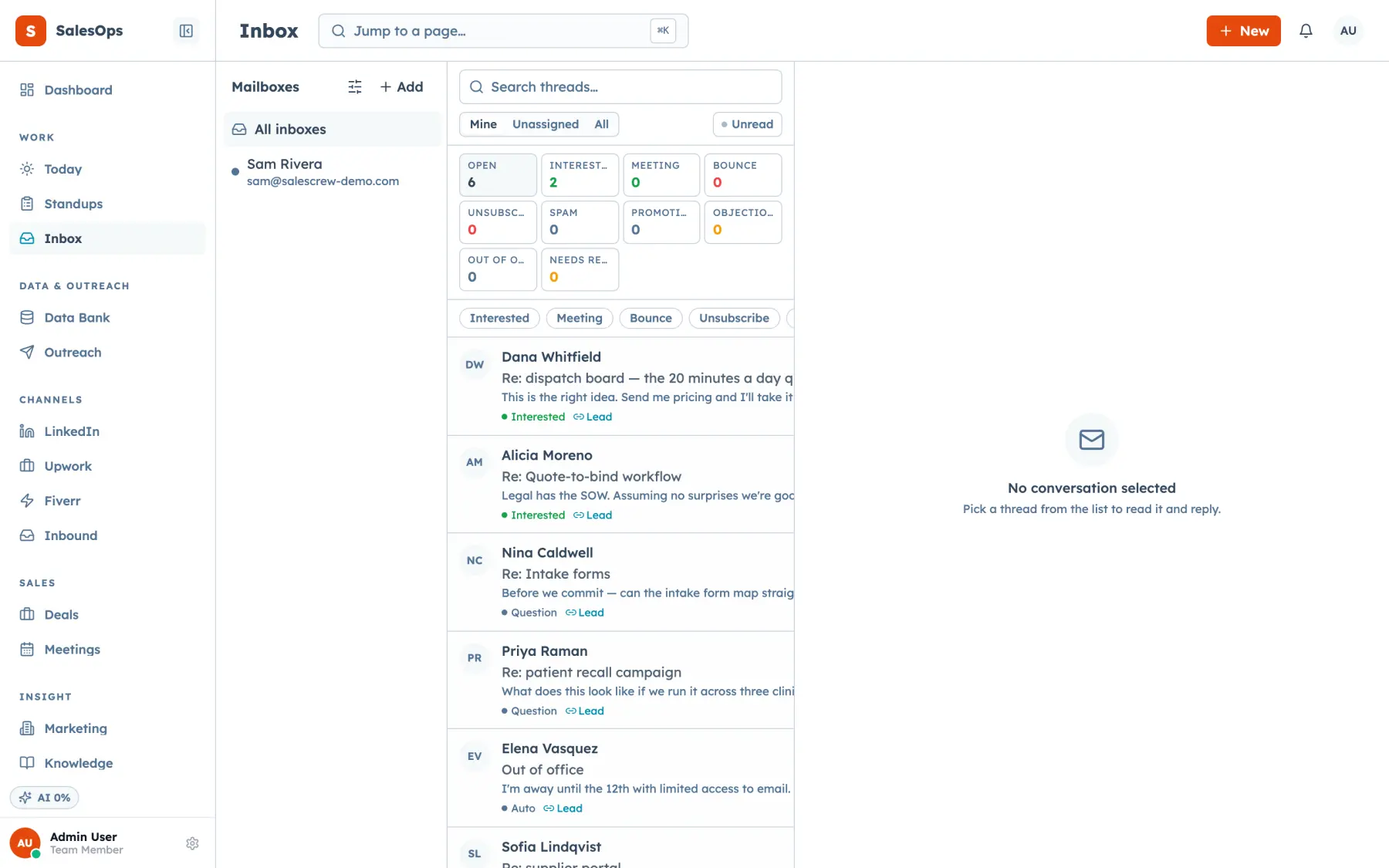
SalesCrew starts every agent in review. Research, tagging, scoring and reply classification run on their own, while any email, LinkedIn message or marketplace proposal waits for a person. Guardrails keep at least 3 days between touches to one contact, cap sends per mailbox and per domain each day, and re-check suppression at send time. The agents page shows each mode.
Questions
- What is the difference between human in the loop and human on the loop?
- Human in the loop means a person approves an action before it takes effect. Human on the loop means the system acts on its own and a person watches, ready to step in. Sales teams often run outside sends in the loop and internal work such as tagging on the loop.
- Does every AI action in sales need human approval?
- No, only the ones a buyer sees or that are hard to undo. Tagging, scoring, summaries and reply classification can run unattended. Emails, LinkedIn messages, stage changes and any spend are the usual review set.
- When should an agent move from review to auto?
- When its approvals on one action class have run clean for a set period, often a week. Move one action at a time, keep outside sends in review longest, and leave a confidence threshold in place so doubtful work drops back to a person.
- Is an AI SDR the same as human-in-the-loop AI?
- An AI SDR is usually sold to send on its own at volume. Human-in-the-loop AI does the same drafting and research but holds each outside send for a person. The difference is who presses send.