SalesCrew vs Clay
Clay is a data enrichment and workflow tool with deep waterfalls across 150+ providers. SalesCrew is a CRM with pipeline, cadences and an approval-gated AI layer. Closer to complementary than competing.
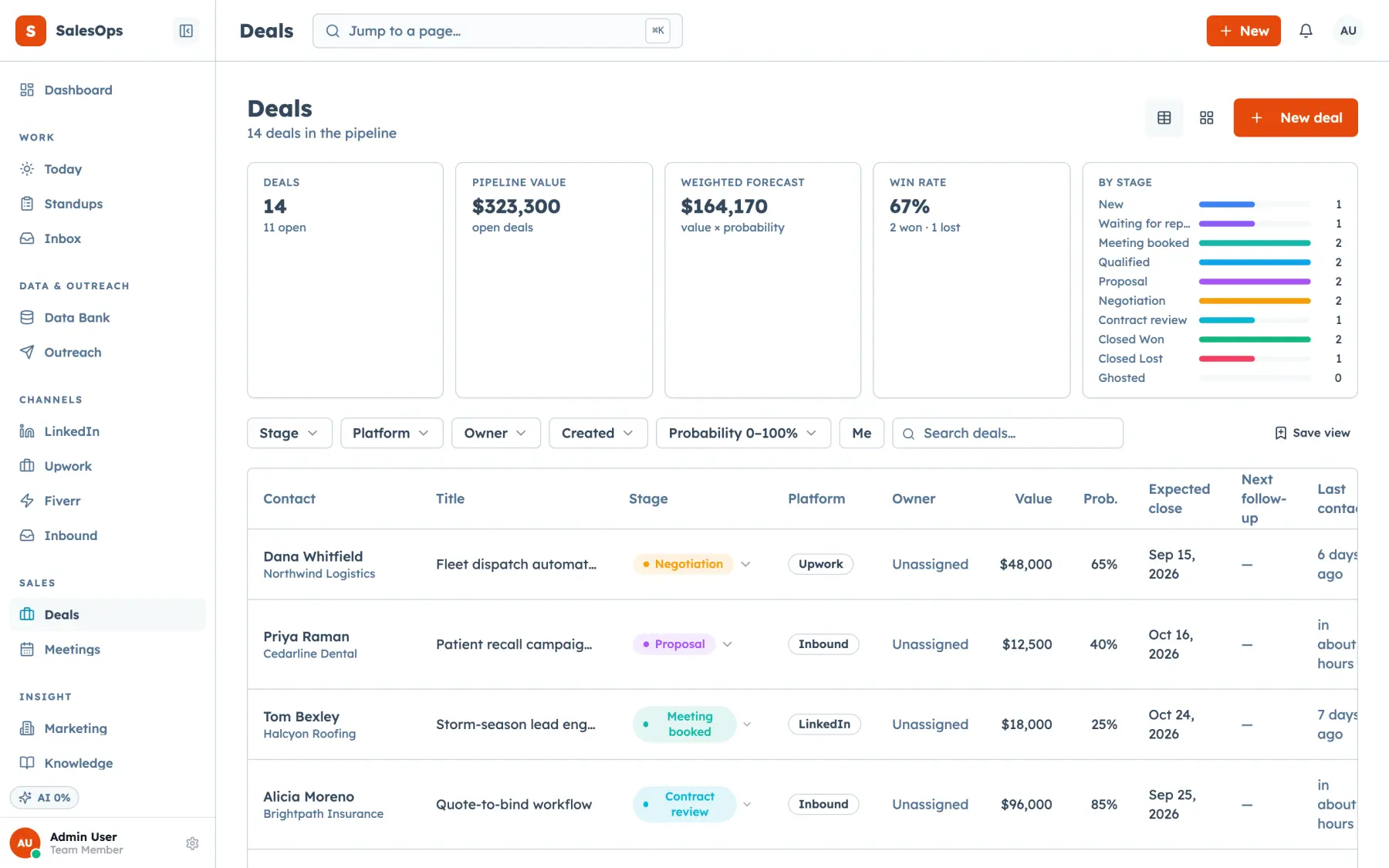
Choose Clay when the job is enrichment orchestration itself, running a waterfall across many data providers to fill in fields a list is missing. Choose SalesCrew when the job is what happens after that: running the pipeline, the cadence and the suppression list, with an approval queue over every AI-proposed send.
The short answer
- Clay is built for enrichment orchestration: 150+ data providers in a waterfall, credit-based per-field pricing, and a workflow builder for that job.
- SalesCrew is the system of record: pipeline, cadences, inbox and suppression in one database, with every AI-proposed send waiting in one approval queue.
- These are complementary more than competing: Clay finds and fills in the data, SalesCrew runs the pipeline and outbound once the record exists in the system of record.
SalesCrew vs Clay at a glance
| Dimension | SalesCrew | Clay |
|---|---|---|
| Price | $299–$1,200/mo, unlimited seats on every tier | Free; Launch from $54–167/mo; Growth from $185–446/mo; Enterprise custom |
| Seats | Unlimited on every tier | Unlimited seats on all plans; usage priced by actions and data credits instead |
| Cold outbound policy | Suppression enforced at audience freeze, sender pool, deliverability loop | Email campaign integrations on Launch+; not a sending platform itself |
| Data ownership / export | One Supabase project per client; full Postgres + CSV export | Table export; data credits and actions metered separately from seats |
| Data enrichment breadth | Provider connections (such as Apollo) for import and enrich | 150+ data providers in configurable waterfalls, per Clay's own site |
| AI approval controls | Every AI action queues for review by default before anything external sends | Claygent AI agent runs research/enrichment tasks; no send-approval queue, since Clay isn't a sending platform |
| Agent API / MCP | 140+ tools over MCP, one per UI action | HTTP API integrations on Growth+ |
| Voice / SMS | Outbound calls through Vapi, phone numbers and two-way SMS, logged on the contact timeline | Not a feature of the product |
| Integrations breadth | Connects via webhooks, API and 140+ MCP tools | 150+ native data-provider integrations plus CRM auto-sync and warehouse syncs |
| Mobile app | Responsive web | See clay.com |
| Best for | Running pipeline, cadences and suppression after a record exists | Enrichment orchestration across many data providers before a record is outreach-ready |
Figures checked on vendor pricing page, September 2026 (clay.com/pricing). SalesCrew figures from the SalesCrew product fact sheet, September 2026.
What each one does well
SalesCrew
- Suppression enforced at audience freeze and an approval queue over every AI action
- One Supabase project per client, with full export on churn
- Pipeline, cadences and inbox built in as the product, not assembled
Clay
- 150+ data providers in configurable enrichment waterfalls
- Unlimited seats on every plan; cost scales with usage instead
- A workflow builder purpose-built for GTM data orchestration
- Email campaign integrations on Launch and above connect it to a separate sending tool
How to choose
These tools rarely compete for the same budget line because they solve different steps in the same workflow. Clay's job is turning a thin list into a rich one, running an email through five enrichment providers in sequence until one returns a verified phone number or a job title Clay didn't have before. SalesCrew takes that record once it is ready and puts it to work.
SalesCrew's job starts once a record is ready to work: which cadence it enters, whether an AI-drafted follow-up needs a person to approve it before sending, what stage the deal moves to when a reply comes in. Every one of those actions is also an MCP tool, so an agent can run it too.
Most teams that use Clay seriously end up piping its output into a CRM anyway, since a spreadsheet of enriched leads isn't a pipeline. SalesCrew is a reasonable landing spot for that output, connected through Clay's own CRM auto-sync or a webhook, without either tool duplicating what the other already does well.
Questions
- Can you use SalesCrew and Clay together?
- Yes, and it's arguably the more common pairing than choosing one over the other. Clay's enrichment waterfalls can push finished records into a CRM through its CRM auto-sync feature or a webhook, which SalesCrew accepts on the way in. Clay does the enrichment orchestration; SalesCrew runs the pipeline and cadence once the record lands.
- How do you move records between Clay and SalesCrew?
- Clay's Growth tier and above support CRM auto-sync and HTTP API integrations, which can write enriched records directly into SalesCrew through its API or a webhook, rather than a manual CSV export. Records already in SalesCrew can be enriched by pointing a Clay table at SalesCrew's API to pull them, run a waterfall, and sync results back.
- What does SalesCrew cost next to Clay?
- SalesCrew is $299, $699 or $1,200 a month, with unlimited seats on every tier. There is no per-field credit to track for pipeline work. Clay prices by actions and data credits, so the two bills measure different things. A 14-day trial is available; a card is required to start it.
- How does SalesCrew gate AI-proposed sends?
- Every agent ships in review mode. Any external send waits in one approval queue, with the draft, the evidence, a confidence score and the cost shown. A person approves, edits or rejects it. Suppression is re-checked at send time, and one kill switch stops every agent.