SalesCrew vs Apollo
Apollo is a sales intelligence platform built around a large B2B contact database. SalesCrew is a CRM with its own approval-gated AI layer that uses providers like Apollo to source contacts, not to replace one.
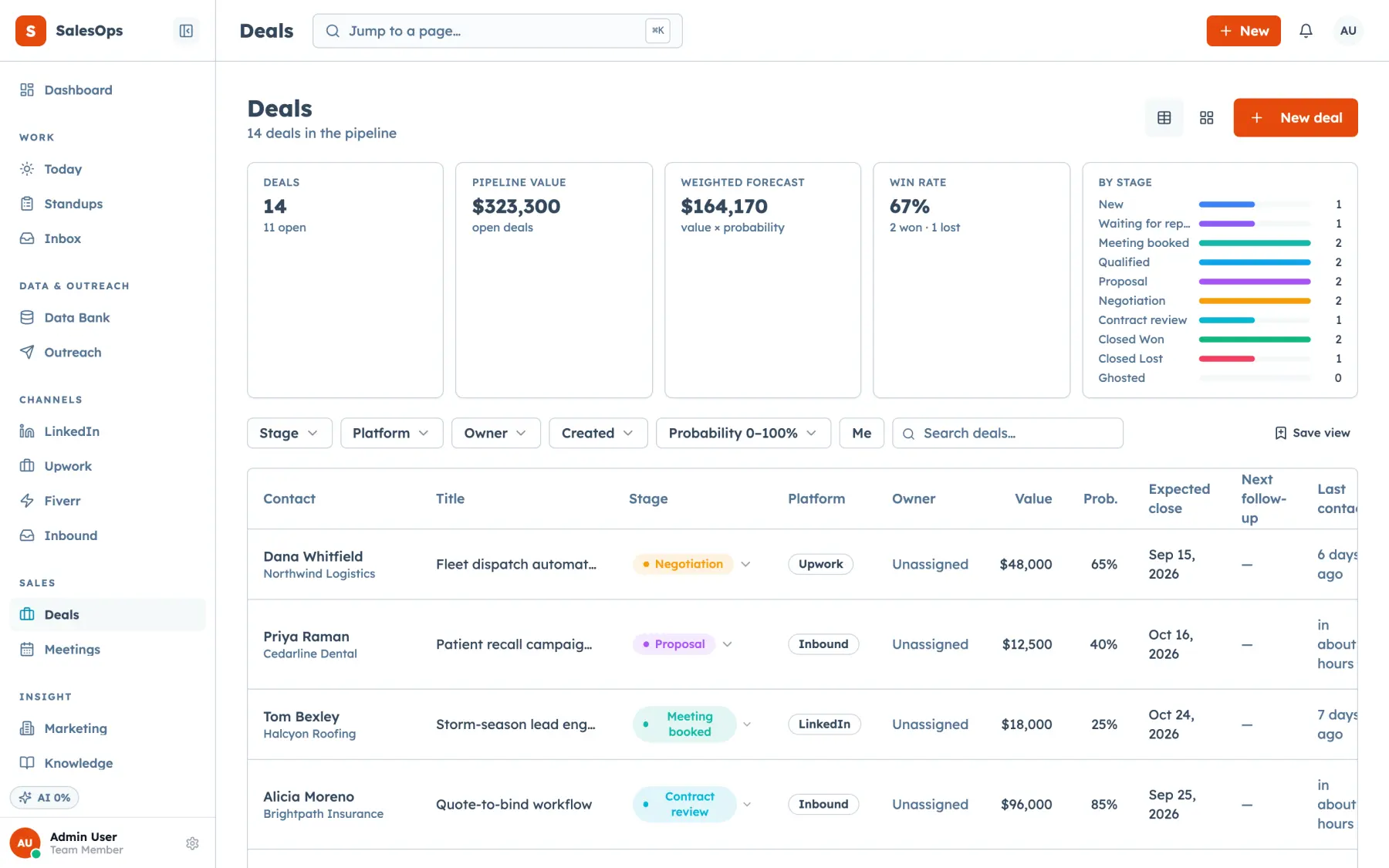
Choose Apollo when the priority is finding new contacts at scale from a large B2B database with built-in sequencing. Choose SalesCrew when the priority is running the pipeline and outbound that happens after contacts exist, with suppression, an approval queue and a database your team owns.
The short answer
- Apollo's own database, claimed at 240M+ contacts and 30M+ companies on its site, is real scale that SalesCrew does not attempt to match; SalesCrew has no contact database of its own and imports from providers like Apollo instead.
- SalesCrew's approval queue sits over every AI-proposed external action by default; Apollo's AI features assist prospecting and sequencing without one central review gate across an account.
- These solve adjacent but different problems: Apollo is strongest at finding who to contact, SalesCrew is strongest at running what happens once that contact enters a pipeline.
SalesCrew vs Apollo at a glance
| Dimension | SalesCrew | Apollo |
|---|---|---|
| Price | $299–$1,200/mo, unlimited seats on every tier | Free Starter plan; paid plans billed per seat plus a credit system, priced from apollo.io |
| Seats | Unlimited on every tier | Per-seat pricing on paid plans |
| Cold outbound policy | Suppression enforced at audience freeze, sender pool, deliverability loop | Built-in sequences with A/B testing; credit-metered sending and exports |
| Data ownership / export | One Supabase project per client; full Postgres + CSV export | CSV export of records; credits consumed per export |
| Own contact database | None; imports and enriches via provider connections like Apollo | 240M+ contacts and 30M+ companies, per Apollo's own site |
| AI approval controls | Every AI action queues for review by default before anything external sends | AI-assisted prospecting and sequencing; no single cross-account approval queue |
| Agent API / MCP | 145+ tools over MCP, one per UI action | REST API on higher tiers; no MCP server |
| Voice / SMS | On the roadmap (P1), not shipped | Not a core feature; sequences are primarily email and task-based |
| Integrations breadth | Fewer native listings; connects via webhooks, API and MCP | Native connections to Salesforce, HubSpot, Outreach, SalesLoft and others |
| Mobile app | Responsive web only, no native app | Mobile credits referenced on the pricing page; primarily a web product |
| Best for | Running pipeline and outbound after contacts exist, with suppression and review built in | Sourcing and enriching new contacts from a large existing database |
Figures checked on vendor pricing and product pages, September 2026 (apollo.io/pricing, apollo.io). SalesCrew figures from the SalesCrew product fact sheet, September 2026.
Where each product holds up, and where it doesn't
SalesCrew
- Suppression enforced at audience freeze and an approval queue over every AI action
- One Supabase project per client, with full export on churn
- Unlimited seats on every tier
- No contact database of its own; sourcing depends on a provider connection like Apollo
- New product: no customers yet, and no third-party reviews yet
- Fewer native integrations than Apollo's connections to established sales tools
Apollo
- A large, established B2B contact and company database
- Native integrations with major CRMs and sequencing tools
- Sequencing and prospecting features built for volume sourcing
- No single approval queue gating AI-proposed sends across an account
- Credit-metered exports and sending add a second cost dimension beyond the seat price
- Not built as a system of record for a full pipeline the way a dedicated CRM is
How to choose
The honest framing is that these tools do different jobs more than they compete head to head. Apollo's strength is finding people: a database large enough that most B2B searches turn up something, with sequencing built in to reach them. If the bottleneck is sourcing, running out of contacts or needing enrichment on the ones already on file, Apollo's own database does that work in a way SalesCrew, with no database of its own, cannot.
SalesCrew's strength starts after that: what happens once a contact is in a pipeline, whether an AI-drafted reply gets sent without a person checking it first, whether a contact who unsubscribed six months ago still gets emailed by a new campaign. Suppression enforced at audience freeze and an approval queue over every external send are the specific controls SalesCrew adds that a sourcing tool doesn't need to have.
Plenty of teams run both: Apollo to find and enrich the list, SalesCrew to run the cadence, track the deal and keep an audit log of what an agent actually did. Neither replaces the other's core job.
Questions
- Can you use SalesCrew and Apollo together?
- Yes, and it's a common setup. Apollo's fact sheet lists it as a data-source provider inside SalesCrew today: contacts and companies found in Apollo import and enrich into SalesCrew's own database, where cadences, suppression and the pipeline take over. Apollo supplies the data; SalesCrew runs the outbound and tracks the deal.
- How do you move contacts from Apollo into SalesCrew, or the other way?
- Apollo contacts come into SalesCrew through the existing import/enrich provider connection, not a manual CSV round-trip. Moving records the other direction, out of SalesCrew, uses SalesCrew's own export: a full Postgres dump or CSV per object, since every client's data lives in its own database and isn't locked to a proprietary format.
- Why would I choose a brand-new CRM with no reviews over Apollo, which has a large customer base?
- If sourcing volume and data breadth are the priority, that's a real point in Apollo's favor: it has spent years building a database at a scale SalesCrew doesn't attempt to match on its own. SalesCrew's case is different: it's a CRM and outbound system with an approval queue over every AI action and its own database per client, and it uses Apollo as a data source rather than competing to build one.
- Does Apollo have anything like SalesCrew's approval queue for AI actions?
- Not as a single cross-account concept. Apollo's AI features assist with prospecting, sequence writing and scoring, but there's no one queue where every AI-proposed send, across every sequence, waits for a person to approve, edit or reject it before it goes out. That review-first default is specific to SalesCrew's agent design.