SalesCrew vs Airtable
Airtable is a flexible database that many sales teams stretch into a CRM with linked tables and automations. SalesCrew is a CRM built for pipeline and outbound from the start.
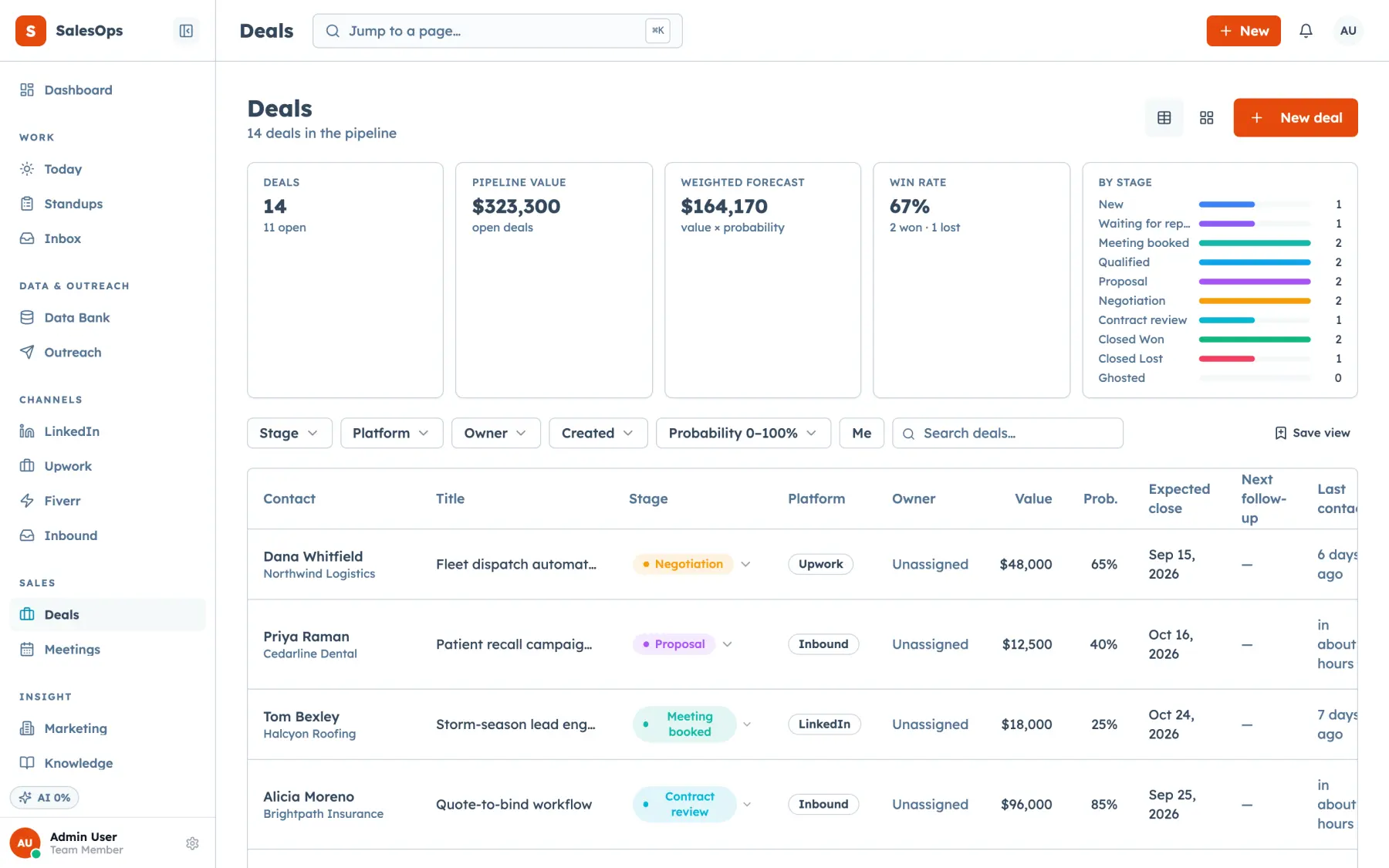
Choose Airtable when the job is a flexible database with a large app ecosystem and a visual builder, and cold outbound isn't the core workflow. Choose SalesCrew when the job is running pipeline and cold outbound with suppression built in, and every AI action needs to pass through one approval queue before it does anything external.
The short answer
- Airtable is not a CRM out of the box; teams build one from a base, and how good that CRM is depends entirely on how it's built, since Airtable ships no pipeline, suppression list or cadence engine of its own.
- SalesCrew ships pipeline stages, cadences, suppression and an inbox as native objects, not something assembled from linked tables and automation scripts.
- Airtable's app ecosystem and integration marketplace are larger and more mature than SalesCrew's; most of SalesCrew's connections go through webhooks, the API and MCP rather than a native app listing.
SalesCrew vs Airtable at a glance
| Dimension | SalesCrew | Airtable |
|---|---|---|
| Price | $299–$1,200/mo, unlimited seats on every tier | Free; Team $20/user/mo, Business $45/user/mo (annual), Enterprise custom |
| Seats | Unlimited on every tier | Per-seat for anyone with edit access; view-only collaborators are free |
| Cold outbound policy | Built for it: suppression enforced at audience freeze, sender pool, deliverability loop | No native cold-outbound controls; teams bolt on a mail-merge extension or a separate tool |
| Data ownership / export | One Supabase project per client; full Postgres + CSV export | CSV export per table; no dedicated database instance per customer |
| AI approval controls | Every AI action queues for review by default before anything external sends | Airtable AI can write and transform data in a base; no single cross-workspace approval queue for AI actions |
| Agent API / MCP | 145+ tools over MCP, one per UI action | REST API and a scripting extension; no MCP server |
| Voice / SMS | On the roadmap (P1), not shipped | Not a feature of the product |
| White-label | Branding controls per instance; no white-label mobile app | Not offered |
| Integrations breadth | Fewer native listings; connects via webhooks, API and MCP | Native marketplace plus Zapier/Make; broad, mature ecosystem |
| Mobile app | Responsive web only, no native app | Native iOS and Android apps |
| Best for | Teams running cold outbound and pipeline who want AI actions gated behind one review queue | Teams that want a flexible database with a visual builder and don't need outbound-specific controls |
Figures checked on vendor pricing pages, September 2026 (airtable.com/pricing). SalesCrew figures from the SalesCrew product fact sheet, September 2026.
Where each product holds up, and where it doesn't
SalesCrew
- Suppression, cadences and an approval queue as native objects, not assembled from automations
- One Supabase project per client, with full export on churn
- 145+ tools over MCP with a UI twin for every one
- New product: no customers yet, and no third-party reviews yet
- No native mobile app; responsive web only
- Fewer native integrations than Airtable's marketplace; most connections go through webhooks and the API
Airtable
- Large, mature integration and app ecosystem
- Native iOS and Android apps
- A genuinely flexible builder for databases that aren't sales pipelines at all
- No native suppression list, cadence engine or outbound-specific controls; a CRM has to be built and maintained by hand
- No single approval queue gating AI-proposed actions across a workspace
- Per-seat pricing on paid tiers, so cost climbs with headcount
How to choose
Start with what's actually being built. If the plan is a general-purpose database, a content calendar, an ops tracker, an inventory list, Airtable is the better tool: its builder, its linked-table model and its app ecosystem exist for exactly that kind of flexible structure. Trying to make a spreadsheet-database behave like a CRM with suppression and cadences means building all of that by hand with automations, and maintaining it as the team's process changes.
If the job is specifically outbound and pipeline, cold email at volume with suppression that's actually enforced, cadences that advance contacts through steps, an inbox that threads replies, SalesCrew ships those as the product rather than as a base someone configured. The tradeoff is real: Airtable's integration marketplace and mobile apps are more mature, and SalesCrew is a new product without the review history Airtable has built up over years.
Some teams keep both, Airtable for internal operations that aren't sales-shaped, SalesCrew for the pipeline and outbound work, connected by a webhook when a record needs to move between them.
Questions
- Can you run SalesCrew and Airtable together?
- Yes. A common pattern is running SalesCrew as the system of record for contacts, deals and outbound, and keeping Airtable for the things it's genuinely better at: a content calendar, an internal ops tracker, a lightweight database for a process that isn't sales at all. SalesCrew's webhooks and API can push records into an Airtable base if a team wants a mirror there, though nothing in SalesCrew requires it.
- How hard is it to move data from an Airtable CRM base into SalesCrew?
- Airtable exports any base to CSV, which is the same format SalesCrew's contact and company import expects, so the move is a file export and a re-import, then a pass to check field mapping and any linked-record relationships Airtable represented as links between tables rather than a single flat table. Teams that built a heavily customized Airtable CRM with many linked tables should expect that mapping pass to take longer than the export itself.
- Why would I choose a brand-new CRM with no reviews over Airtable, which has thousands?
- If the deciding factor is track record, Airtable's is longer and better documented right now, and that's a legitimate reason to pick it. SalesCrew's case is different: it's purpose-built for outbound and pipeline with suppression, cadences and an approval queue as native objects, not a spreadsheet feature repurposed for sales. If that specific workflow is the job, SalesCrew does it without the linked-table workarounds a spreadsheet-database needs to behave like a CRM.
- Does Airtable have anything like an approval queue for AI actions?
- Not as a built-in concept. Airtable AI can generate and transform data inside a base, and Airtable's automation builder can run scripted or AI-assisted steps on a trigger, but there's no single queue across a workspace where every AI-proposed action waits for a person to approve, edit or reject it before anything external happens. That's a SalesCrew-specific control, not an Airtable one.