HubSpot vs Pipedrive
A broad marketing-and-sales platform against a sales-first pipeline CRM. The comparison mostly turns on whether marketing tools are needed beside the pipeline.
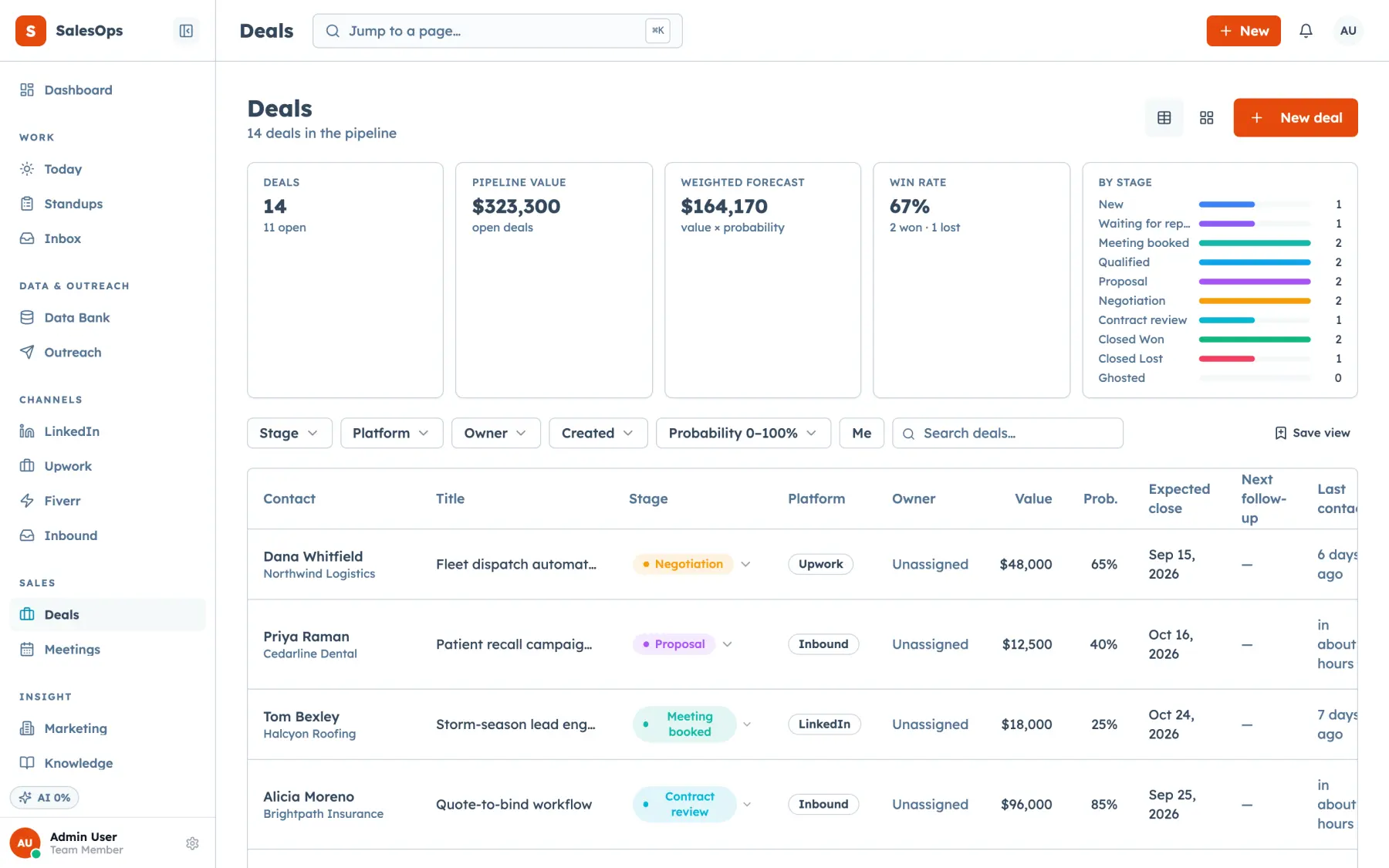
Choose HubSpot when the company wants marketing and sales tools integrated in one platform and can absorb per-seat and contact-tier costs as it scales. Choose Pipedrive when the need is specifically a focused, visual sales pipeline without marketing automation bundled in.
The short answer
- HubSpot Sales Hub has a real free tier (up to 2 users). It then scales through $7, $90, and $150 per seat per month. Professional and Enterprise add one-time onboarding fees of $1,500 and $3,500.
- Pipedrive's own pricing page returned a bot-detection block on every direct check for this comparison. Its tier structure is publicly well known. Current dollar figures were not independently verified here.
- HubSpot's core strength is breadth. Marketing, sales, service, and content tools share one contact database. That matters most for companies running inbound marketing beside sales.
- Pipedrive's core strength is focus. A visual, stage-based pipeline built as the primary interface, without the marketing-platform features a pure sales team may never touch.
HubSpot vs Pipedrive at a glance
| Dimension | HubSpot (Sales Hub) | Pipedrive |
|---|---|---|
| Starting price | $0/month (Free, up to 2 users); $7/seat/month (Starter) | Pricing on request; vendor page could not be verified directly as of September 2026 |
| Mid/top tier | $90/seat/month (Professional, +$1,500 onboarding); $150/seat/month (Enterprise, +$3,500 onboarding) | Pricing on request |
| Pipeline management | Included; 1-2 pipelines on Free/Starter, up to 15 on Professional, 100 on Enterprise | The product's core strength; visual, drag-and-drop pipeline is the primary interface |
| Marketing tools | Deep integration available via Marketing Hub (sold separately or bundled); Sales Hub alone includes basic email tools | Not core to the product; sales-focused, marketing typically handled via integration |
| Reporting/forecasting | Included on Professional and Enterprise, with more depth at higher tiers | Available; specific tier gating not verified for this comparison |
| Free tier | Yes, genuinely free for up to 2 users with core CRM tools | No confirmed free tier; typically offers a free trial instead |
| Onboarding cost | One-time $1,500 (Professional) or $3,500 (Enterprise) fee on top of the subscription | Not confirmed for this comparison |
| Best for | Companies wanting marketing and sales tools integrated in one platform, with budget for per-seat and onboarding costs at higher tiers | Sales teams wanting a focused, visual pipeline without marketing-platform overhead |
Figures checked on vendor pricing pages, September 2026. HubSpot: hubspot.com/pricing/sales (direct fetch succeeded). Pipedrive: pipedrive.com/en/pricing returned a bot-detection page ('Attention Required') on every direct attempt; rows above avoid stating an unverified price rather than estimating one.
Where each platform holds up, and where it doesn't
HubSpot
- A genuine free tier and one of the best-documented products in the category, with a large library of guides and templates
- Marketing, sales, and service data live in one system, useful for a company actually running inbound marketing campaigns alongside its sales pipeline
- Professional and Enterprise pricing adds one-time onboarding fees ($1,500 and $3,500) on top of per-seat costs, which most price comparisons leave out
- A pure sales team that never touches the marketing tools is still paying for a platform built around a broader use case than it needs
Pipedrive
- Purpose-built as a sales pipeline first, which tends to mean a shorter learning curve for reps who just need to move deals through stages
- Known for a large third-party integration marketplace, letting a team add marketing or calling tools only if and when it actually needs them
- Current pricing was not verifiable directly from the vendor for this comparison, which is itself a reason to confirm the exact figure before budgeting
- No integrated marketing platform the way HubSpot has, so a team that later wants inbound marketing tools is adding a second system rather than expanding the one it has
How to choose
Start by being honest about whether marketing tools are needed, not only nice to have. A company running content, email campaigns, and lead scoring as a real part of its growth motion gets real value from having that data live next to the sales pipeline in HubSpot. A company whose leads mostly come from referrals, outbound, or a separate marketing function is paying for capability it will not use if it buys HubSpot for the sales team alone.
Price the tier the team will run, including the parts that do not show up on the homepage. HubSpot's Professional and Enterprise onboarding fees, $1,500 and $3,500, are a real one-time cost on top of the monthly per-seat price. They change the total first-year math for a growing team. Confirm Pipedrive's current tier pricing directly on its site before comparing. It could not be independently verified for this comparison.
If the team is small and the need is narrowly a sales pipeline, Pipedrive's focus is generally the simpler starting point. If the company plans to grow into a full marketing-and-sales motion under one roof, HubSpot's breadth becomes more valuable the more of the platform gets used. That is also exactly when its per-seat and onboarding costs start to add up.
Questions
- Can you use both HubSpot and Pipedrive?
- Some companies run HubSpot for marketing (email campaigns, landing pages, lead scoring) while a separate sales team runs deals in Pipedrive. They sync contacts between the two through an integration. It is a workable split for companies with separate marketing and sales tooling budgets. It means paying for and maintaining two systems instead of one. Confirm HubSpot's own sales pipeline does not already cover the need before adding a second tool.
- How hard is it to switch from HubSpot to Pipedrive, or the other way?
- Contacts, deals, and notes export and import reasonably well between the two. What is harder to move is anything built on HubSpot's marketing side. Email sequences, lead scoring, workflow automation tied to marketing content. Pipedrive is not built as a marketing platform and has no equivalent to migrate into. A company moving from HubSpot to Pipedrive because it only ever used the sales side finds the switch easier than one that also relied on HubSpot's marketing tools.
- Which one is cheaper?
- HubSpot's Sales Hub has a genuine free tier for up to 2 users. Then $7/seat/month (Starter), $90/seat/month (Professional, plus a $1,500 onboarding fee), and $150/seat/month (Enterprise, plus a $3,500 onboarding fee). Pipedrive's own pricing page could not be verified directly for this comparison as of September 2026, due to a bot-detection block. Its Essential-through-Enterprise tier structure is well known publicly. Current dollar figures were not independently confirmed here.
- Do I need HubSpot's marketing tools if I only want a sales CRM?
- No. Paying for them when you do not need them is a common way companies overspend on HubSpot. Sales Hub can be bought on its own without Marketing Hub. The free and Starter tiers are built around exactly that: a sales pipeline, deal tracking, and basic email tools without content, SEO, or campaign management. Pipedrive is built as a sales-only tool from the start. A company with no marketing-automation need may find it the simpler, more focused option whatever the price.