Aircall vs a CRM With Calling Built In
Aircall is a phone system built to plug into a CRM. A CRM with calling built in keeps the call, the recording, and the deal record in one database instead of two.
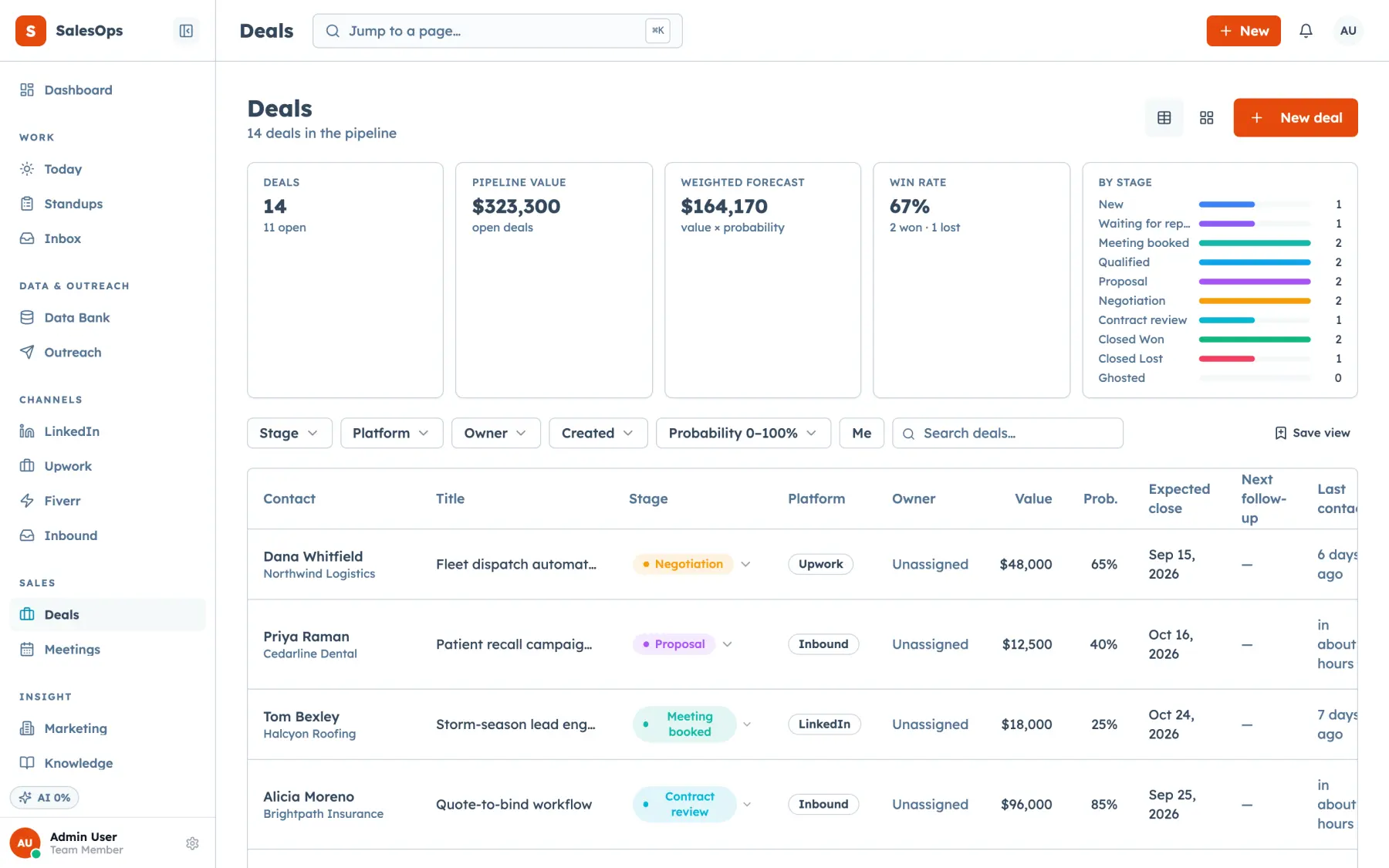
Choose a dedicated telephony platform like Aircall when a team's CRM lacks solid calling features and swapping CRMs isn't on the table. Choose a CRM with calling built in when avoiding a second subscription, a second login, and a second place where call data can drift out of sync with the deal record matters more than Aircall's deeper telephony feature set.
The short answer
- Aircall is a dedicated phone system, IVR, call recording, click-to-dial, power dialer on its Professional tier, built to integrate with an existing CRM rather than replace one.
- A CRM with calling built in logs the call against the contact or deal record automatically, without a separate integration keeping two systems in sync.
- Aircall's pricing starts with a 3-license minimum and per-license rates that aren't published without selecting a country, a common pattern for VoIP platforms priced by volume.
- The real trade-off is depth versus consolidation: Aircall's telephony features go deeper than most CRM-native calling, at the cost of running and paying for a second system.
Aircall vs a CRM with calling built in
| Dimension | Aircall | CRM With Calling Built In |
|---|---|---|
| What it is | Dedicated business phone system with IVR, recording, and dialer features | A CRM whose calling feature is part of the same record, not a bolted-on integration |
| Where call data lives | In Aircall, synced to the CRM through an integration | In the CRM directly, against the same contact or deal record |
| Minimum commitment | 3 licenses minimum on Essentials and Professional; 25 on Custom | Varies by CRM; not telephony-specific |
| Power dialer | Included on the Professional tier, not the entry Essentials tier | Depends entirely on the specific CRM; not universal |
| IVR and call recording | Included from the entry tier | Depends on the specific CRM's calling feature set |
| Setting up two systems | Requires an integration between Aircall and the CRM, another sync point to maintain | None; there's only one system to configure |
| Best for | Teams with an existing CRM that has weak or no native calling, and a need for deep telephony features | Teams that want the call log, disposition, and deal record to live in the same place by default |
Aircall tier names, features, and license minimums checked on aircall.io/pricing, September 2026. Exact per-license price is not published without selecting a country and license count on the live pricing page; contact Aircall sales for a quote.
Where each holds up, and where it doesn't
Aircall
- Deep, dedicated telephony features: IVR, call recording, click-to-dial, and a power dialer at the Professional tier
- 250+ integrations means it can plug into most CRMs a team already uses
- Exact per-license pricing isn't published without going through a country and license-count selector
- Requires and maintains a separate integration to keep call data in sync with the CRM's contact and deal records
CRM With Calling Built In
- One system, one login, one place where the call and the deal record live together
- No integration to configure or break between a phone system and the CRM
- Native calling features vary a lot by CRM and are often shallower than a dedicated telephony platform's feature set
- Switching CRMs to get better calling means migrating everything else in the CRM too, not only the phone system
How to choose
If a team already has a CRM it likes and the only gap is calling, adding a dedicated platform like Aircall on top is often the path of least resistance. Aircall's IVR, recording, and dialer features are built specifically for phone work and tend to go deeper than what a general CRM bolts on as a secondary feature, and the integration work to connect it to an existing CRM is a known, well-documented pattern for a platform with 250+ listed integrations.
If a team is choosing or replacing a CRM anyway, or finds itself constantly reconciling call logs between two systems, a CRM with calling built in removes an entire category of sync problems: no integration to maintain, no chance the call shows up in one system but not the other, one login instead of two. The trade is usually feature depth on the calling side itself.
A useful test: count how often someone on the team has had to check two systems to answer "what happened on that call and what's the deal status now." If that happens often, consolidation is worth more than Aircall's extra telephony depth. If it rarely comes up, a dedicated phone system plugged into the existing CRM is the lower-disruption choice.
Pricing changes; verify before you commit
Questions
- Can you use both Aircall and a CRM with calling built in?
- Not usefully at the same time for the same call flow. Aircall is built to be the phone system that plugs into a CRM's contact and deal records via an integration, so pairing Aircall with a separate CRM is the normal setup, not a conflict. What doesn't make sense is running Aircall's dialer alongside a CRM's own native calling for the same team; that just means picking which system places the call.
- How hard is it to move from Aircall to a CRM's native calling?
- Porting or repointing the phone numbers is usually straightforward with most providers. The bigger work is call history and recordings: Aircall's own call logs and any custom IVR or routing setup have to be rebuilt or exported into the new system, and a team has to relearn where to dial from day to day. Budget for a short overlap period where both systems can place calls while the switch settles.
- Does Aircall replace a CRM?
- No. Aircall is a telephony and call-management platform, IVR, call recording, click-to-dial, power dialer in its Professional tier, built to plug into a CRM rather than be one. It integrates with Salesforce and 250+ other tools rather than storing deals or pipeline stages itself, so a team using Aircall still needs a separate CRM behind it.
- What does Aircall cost?
- Aircall publishes three tiers, Essentials, Professional, and Custom, each requiring a minimum of 3 licenses (25 for Custom), with the exact per-license monthly rate shown only after selecting a country and license count on aircall.io. The Essentials tier includes IVR, call recording, click-to-dial, and 250+ integrations; Professional adds power dialer, voicemail drop, and Salesforce CTI; Custom is contact-sales with SLA and onboarding. Checked September 2026.