Apollo vs HubSpot
Apollo starts from a contact database and meters it in credits. HubSpot starts from the CRM record and bills per seat. You're choosing where the work begins.
Choose Apollo when your team's day is finding new contacts and sending the first emails, and credits fit your list size. Choose HubSpot when the day is running deals after the reply, with forecasting and one contact record that marketing and service share.
The short answer
- Apollo pairs a contact database with sequences, a parallel dialer and tasks, and meters contact data in credits (apollo.io/pricing, checked September 2026).
- HubSpot Sales Hub bills per seat; Professional and Enterprise add a required one-time onboarding fee (hubspot.com/pricing/sales, checked September 2026).
- Apollo's MCP connects Claude, ChatGPT and Perplexity to search leads, enrich contacts and build sequences from a chat.
- Many teams run both: Apollo feeds contacts in, and HubSpot tracks what happens after a reply.
Apollo vs HubSpot at a glance
| Dimension | Apollo | HubSpot Sales Hub |
|---|---|---|
| What it is at its core | A contact database with outreach on top | A CRM with sales tools, one hub in a wider suite |
| Free option | A free plan after the trial | Free tools for a small team, no card |
| How you pay | Per plan, with contact data metered in credits | Per seat: Core Seats on Starter, Sales Seats above it |
| One-time fees | None listed on the pricing page | Required onboarding fee on Professional and Enterprise |
| Outreach | Sequences on every account, plus a parallel dialer | Sequences and calling minutes by edition |
| AI assistant access | Apollo MCP for Claude, ChatGPT and Perplexity | Breeze AI; editions include HubSpot Credits |
| Connects to the other | Lists HubSpot as a CRM integration | Takes Apollo data through that integration |
Checked on apollo.io/pricing, apollo.io/product/mcp and hubspot.com/pricing/sales, September 2026. Structure only: this table quotes no prices.
Where each one is strong, and where it costs you
Apollo
- A rep can build a list and send to it on day one, because the data and the sequence sit in the same account
- Its MCP lets an AI assistant search, enrich and write sequences without opening the app
- Contact data runs on credits, so a big list can outgrow the plan before your headcount does
- API access sits on Custom plans, per its own pricing page
HubSpot Sales Hub
- Sales shares one contact record with HubSpot's marketing and service hubs
- Forecasting and a deep pipeline arrive on Professional, with free tools to start
- Professional and Enterprise each carry a required one-time onboarding fee
- Every rep on Professional or Enterprise needs a paid Sales Seat, so the bill tracks headcount
How to choose between Apollo and HubSpot
Start with the work your team does most. If your reps spend the day building lists and sending first emails, Apollo fits that work. The data and the sequence live in one place, so nobody copies contacts between tools before a send.
If the day is spent after the reply, on calls, proposals and forecasts, HubSpot fits better. The record, the pipeline and the reports are the product there. You'll pay per Sales Seat on Professional, plus the onboarding fee once.
Many teams run both. Apollo feeds contacts in, and HubSpot tracks what happens next. That works, but you're paying two bills that both grow with the team. Pick one tool to own each contact, or sync rules will fight each other.
Choose neither when two people work a short list with no outbound at all. A shared inbox and a spreadsheet cover that. For the next matchups, see Apollo vs Clay and HubSpot vs Salesforce.
Apollo and HubSpot questions
- Can you use Apollo and HubSpot together?
- Yes, and many teams do. Apollo lists HubSpot among its CRM integrations on apollo.io/pricing (checked September 2026). The usual split: Apollo finds the contact and runs the first touches, and HubSpot holds the deal once someone replies. Decide up front which tool owns the contact record, or you'll clean up duplicates every week.
- Is Apollo a CRM?
- Apollo sells itself as a go-to-market platform built on a contact database. It includes sequences, a parallel dialer, tasks and contact and account records, per apollo.io in September 2026. Teams that need forecasting and a pipeline shared with marketing and service usually keep a CRM such as HubSpot beside it.
- How does HubSpot Sales Hub charge?
- HubSpot Sales Hub charges per seat. Starter is priced per Core Seat, and Professional and Enterprise are priced per Sales Seat. Professional and Enterprise each require a one-time onboarding fee, and every paid edition includes a set of HubSpot Credits (hubspot.com/pricing/sales, checked September 2026).
- How do Apollo credits work?
- Apollo meters contact data in credits. You spend export credits when you export contacts, and you can buy more credits at any time. Apollo's pricing page also describes a fair-use policy on its unlimited plans (apollo.io/pricing, checked September 2026). Size your list before you pick a plan, because credits run out before seats do on a heavy outbound month.
- Is there one tool that holds the contact data, the cadences and the pipeline?
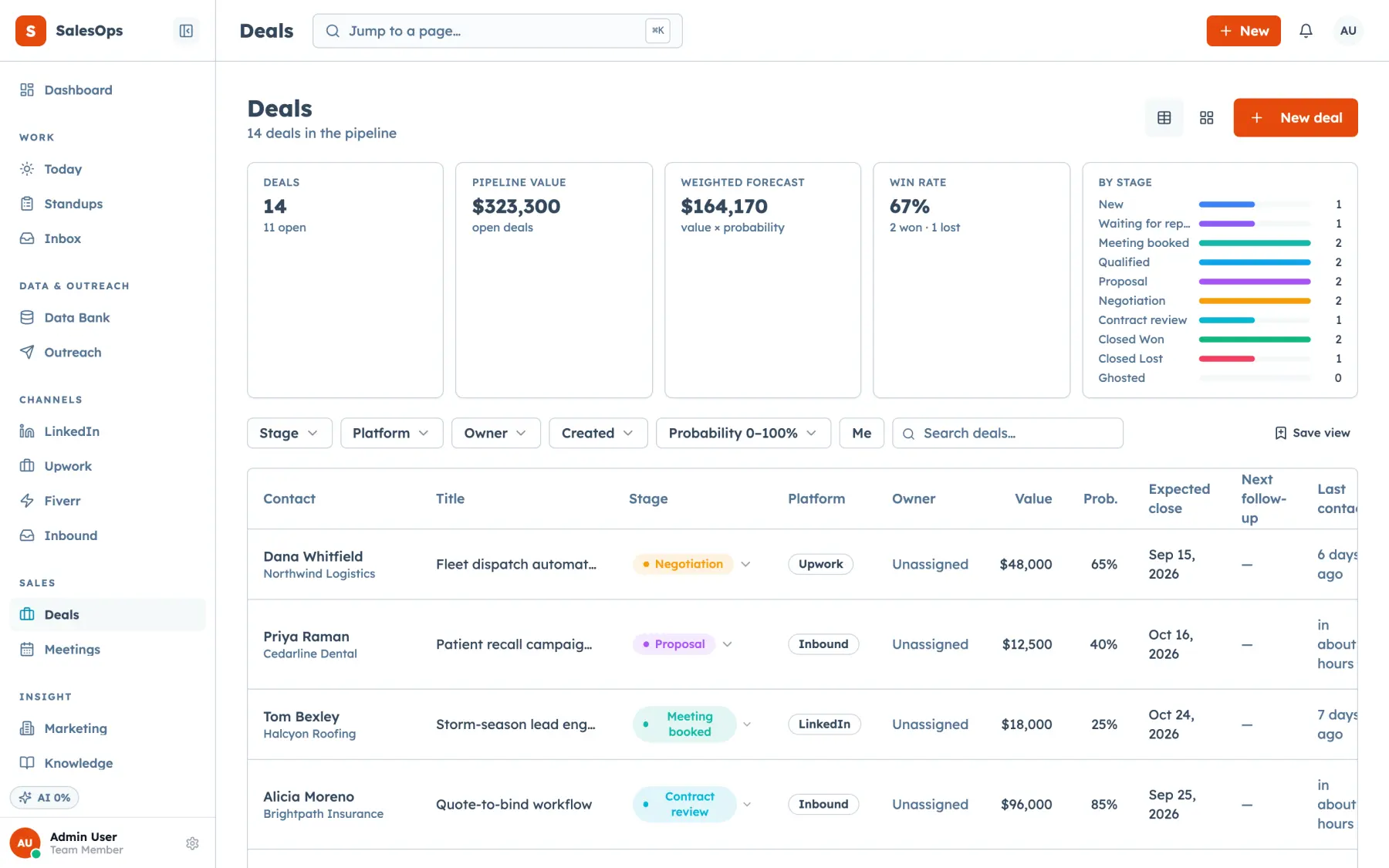
- SalesCrew does. It keeps a data bank, multi-step cadences on your own mailboxes and a deal pipeline in one database per client. Apollo connects to it as a data source. Core is $299 a month with unlimited seats. SalesCrew is our product.