Best open-source CRMs
Free software still costs hosting time and maintenance. What each project's self-host and managed-cloud options actually mean in practice.
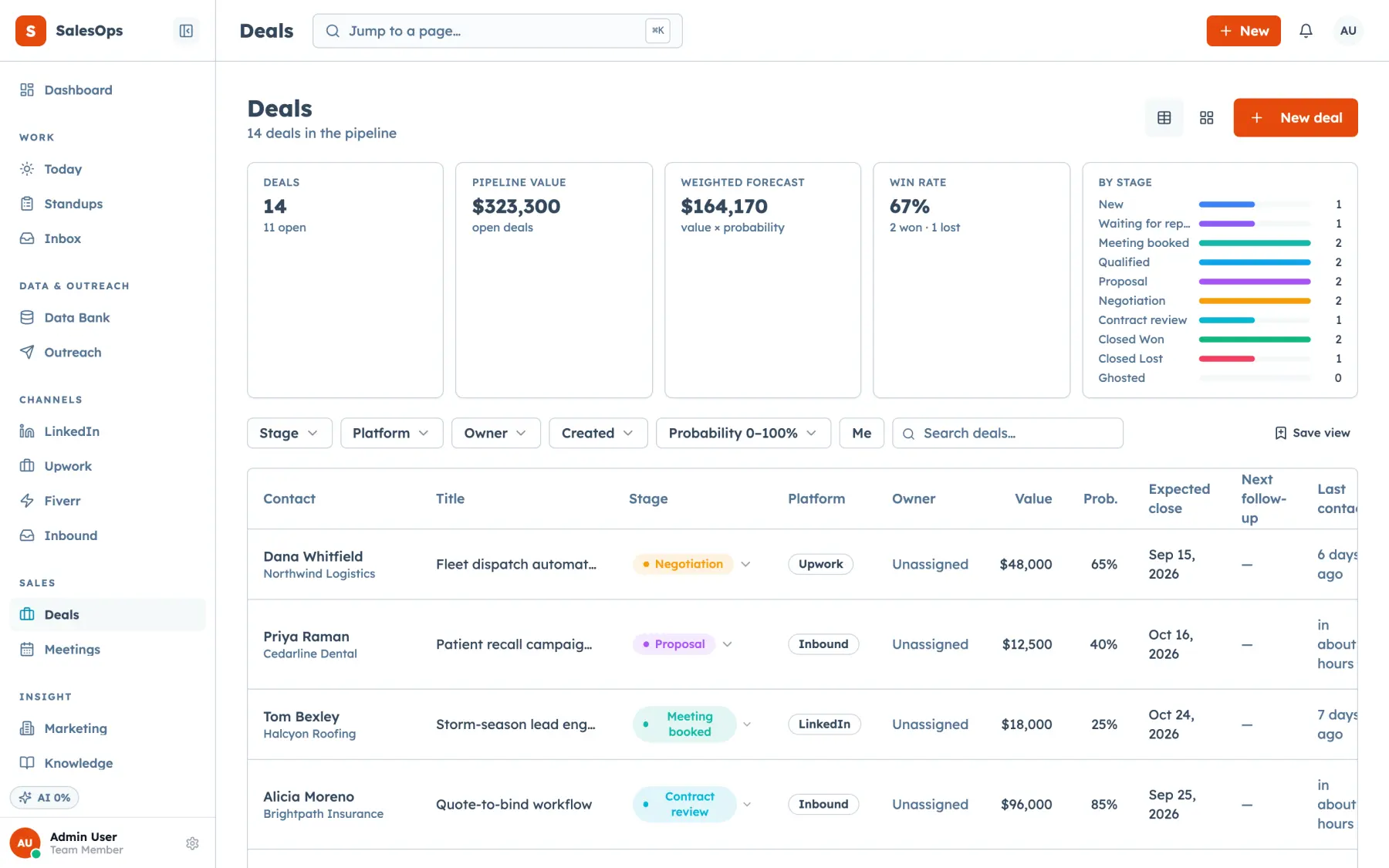
Twenty wins for a team that wants a modern interface and a real managed-cloud fallback at $9/user/mo if self-hosting turns out to be more overhead than expected.
The short answer
- Twenty is free to self-host from its open-source code, or available as managed cloud hosting at $9/user/mo (Pro) or $19/user/mo (Organization, adds SSO and priority support).
- EspoCRM is free to self-host and lighter on server resources than some alternatives, with built-in email sync, a call log with VoIP integration hooks, and a mature report builder out of the box.
- Self-hosting is not free in practice once server costs, setup time and ongoing patching are counted; a managed-cloud tier from the same vendor is often the more honest cost comparison against a paid CRM.
- Open source and single-tenant data isolation are different properties; a CRM can offer one without the other, so check which one actually matters for a given data-ownership requirement.
How we compared these
We compared each project on whether self-hosting is genuinely free versus requiring separately-priced infrastructure, what a managed-cloud alternative costs from the same vendor, and what ships built in versus needing a plugin or custom work. Facts checked on vendor pricing pages, September 2026.
Open-source CRM comparison
| CRM | Self-host cost | Managed cloud price | Built in out of the box | Best for | Not for |
|---|---|---|---|---|---|
| Twenty | Free (open-source code); server hosting cost is separate and not fixed | $9/user/mo Pro; $19/user/mo Organization (adds SSO) | Custom objects, full API access, email integration | A team that wants a modern interface with an easy managed-cloud fallback | A team that needs a mature report builder or VoIP call logging out of the box |
| EspoCRM | Free (open-source code); server hosting cost is separate and not fixed | $15/user/mo Basic (3-user minimum), $25/user/mo Enterprise (5-user minimum), $69/user/mo Ultimate (10-user minimum) | Mass email campaigns, IMAP/SMTP sync, call log with VoIP hooks, report builder | A team that wants more built-in functionality without plugins, and a lighter server footprint | A team that wants the newest, most actively evolving interface |
| SuiteCRM | Free (open-source code); no per-user licensing fee at all, even at scale | Fully managed hosting from £50/mo; implementation packages from £2,520 one-time; support plans from £1,200/yr | Sales, marketing and case modules; workflow automation; no per-seat cost ever, self-hosted or managed | A team that wants to avoid per-seat pricing entirely, even as headcount grows | A team that wants the vendor to host, patch and support it with no separate implementation project |
| Odoo | Free (Community edition, open-source code); Odoo CRM is not sold as a standalone paid app | Standard plan $7.95-$11.20/user/mo (annual/monthly), Custom plan $10.90-$17/user/mo, both bundle CRM with dozens of other Odoo apps | CRM plus the full Odoo app suite (inventory, accounting, website) on paid plans | A team that wants CRM alongside a much wider operational app suite from one vendor | A team that wants CRM only, without paying for or configuring unrelated apps |
Figures checked on vendor pricing pages, September 2026, including espocrm.com/pricing, suitecrm.com and odoo.com/pricing. Krayin and Vtiger's self-hosted editions were considered but their current published figures were not independently confirmed for this table, so they are left out rather than guessed.
The field, ranked
1. Twenty
A modern interface and a genuine managed-cloud option at a clear per-user price if self-hosting proves to be more work than expected. Not for a team that wants a mature, feature-complete tool out of the box without customization.
2. EspoCRM
More built-in functionality without plugins, including email sync and a report builder, at a lighter server footprint. Not for a team that prioritizes the newest interface or the most active roadmap.
3. SuiteCRM
Genuinely free at any headcount, with no per-seat fee even on the managed-hosting or support add-ons. Not for a team that wants a single vendor to host, patch and support it without a separate implementation project.
4. Odoo
CRM bundled with a much wider operational app suite, useful if the team also needs inventory or accounting from the same vendor. Not for a team that wants CRM only, since the paid plans price and configure the whole suite together.
When none of these is the answer
A team with no engineering capacity to maintain a server, patch security updates or debug a self-hosted deployment should not choose an open-source CRM on the strength of the free license alone; the real cost shows up later as unplanned maintenance time. A managed CRM, open source or not, is the better fit when nobody on the team wants to own infrastructure.
Questions
- Is open-source the same as free?
- The software is free to run yourself, but self-hosting is not free in practice: it costs server time, setup effort and ongoing maintenance. Most open-source CRM vendors also sell a managed-cloud version of the same software for a monthly fee that covers hosting and support instead.
- Why would a team self-host instead of paying for a managed CRM?
- Full control over the data and infrastructure, no per-seat pricing at scale, and the ability to modify the source code directly. The tradeoff is that the team, not a vendor, is responsible for uptime, backups, security patches and upgrades.
- Is self-hosted the same as single-tenant?
- Not necessarily. Self-hosted means you run the software on your own infrastructure. Single-tenant means each customer gets an isolated database and instance, whether hosted by the vendor or by you. A CRM can be single-tenant without being open source, and open source without being single-tenant if it is run as one shared instance for many teams.
- Is SalesCrew open source?
- No. Disclosure: SalesCrew is our product. It is single-tenant, meaning each client gets its own Supabase project and full data export, but the source itself is not open for self-hosting. It appears here as a comparison point for teams weighing data ownership against open-source control specifically.