Jobber or a Configurable CRM?
Jobber schedules jobs, dispatches technicians and sends invoices for home-service trades. A configurable CRM handles the sales pipeline beside it, not the field work.
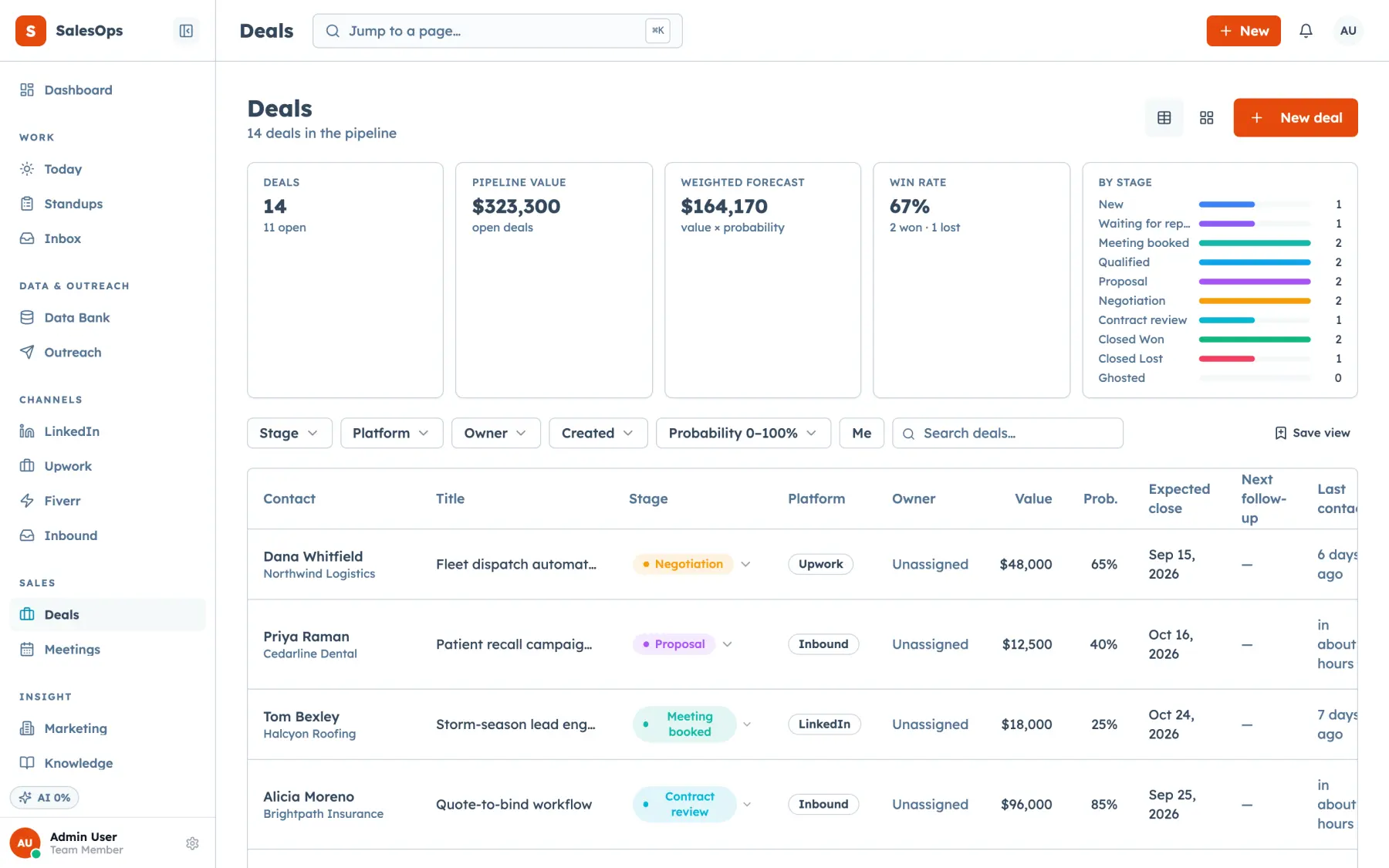
Choose Jobber when the job is scheduling, dispatch, routing and field invoicing that a general CRM does not model at all. Choose a configurable CRM beside it when the estimate-to-sold pipeline, a maintenance-renewal cadence, or new commercial-account outreach needs more structure than Jobber's client list gives it. That way you avoid forcing a sales workflow into a scheduling tool.
The short answer
- Jobber is a purpose-built field-service platform. Scheduling, technician dispatch, quotes and invoicing, priced from $29/month (Core, 1 user, annual billing) up to $399/month (Plus, 15 users) plus $29/month per added user.
- A configurable CRM does not model jobs, routes or technician schedules at all. It is a general contacts-companies-deals database built for whatever pipeline a trade business configures. That includes estimate follow-up or a renewal push Jobber's client list was not built to run as a campaign.
- The two are not substitutes. Jobber's value is the field-operations workflow and its 100+ app integrations. A configurable CRM's value is a flexible, agent-operable pipeline for the sales motion around the job.
- A configurable CRM like SalesCrew ships with real gaps today. No native mobile app, no page or funnel builder, no app marketplace, fewer native integrations than an established field-service platform. It is a new product with no third-party reviews yet.
Jobber vs a configurable CRM at a glance
| Dimension | Jobber | A configurable CRM (e.g. SalesCrew) |
|---|---|---|
| Core object model | Jobs, quotes, invoices, schedules and routes, built for field-service work | Contacts, companies, deals with configurable pipeline stages, not job- or route-specific |
| Starting price | $29/month, 1 user, annual billing (Core); $399/month, 15 users (Plus) | $299/month, unlimited seats (Core tier) |
| Seats model | Per-tier user caps; $29/month per added user | Unlimited seats on every tier |
| Scheduling and dispatch | Built in: calendar, technician routing, mobile app for the field | Not built for scheduling or dispatch at all |
| Estimate and renewal follow-up as a campaign | A quote list and reminders, not a multi-step cadence engine | Built in: multi-step cadences, segments, suppression enforced at send |
| Agent / MCP API | Not part of the core platform | Every action is also an MCP tool; works with Claude, ChatGPT, Cursor or any MCP client |
| Integration marketplace | 100+ app integrations, including QuickBooks Online sync | Fewer native integrations than an established field-service platform; most connections run via webhooks, MCP, and the API |
| Best for | Firms whose primary need is scheduling, dispatch and field invoicing | The sales side beside Jobber: estimate follow-up, renewal pushes, new commercial-account outreach |
Figures checked on vendor pricing pages, September 2026 (getjobber.com/pricing). SalesCrew figures from the product's own published fact sheet, current as of September 2026.
Where each tool holds up, and where it doesn't
Jobber
- Purpose-built field-service workflow: scheduling, technician dispatch and routing, and invoicing modeled the way trade businesses actually run jobs
- 100+ app integrations and a published, transparent pricing ladder from $29 to $399 a month, so a business knows the cost before signing up
- Every added user costs $29/month on top of the plan price, which adds up for a larger office and field team
- Not built for a multi-step follow-up cadence on unsold estimates or a seasonal renewal campaign; that's client-list and reminder functionality, not a sequencing engine
A configurable CRM
- Every action is also an MCP tool, so an agent can read and act on the sales pipeline directly, something Jobber's core platform isn't built around
- Multi-step cadences with suppression enforced at send, useful for an unsold-estimate follow-up sequence or a spring/autumn maintenance-agreement push
- Unlimited seats on every tier, so the office and sales side of the business doesn't scale the bill the way per-user field-service seats do
- No native mobile app, responsive web only, a real gap for anyone expecting field-usable software the way Jobber's technician app is built
- No page or funnel builder and no app marketplace, so anything beyond the core CRM and its MCP/webhook connections has to be built, not installed
- Fewer native integrations than an established field-service platform like Jobber; most third-party connections run through webhooks, MCP, or the API rather than a one-click app
- New product with no customers yet and no third-party reviews, unlike Jobber's established track record with home-service trades specifically
- No scheduling, dispatch or routing model at all; it is not a field-service platform and should not be evaluated as a Jobber replacement
How to choose
If the daily work is getting a technician to the right address with the right job details, tracking the visit, and invoicing on completion, Jobber is the right tool. Its scheduling and dispatch model is the reason it is built the way it is. A general configurable CRM has no concept of a route or a scheduled visit. Trying to run field operations through a sales database is a worse outcome than paying for a tool built for that job.
Some businesses lose unsold estimates because nobody remembers to follow up a second or third time. Or the spring maintenance-agreement renewal push happens by memory instead of a scheduled campaign. That is the work a configurable CRM is built for. Jobber's client list can hold a reminder, but it is not a sequencing engine. Forcing a multi-step outbound cadence into a scheduling tool's reminder feature is the same mismatch in the other direction.
Most trade businesses that need both end up running Jobber for scheduling, dispatch and invoicing, and a configurable CRM for the follow-up and renewal side. They connect the two where useful through Jobber's API rather than merging them into one system. That is not a compromise. Field operations and outbound sales follow-up are different jobs, and no single tool does both well.
Questions
- Can you run Jobber and a configurable CRM at the same time?
- Yes, and that is the realistic setup once a trade business outgrows what one tool can carry. Jobber stays the system of record for scheduling, dispatch, quotes and invoicing, the field-service workflow it is built for. A configurable CRM sits beside it for the sales side that does not fit that model cleanly. A multi-step follow-up cadence on an unsold estimate. A maintenance-agreement renewal push each spring and autumn. Business-development outreach to commercial accounts that never becomes a Jobber job until a deal closes.
- How hard is it to move data between Jobber and a configurable CRM?
- Jobber has an open API and supports CSV export. Client and job history can move between systems without manual re-entry. What does not move cleanly is the operational side. A scheduled visit, a technician's route, and a job's line items are concepts a general CRM does not represent natively. The realistic integration is keeping shared contacts in sync rather than replacing one system with the other.
- Does a configurable CRM replace Jobber's scheduling and dispatch?
- No. Scheduling, technician dispatch, route optimization and field invoicing are a purpose-built workflow. Jobber's mobile app and office-side calendar are built specifically around that job. A general-purpose configurable CRM has no scheduling or dispatch model at all. Trying to run field operations out of a sales database is a worse outcome than running the two side by side.
- What does SalesCrew actually do for a trade business, if not scheduling?
- It handles the sales work around the job itself. Following up on an estimate that has not closed. Running a seasonal maintenance-agreement campaign. Tracking a pipeline for larger or commercial accounts before they become a scheduled Jobber job. It has no dispatch, routing or field-invoicing model and does not try to replace Jobber's core operational role.