Clio or a Configurable CRM?
Clio manages matters, trust accounting and billing for law firms. A configurable CRM handles intake and pipeline for prospective clients beside it, not case management.
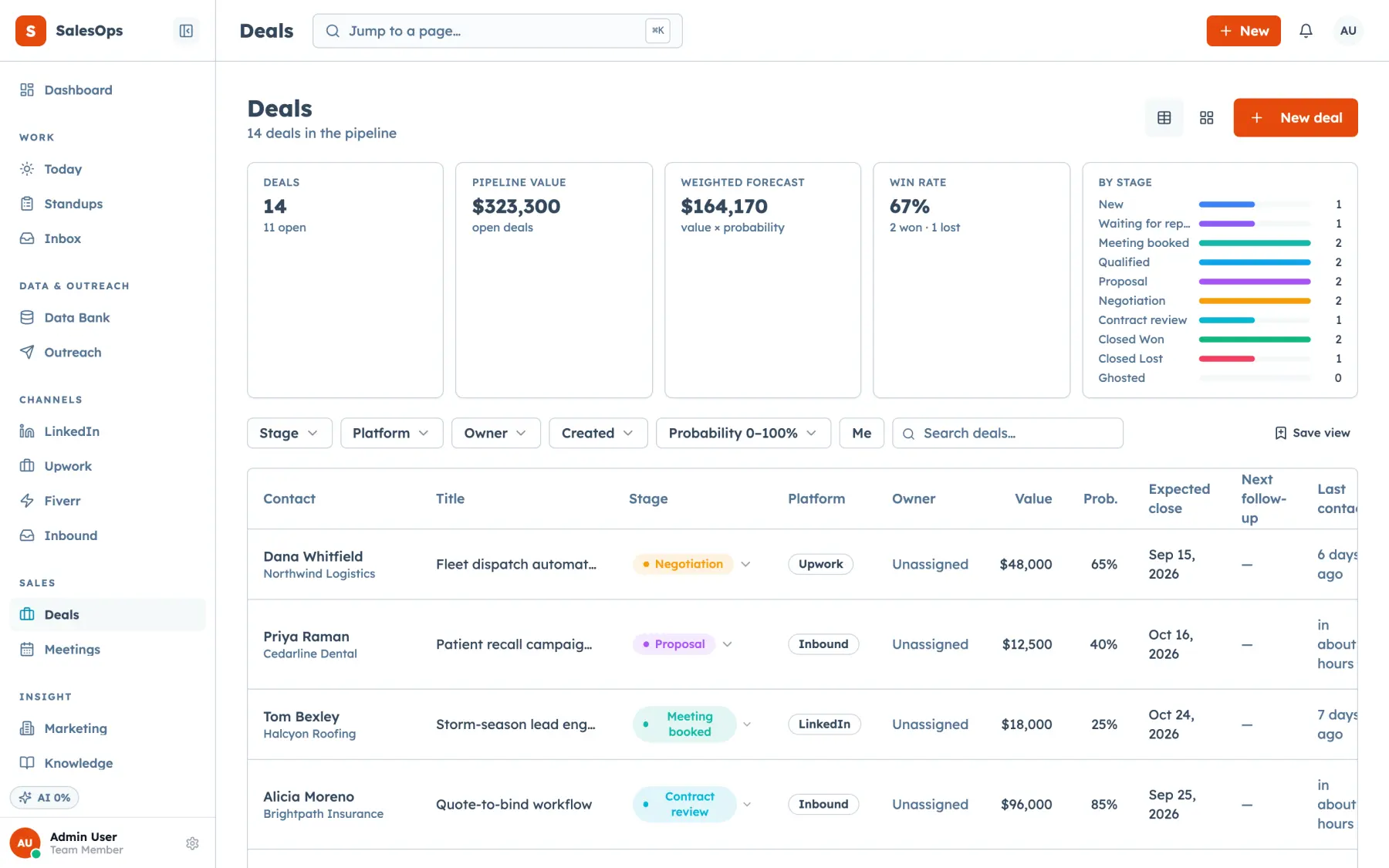
Choose Clio when the job is case management, trust accounting and billing that a general CRM does not model and should not attempt to. Choose a configurable CRM beside it when intake follow-up, a referral pipeline, or an agent-operable database for the pre-engagement sales side matters more than what Clio already does well.
The short answer
- Clio publishes tiered pricing on its site. The page was not independently verifiable for this comparison as of September 2026. Pricing is on request from clio.com/pricing or a sales conversation.
- A configurable CRM does not model matters, trust ledgers, or billing at all. It is a general contacts-companies-deals database configured for intake and business development, not for anything a state bar would treat as regulated accounting.
- The two solve different halves of a law firm's workflow. Clio owns everything from the moment a matter opens through billing and compliance. A configurable CRM owns the enquiry and follow-up before that point.
- A configurable CRM like SalesCrew ships with real gaps today. No native mobile app, no page or funnel builder, no app marketplace, fewer native integrations than an incumbent legal platform. It is a new product with no third-party reviews yet.
Clio vs a configurable CRM at a glance
| Dimension | Clio | A configurable CRM (e.g. SalesCrew) |
|---|---|---|
| Core object model | Matters, trust accounts, billing entries, built for the practice-management and compliance workflow | Contacts, companies, deals with configurable pipeline stages, not matter- or trust-specific |
| Starting price | Pricing on request; vendor page could not be verified directly for this comparison as of September 2026 | $299/month, unlimited seats (Core tier) |
| Trust accounting | Built in, widely cited as a category strength | Not present; a configurable CRM has no accounting or compliance-ledger model |
| Client portal (existing clients) | Included, built around active matters | Not built for active-matter client communication; that stays in the practice-management system |
| Intake / pre-engagement follow-up | Not the platform's focus; intake typically feeds Clio once a matter is opened | Built in: lead capture, multi-step cadences, suppression enforced at send |
| Agent / MCP API | Not part of the core platform | Every action is also an MCP tool; works with Claude, ChatGPT, Cursor or any MCP client |
| Integration marketplace | Largest legal-specific app marketplace in the category, built over more than a decade | Fewer native integrations than incumbent legal platforms; most connections run via webhooks, MCP, and the API |
| Best for | Firms whose primary need is case management, trust accounting, and billing for active matters | The intake/BD side beside a practice-management system: enquiry capture, follow-up cadences, referral tracking |
Clio's pricing page returned a bot-detection challenge on every attempt and could not be verified directly for this comparison, so no dollar figure is stated; confirm current pricing at clio.com/pricing. SalesCrew figures from the product's own published fact sheet, current as of September 2026.
Where each tool holds up, and where it doesn't
Clio
- Purpose-built compliance workflow: trust accounting and billing modeled the way state bar rules actually require
- The largest legal-specific integration marketplace in the category, built over more than a decade as the incumbent
- Pricing was not verifiable directly from the vendor for this comparison; a firm has to get a quote to know the cost
- Not built for a flexible pre-engagement follow-up cadence or a general business-development pipeline; intake typically becomes Clio's job only once a matter exists
A configurable CRM
- Every action is also an MCP tool, so an agent can draft intake follow-up or triage a new enquiry directly, something Clio's core platform isn't built around
- Multi-step cadences and suppression enforced at send handle the pre-engagement follow-up that a practice-management system doesn't model
- Unlimited seats on every tier, useful for a firm's intake staff and referral partners without per-seat cost creeping up
- No native mobile app, responsive web only, a real gap for anyone expecting a mobile-first intake or case app
- No page or funnel builder and no app marketplace, so anything beyond the core CRM and its MCP/webhook connections has to be built, not installed
- Fewer native integrations than an incumbent legal platform like Clio's marketplace; most third-party connections run through webhooks, MCP, or the API
- New product with no customers yet and no third-party reviews, unlike Clio's long track record specifically in legal practice management
- Has no trust-accounting or matter model at all; it is not a practice management system and should not be evaluated as a Clio replacement
How to choose
If the work in question is anything touching an open matter, trust accounting, billing, document management tied to a case, Clio is the right tool. Its purpose-built compliance workflow is the reason it is the category standard. A general configurable CRM has no model for a trust ledger. A state bar audit is the wrong place to discover that a general sales database was standing in for compliance-grade accounting software.
Some work happens before a matter opens. A prospective client's enquiry. A follow-up sequence for people who called but have not retained the firm. A referral-source pipeline the firm wants to nurture over months. That is the job a configurable CRM is built for. Clio does not model a lead that has not become a matter yet. Forcing pre-engagement follow-up into it means working around a system built for a later stage of the relationship.
Most firms running both intake marketing and active-matter management end up with Clio for the latter and a configurable CRM for the former. The point of handoff is the moment a prospective client becomes a matter. That split matches how the two systems are built, rather than forcing one tool to do a job it was not designed for.
Questions
- Can you run Clio and a configurable CRM at the same time?
- Yes. Clio stays the system of record for matters, trust accounting, billing, and everything tied to bar compliance. A configurable CRM sits beside it for the part Clio is not built around. Pre-engagement intake. Marketing follow-up on prospective clients who have not signed yet. A referral or business-development pipeline. Once a matter opens, that work moves into Clio. The CRM's job is largely done before the case management system's job begins.
- How hard is it to move data between Clio and a configurable CRM?
- Contact and lead data moves through CSV export/import or an API-based sync, which is mechanical. What does not move automatically, and should not, is anything touching trust accounting. Those ledgers are tied to state bar compliance. Firms generally reconcile that data by hand rather than trusting an automated sync between two different systems to get every transaction right.
- Does a configurable CRM replace Clio's case management or trust accounting?
- No. Case management, trust accounting, and billing are a purpose-built, compliance-critical workflow. Clio, and the broader legal-tech ecosystem built around it, are designed for that. A general-purpose configurable CRM does not model matters or trust ledgers. Building that from scratch in a general CRM would mean rebuilding compliance-grade accounting that already exists, badly.
- What does SalesCrew actually do for a law firm, if not case management?
- It handles intake and the sales side that happens before a matter exists. Capturing a prospective client's enquiry. Running a follow-up cadence for people who called but have not retained the firm yet. Tracking a referral-source pipeline. It has no matter, trust-ledger, or billing model, and is not a case management system.