What bounce rate is too high?
Roughly 2-5% is where most deliverability guidance starts recommending a pause and a list review. Google's own bulk sender rules use spam complaint rate, not bounce rate, as the enforcement trigger.
The short answer
- A bounce rate above roughly 2% is commonly flagged in deliverability guidance as worth investigating. Rates above 5% are widely treated as a signal to pause sending and clean the list.
- Hard bounces (the address does not exist) and soft bounces (a temporary delivery failure) need different handling. Suppress hard bounces immediately. Retry soft bounces before treating them as invalid.
- Google's bulk sender guidelines key on spam complaint rate, not bounce rate directly, with 0.3% as the stated hard enforcement threshold. A high bounce rate often goes with, and contributes to, complaint problems.
- Track bounce rate per sending domain, not only per campaign. Sender reputation accumulates at the domain level, and one bad campaign can affect every other send from that domain.
Why there is no single official bounce rate threshold
For spam complaint rate, Google's bulk sender guidelines state a specific number: a 0.3% hard enforcement line, with a 0.10% recommended target (support.google.com, checked September 2026). No major mailbox provider publishes an equivalent official bounce rate threshold. What exists instead is practitioner guidance that converges on a rough range. Under roughly 2% is generally considered healthy. Between 2% and 5% is worth investigating and cleaning the list. Above 5% is widely treated as a signal to pause the send rather than continue.
Bounce rate matters even without an official threshold because of its relationship to spam complaint rate and sender reputation. Mailbox providers use bounce patterns as one of several signals in how they treat a sending domain. A high bounce rate often correlates with the list quality issues that also produce spam complaints, even though the two are measured and enforced somewhat separately.
Bounce rate ranges and what they typically indicate
| Bounce rate | Common interpretation |
|---|---|
| Under 2% | Generally healthy, typical of a well-maintained list |
| 2-5% | Worth investigating; clean the list before continuing at volume |
| Above 5% | Widely treated as a signal to pause sending and address list quality directly |
Based on widely cited deliverability practitioner guidance, not an official threshold published by a specific mailbox provider.
What to actually do when bounce rate climbs
Separate hard bounces from soft bounces first. They need different responses. Hard bounces represent addresses that do not exist, so suppress them from future sends immediately. Soft bounces are usually worth a retry or two before being treated the same way, because they can reflect a temporary issue rather than an invalid address. If the overall rate stays high after separating these, the list itself needs verification or re-sourcing, not a technical fix on the sending side.
Track bounce rate per list source, not only as one aggregate across all outbound. A team running campaigns from several sources, a data provider, a self-researched list, an older import, benefits from knowing which source drives a high bounce rate. The fix becomes targeted: retire or re-verify the problem source, instead of pausing all outbound while the cause is still unclear.
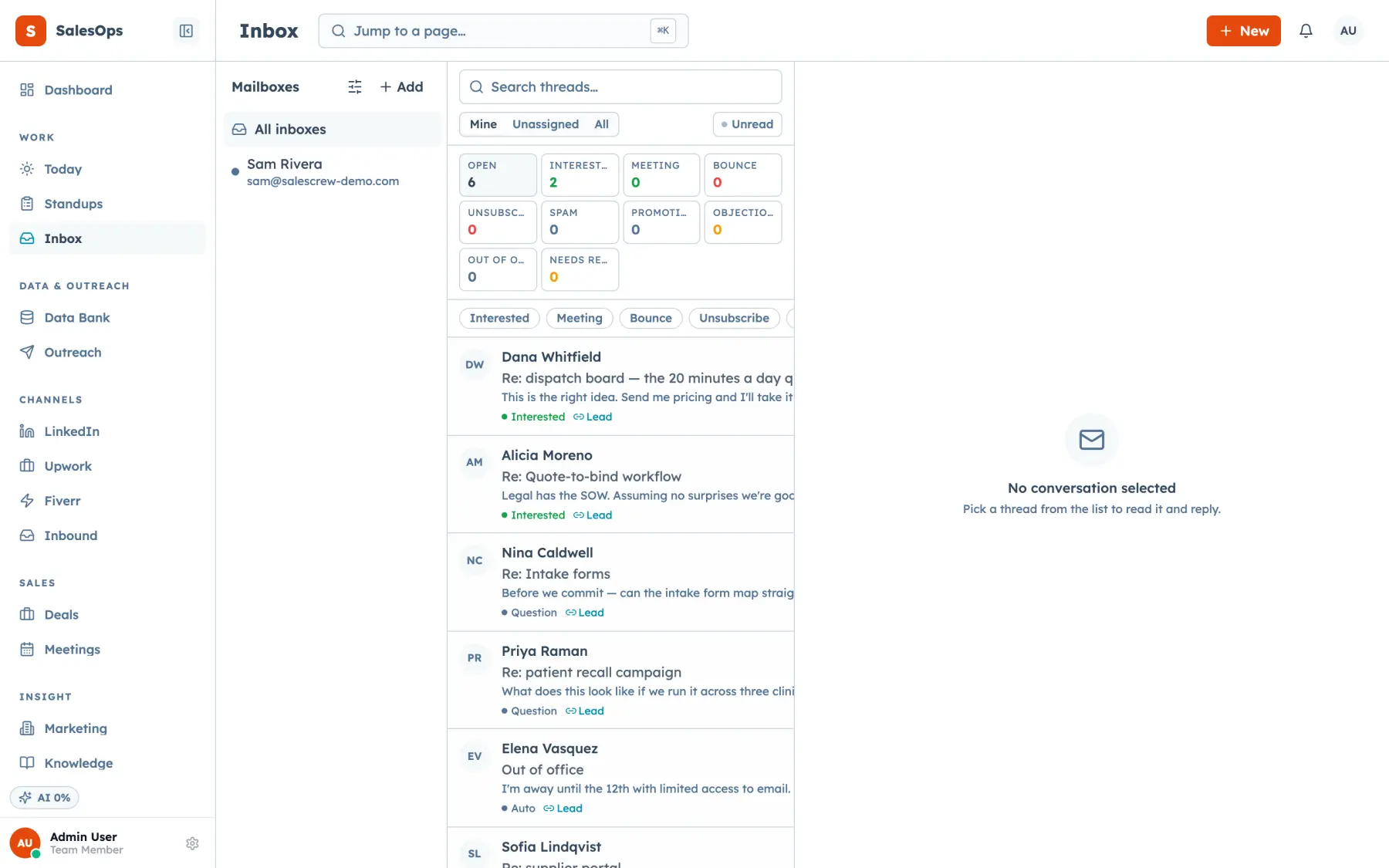
Disclosure: SalesCrew is our product. Bounces feed the suppression list automatically, and suppression is checked again at send time, so a hard-bounced address is not emailed again in a later campaign. It does not verify a list before the first send. That step happens separately, before a list reaches the product's data bank.
A high bounce rate is a symptom, not only a number to bring down
Questions
- What is the difference between a hard bounce and a soft bounce?
- A hard bounce means the address does not exist or the domain is invalid. It is permanent. A soft bounce is usually temporary, such as a full inbox or a server issue, and may succeed on a later attempt. Hard bounces should be suppressed immediately. Soft bounces are usually retried before being treated as invalid.
- Does a single high-bounce campaign permanently damage a sending domain?
- Not necessarily permanently, but recovery takes time. Mailbox providers track sender reputation over a rolling window rather than resetting after one bad send. Repeated high-bounce sends are more damaging than a single incident.
- Should bounce rate be measured per campaign or per sending domain?
- Both matter. Per-domain tracking is more important for protecting deliverability, because a domain's overall reputation is what mailbox providers evaluate, not any single campaign in isolation.