Should a cadence stop on any reply?
Only a genuine reply should stop it outright. An out-of-office or other automated response should pause the cadence instead. Otherwise the contact never sees the rest of the sequence once they return.
The short answer
- A genuine reply, positive, negative, or a question, should stop a cadence. Continuing to send scheduled touches after any real response from the contact reads as ignoring what they said.
- An out-of-office or other auto-response is not a genuine reply. It should pause the cadence rather than stop it outright, resuming once the pause window passes so the contact still receives the rest of the sequence.
- Both positive and negative genuine replies should stop the cadence, even though typically only a positive reply creates a new deal. Continuing to email someone who explicitly declined damages trust.
- An ambiguous reply, not clearly an auto-response and not clearly a genuine answer, is safer routed to a human for review. Misreading it as an auto-response and continuing the cadence is the more damaging mistake.
Why 'stop on any reply' is too blunt a rule
A simple rule, stop the cadence the moment anything lands in the reply thread, sounds safe. It produces two different failures depending on which way it errs. If the rule stops on every reply, including automated ones, contacts who happened to be away when the first touch landed never receive the remaining messages in the sequence. An out-of-office auto-reply looks identical to a real response to a system that is not checking content.
If the rule is loosened to avoid that problem, by not stopping on replies at all, it swings too far the other way. A contact who explicitly declined, or who is now in a live conversation with a rep, keeps receiving scheduled touches. Those read as tone-deaf at best and as ignoring their response at worst. Neither blunt version serves the real goal: responding appropriately to what the contact communicated.
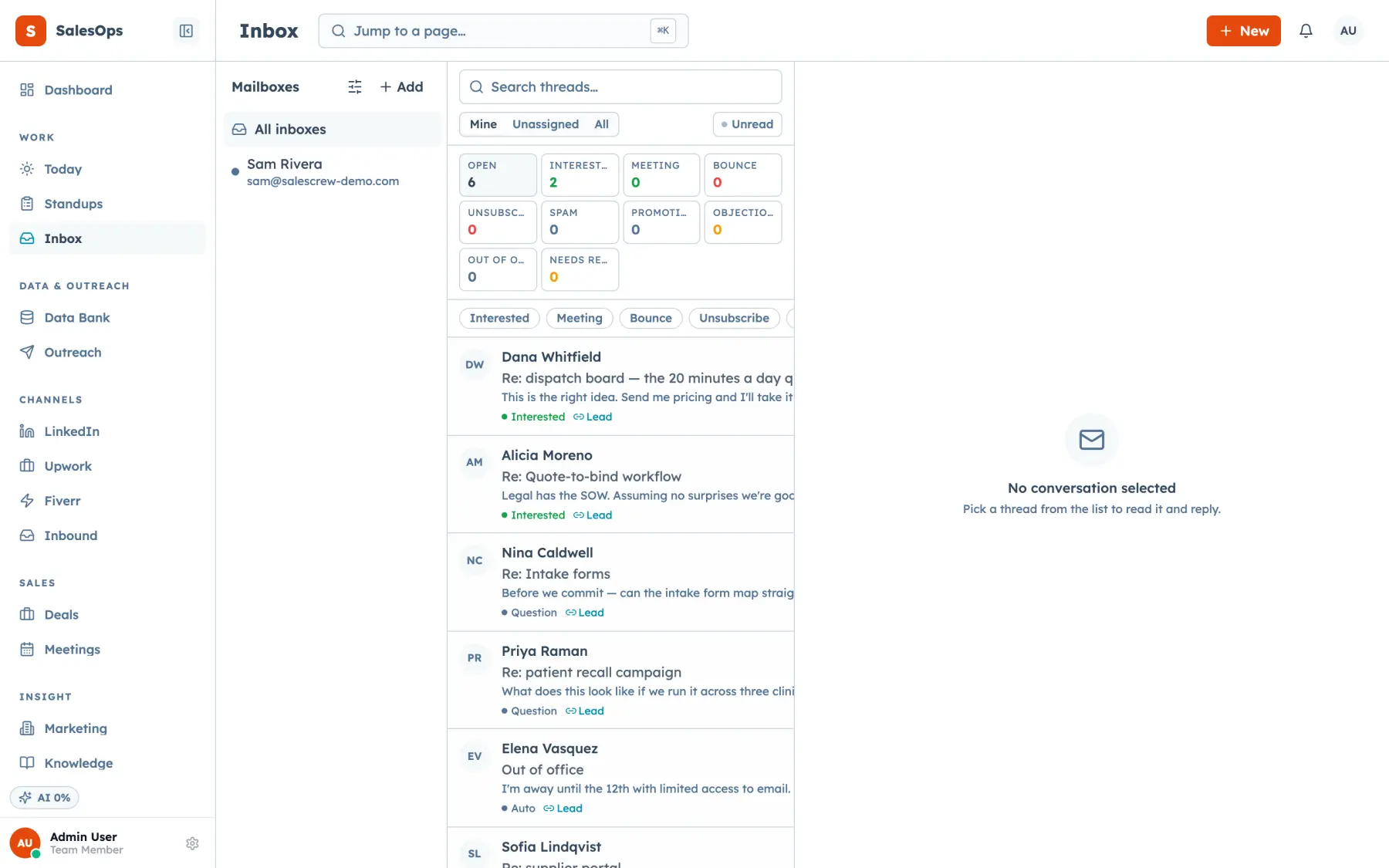
The reliable version of the rule sorts reply types before deciding what to do. Genuine replies (positive, negative, or a question) stop the cadence and hand the contact to a human. Automated replies (out-of-office, auto-acknowledgment) pause the cadence and resume it later. Ambiguous replies get routed for human review rather than an automated guess in either direction.
How different reply types should be handled
| Reply type | Cadence action |
|---|---|
| Genuine positive reply | Stop, hand to a human, typically creates a deal |
| Genuine negative reply | Stop, hand to a human, log as declined |
| Genuine question or ambiguous engagement | Stop, route to a human for a direct response |
| Out-of-office / automated auto-response | Pause, resume after the stated or default return window |
| Truly ambiguous (not clearly automated, not clearly substantive) | Route to a human for review, do not guess automatically |
What to actually check in your own cadence tool
Confirm what your cadence tool does when a reply lands. Does it sort reply types at all, or does every reply stop the cadence the same way? If it treats every reply the same, a periodic manual check of stopped cadences catches false stops caused by auto-responses. Do it before too much time has passed and the contact has moved further out of reach.
Disclosure: SalesCrew is our product. Its inbox classification tells a genuine reply from an automated out-of-office response and applies stop or pause behaviour accordingly, rather than treating every reply the same way. It does not resolve every ambiguous case automatically. Those still route to a human for review before the cadence's fate is decided.
A misclassified reply can look identical to a correctly handled one
Questions
- What counts as a genuine reply that should stop a cadence?
- Any message from the actual contact responding to the content sent, whether interested, declining, or asking a question. The distinguishing feature is that it addresses what was said, unlike an automated out-of-office message.
- Should a negative reply (not interested) stop the cadence the same way a positive one does?
- Yes, generally. Continuing to send scheduled touches to someone who explicitly declined reads as ignoring their response. Both should stop the cadence, even though only a positive reply typically creates a new deal.
- What happens if a reply is ambiguous, neither clearly a decline nor clearly interested?
- Ambiguous replies are safer routed to a human for review than left to an automated system to classify. Misreading an ambiguous reply as an auto-response, and continuing the cadence, is a more damaging mistake than pausing a cadence unnecessarily.