How to connect Calendly to a CRM
A webhook is the standard mechanism. Calendly fires an event the moment someone books, and the CRM listens for it to create or update a meeting and, ideally, a contact record.
The short answer
- The core mechanism is a webhook. Calendly sends an event payload to a URL the CRM exposes the moment a booking, reschedule or cancellation happens. The CRM's side of the integration reacts to that payload.
- A well-built integration does more than log the meeting. It should also create a new contact automatically if the booker is not already in the CRM, rather than leaving an orphaned meeting with no linked record.
- Some CRMs offer a native, no-code Calendly connection through their integrations page. Others require setting up the webhook by hand or through a connector tool such as Zapier or Make.
- A booking is a strong intent signal. The more useful integrations also trigger something beyond record-keeping, such as pausing an active outbound cadence for that contact or notifying the assigned rep.
Why a webhook, not a sync, is the right mechanism
Calendly bookings need to reach a CRM close to the moment they happen, not on a scheduled sync that runs every hour. A webhook does this by design. Calendly calls a URL the receiving system provides, in real time, whenever a booking event occurs. That immediacy matters because a booking is often the highest-intent signal in a sales process. A delay between the booking and the CRM knowing about it is a delay in the rep being notified or a cadence being paused.
Some CRMs expose this as a one-click "connect your Calendly account" integration, handling the webhook setup internally. Others expect the webhook to be configured by hand. That can be directly in Calendly's developer settings, pointed at the CRM's webhook URL, or through a middle layer like Zapier or Make that translates the event into whatever format the CRM's API expects.
What a Calendly-to-CRM integration should do
| Behaviour | Why it matters |
|---|---|
| Create a meeting record on booking | The baseline; without this the booking is invisible to the CRM |
| Create a new contact if the booker is unknown | Prevents orphaned meetings with no linked record |
| Update the meeting on reschedule or cancellation | Keeps the CRM's view accurate, not only the initial booking |
| Pause any active outbound cadence for that contact | A booked meeting means the cadence has done its job; continuing to send is redundant at best |
| Notify the assigned rep | A booking is high-intent and often time-sensitive to follow up on |
What to check once it is set up
Test the integration end to end with a real booking, not only a configuration screen that says "connected". Book a test meeting, cancel it, and reschedule it. Confirm the CRM reflects each state change correctly. Pay particular attention to reschedules and cancellations. Integrations are more often tested against the simple booking case and can miss those secondary events.
It is also worth checking what happens when the same email books twice: once as a new inbound contact, and again a few weeks later as a returning one. A well-built integration should match the second booking to the existing contact rather than creating a duplicate. Not every integration guarantees this, and it is easy to overlook during initial testing. A single test booking never exercises the repeat-booking path.
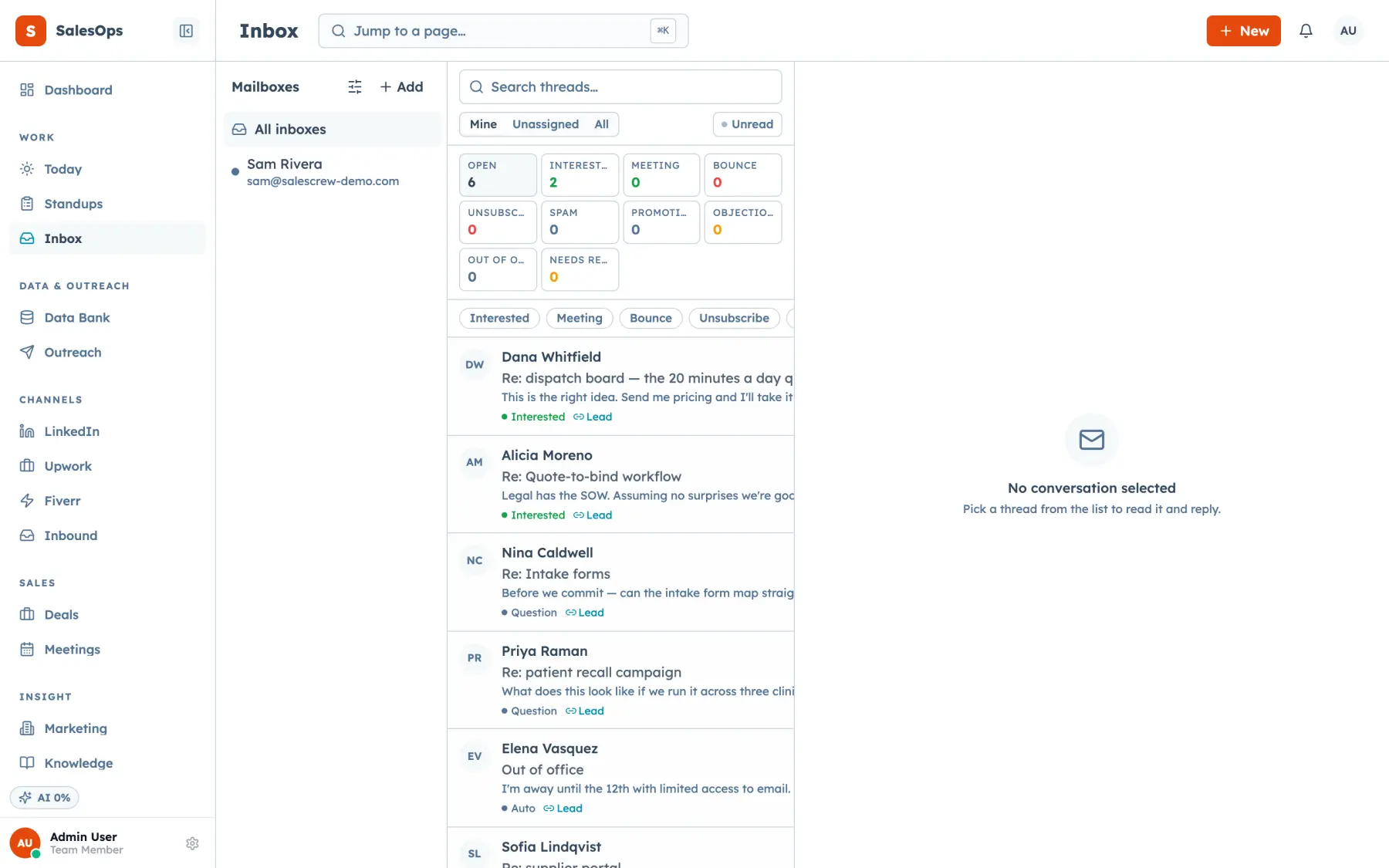
Disclosure: SalesCrew is our product. Calendly connects through a webhook that creates meetings and inbound contact records automatically. A booking through Calendly is one of the two channels (with website forms) that feed the CRM's inbound pipeline. The integration runs on Calendly's own webhook events. It does not control what happens inside Calendly itself, such as availability rules or event types.
Test reschedules and cancellations, not only the happy path
Questions
- Does connecting Calendly to a CRM require custom code?
- It depends on the CRM. Some have a native Calendly integration that needs only an account connection. Others require a webhook set up by hand or through a connector like Zapier or Make. That usually does not require writing code, but it does require configuration.
- What happens if the booker is not already a contact in the CRM?
- A well-built integration creates a new contact automatically from the booking's name and email, rather than dropping the meeting into the CRM with no linked record. Confirm this specifically. Some integrations only log the meeting and leave contact creation as a manual step.
- Can a Calendly booking trigger anything beyond just creating a meeting?
- Depending on the CRM, yes. A booking can stop an active outbound cadence for that contact, move a deal to a new pipeline stage, or notify the assigned rep. Whether this happens automatically depends on the integration, not on Calendly itself.