Do you need a CRM behind a voice agent?
A voice agent with nowhere to read from or write to treats every caller like a stranger and every call like it never happened.
The short answer
- A voice agent without a connected CRM cannot recognize a returning caller, cannot see why they are calling, and cannot leave a record another person can act on after the call ends.
- The call itself is not the deliverable. What a business needs from an inbound call is a logged record: who called, what they wanted, what was promised, and what happens next.
- A voice agent bolted onto a standalone calendar or a generic answering service can book a slot. The booking sits apart from the lead's other touches, so a team following up cannot see the full picture.
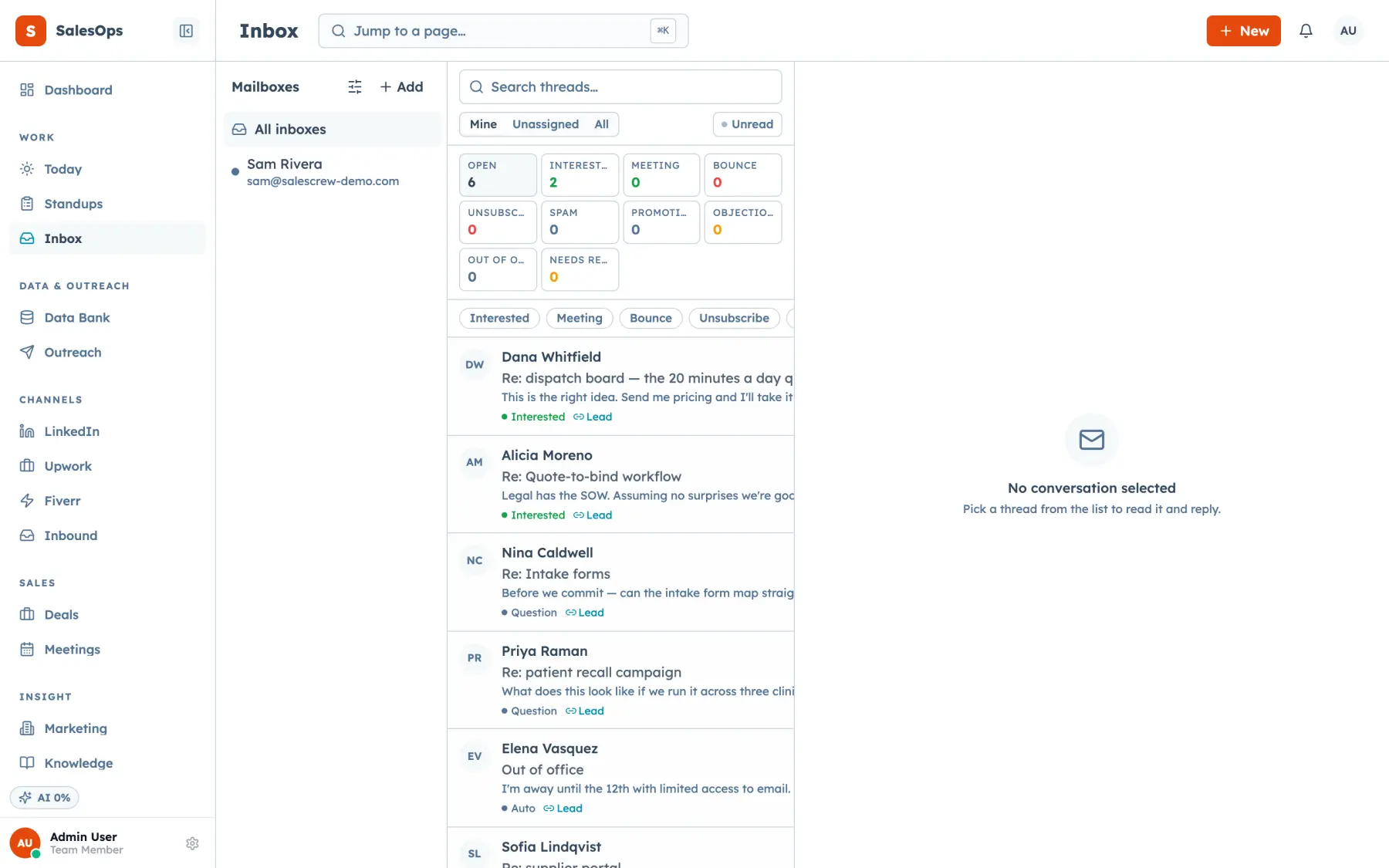
- The CRM is what turns a phone call from an event into pipeline data. A contact, a disposition, a next action, and a timeline entry a rep or another agent can see later.
Why 'the AI answered the phone' is not the whole job
A voice agent that answers, sounds natural, and books an appointment solves the moment of the call. It does not solve what happens five minutes later, when someone on the team needs to know that call happened. Or next week, when the same person calls back and the agent has no memory that this is not a first contact. Those gaps are not a voice quality problem. They are a data problem, and no amount of better speech synthesis fixes a missing record.
The businesses that get real value from an AI receptionist or voice agent are the ones where the call becomes a row in the same system the rest of the pipeline lives in. The same contact record a rep sees for email and text. The same deal a manager sees on a board. The same timeline an owner can scroll to understand what happened with a lead. Without that, a voice agent is a smarter answering machine, not a system that compounds.
This also affects the call itself. An agent that can look up the caller before or during the call, because it is connected to the same records a human rep would check, gives a different experience from one that starts every conversation from zero. Recognizing a returning caller, or knowing there is an open estimate on file, changes what the agent should say.
Voice agent alone vs. voice agent wired to a CRM
| Voice agent, no CRM | Voice agent wired to a CRM | |
|---|---|---|
| Returning caller recognition | Every call starts cold | Caller matched to an existing record |
| Where the call goes after it ends | Nowhere, or a separate log | Logged on the contact's timeline |
| Follow-up assignment | Manual, if anyone notices | A task or next action on the record |
| Visibility for the rest of the team | None | Anyone with access sees the call |
| Booking tied to pipeline stage | Isolated calendar event | Meeting linked to the deal |
What to check before adding a voice agent
Before evaluating voice agent vendors on voice quality or price per minute, check whether the agent can read from and write to a real CRM record, not only a calendar. Ask what happens to the call transcript. Does a disposition get set? Does a human following up see the call in the same place they see everything else about that lead?
Disclosure: SalesCrew is our product, and voice and phone features are on our roadmap, not shipped yet. This is not a pitch for buying voice from us today. The point stands whatever the vendor. Any voice agent you connect should write into the same pipeline as your other channels, not a separate silo. The value of the call is what the team does with it afterward, not the call by itself.
A standalone voice tool creates a second system of record
Questions
- Can a voice agent work with no CRM at all?
- It can hold a conversation and even book a slot on a standalone calendar. Every caller becomes a fresh conversation with no memory of the last one. No one downstream sees the call unless someone writes it up by hand.
- Does the CRM need to be built for voice specifically?
- No. What it needs is a place a call can write to automatically, the same record a rep would open for that contact. The call then becomes part of one history rather than a separate log in a separate tool.
- What is the minimum a voice agent needs from a CRM?
- Read access to know who is calling and why. Write access to log what happened, who is meant to follow up, and any booking or disposition. The next person to touch that lead is then not starting cold.