Retell alternatives
Retell itemises its per-minute price more honestly than most. Six alternatives compared on what each headline rate actually excludes, and where the call ends up.
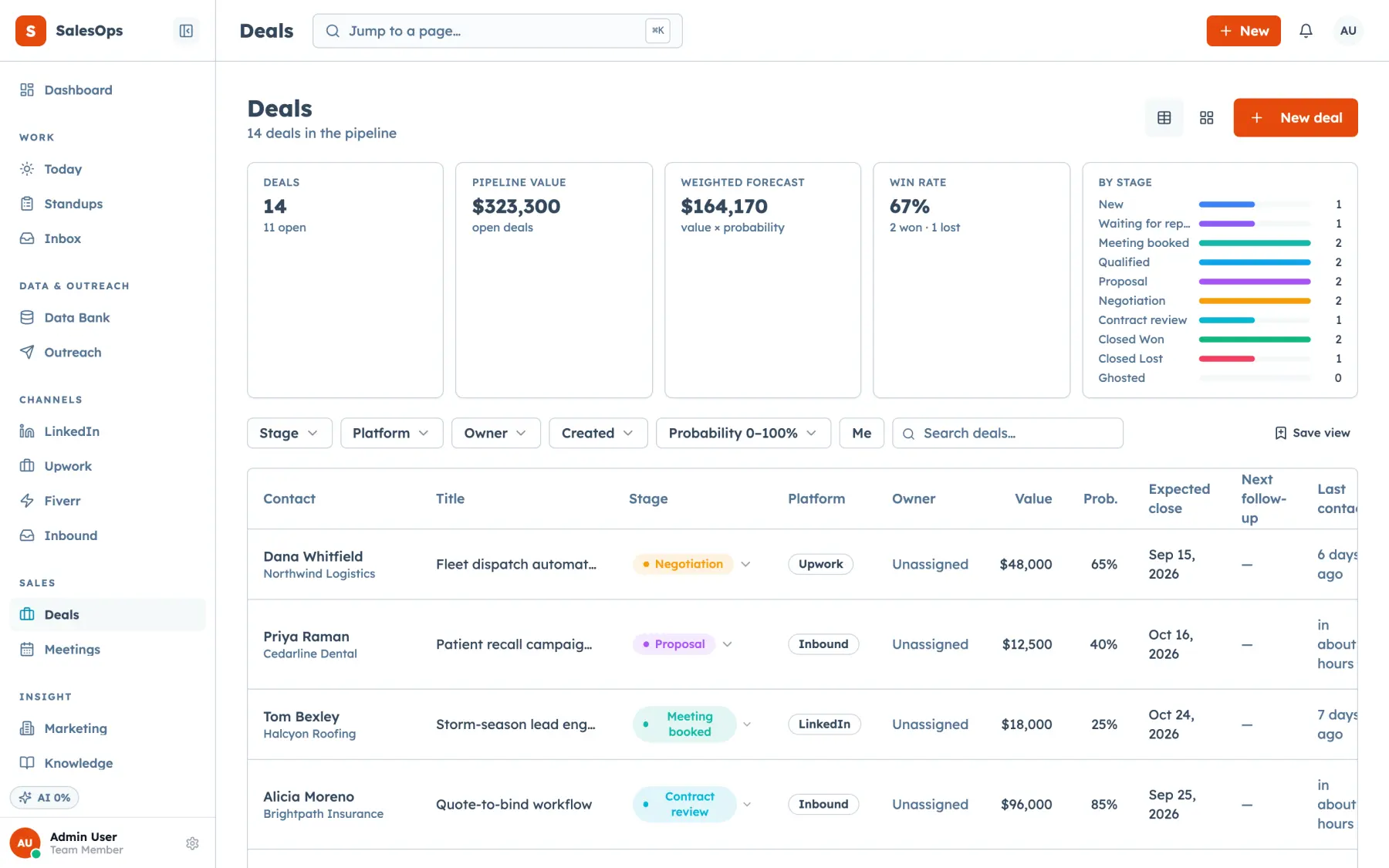
Switch if you want fewer components to price, or if provider control matters more than inbound latency. Stay if a human is waiting on the line, because that is the case Retell optimises for.
The short answer
- Retell publishes a blended $0.07 to $0.31 a minute, itemised: $0.055 voice infrastructure, roughly $0.015 text-to-speech, the language model on top, roughly $0.015 telephony. That itemisation is more transparent than a single headline rate.
- No voice platform's advertised per-minute price is all-in. Vapi excludes model provider costs entirely; Bland includes the model and transcription but excludes telephony. Compare full configurations, never headline numbers.
- None of them is a CRM. The call happens, a webhook fires, and where the outcome gets recorded is a separate decision you still have to make.
How we compared these
Every rate and inclusion comes from each vendor's own pricing page, checked in September 2026. Aircall is the one entry we could not price: its pricing page renders every figure client-side and returned empty placeholders on repeated checks, so its row says so rather than carrying a number from a comparison site.
Evaluated from Retell's own documentation and pricing, September 2026. We have not run it in production. SalesCrew runs Vapi for outbound calls, and Retell is the planned inbound provider rather than one we have operated, so this page reports what its site states.
The table is organised around what each headline price excludes, because that is the single most misleading thing in this category. A platform quoting one low all-in number is either bundling in a way that limits your choices or leaving the pass-through unmentioned.
Retell and its alternatives, on what the price actually covers
| Retell | Vapi | Bland | ElevenLabs Agents | Twilio Voice | SalesCrew | |
|---|---|---|---|---|---|---|
| Published rate | $0.07 to $0.31/min blended; $0.055/min infrastructure floor | $0.05/min platform fee | $0.14/min on Start, with no platform fee | $0.080/min standard, $0.160 burst | US outbound to local $0.0140/min, inbound $0.0085/min | Not a voice platform. $299/mo Core, unlimited seats |
| What the rate excludes | The language model; TTS and telephony itemised alongside | Model provider costs entirely; at cost, or free with your own key | Telephony, and transfers are charged separately | The language model and telephony, both at cost | Everything except the minutes | Not applicable |
| Monthly platform fee | None. Pay as you go | None on usage; concurrency beyond 10 lines is $10 per line/mo | $0 on Start; $299/mo on Build, $499/mo on Scale for lower per-minute rates | A subscription ladder from $6/mo to $990/mo | None. Numbers from $1.15/mo | $299/mo, unlimited seats |
| Free entry | $10 in credits, 20 concurrent calls | Not stated on its pricing page | 2 credits and an inbound number, no card | 15 minutes of calls, 4 concurrent | $15 credit, no card required | 14-day trial, card required |
| Provider control | Partial; more is chosen for you | Full. Its central design | More packaged, fewer choices | Its own voices, external models at cost | Total, along with all the work | Inherited from the voice provider |
| Official MCP server | Yes, hosted at mcp.retellai.com | Yes | Yes, with a documented rate limit | Yes, local and hosted with OAuth | Yes, but in public beta and outside its SLA | Yes. Every UI action has an MCP twin |
| Where the call outcome lands | Webhooks you handle yourself | Webhooks you handle yourself | Webhooks you handle yourself | Webhooks you handle yourself | Whatever you build | A logged call on the contact, in your own database |
Figures checked on vendor pricing pages, September 2026.
The field, ranked for a team leaving Retell
1. Vapi
The main alternative and the platform SalesCrew runs for outbound. It hands you every provider choice, and lets you bring your own model key so those costs are free rather than at cost. Best for: teams who want to own the stack. Not for: latency-critical inbound, which is Retell's strength.
Read more2. Bland
The most packaged option: $0.14 a minute on Start with no platform fee, and the model, transcription and premium voices included in that rate. Telephony and transfers are extra. Best for: teams who want fewer components to reason about. Not for: anyone who needs to swap a provider later.
Read more3. Stay on Retell
Correct for inbound. The itemised pricing is honest, the free $10 in credits with 20 concurrent calls makes testing cheap, and its reputation on latency and inbound quality is the reason most teams chose it. Best for: receptionist lines. Not for: teams who want provider flexibility.
4. ElevenLabs Agents
$0.080 a minute on top of a subscription that starts at $6, with the language model and telephony billed separately. Best for: teams who care most about voice quality itself. Not for: anyone who wants usage-only pricing with no monthly floor.
5. Twilio Voice with your own agent
US outbound at $0.0140 a minute is the floor nobody undercuts, because it is the raw telephony every other platform buys. You supply the model, the speech stack and the orchestration. Best for: teams with engineers and time. Not for: anyone whose constraint is either.
6. SalesCrew
Not a Retell replacement. It is the layer underneath, where a call gets logged against a contact, the disposition is recorded and the follow-up becomes a cadence step, with unlimited seats at $299 a month. Outbound calls run through Vapi today; phone numbers, inbound routing and the AI receptionist are on the roadmap, not shipped. Best for: teams whose calls currently vanish into a webhook log. Not for: anyone shopping for the voice agent itself. New product, no third-party reviews, no mobile app. Disclosure: SalesCrew is our product.
Read moreWhen to stay on Retell
Stay if a human is waiting on the line. Inbound latency is the property Retell is known for optimising, and it compounds: every extra hundred milliseconds makes the agent sound more like software and less like a person, and callers hang up on software. If you are running a receptionist line, that is the only dimension that really decides the outcome.
Stay for the itemised pricing. Retell publishes what each component costs rather than quoting a single number and leaving you to discover the rest on the invoice. That transparency is genuinely rare here, and it means you can model a real bill before you commit, which is more than most of this category permits.
Stay because switching costs more than it looks. The agent prompt is portable; the integration is not. Each platform has its own provider configuration, its own webhook shape, and its own behaviour under concurrency. That rebuild is the real price of moving, and a per-minute difference of a cent or two will not repay it quickly.
Questions
- What does a Retell call actually cost per minute?
- Retell publishes a blended range of roughly $0.07 to $0.31 a minute, itemised as voice infrastructure at $0.055, text-to-speech around $0.015, the language model on top, and telephony around $0.015, as of September 2026. A knowledge-base add-on costs half a cent a minute more. The itemisation is honest; the total depends on which model you pick.
- Is Retell cheaper than Vapi?
- Not comparable on headline numbers, because both exclude components. Vapi publishes $0.05 a minute as a platform fee that excludes model provider costs entirely, and offers those at cost or free if you bring your own API key. Retell's $0.055 is a voice-infrastructure floor with its own additions. The only meaningful comparison is a full configuration priced end to end.
- Why do people pick Retell over other voice platforms?
- Inbound latency and call quality. When a human is waiting on a live line, delay is the difference between a natural conversation and an obviously robotic one, and Retell is generally regarded as strong there. For outbound campaigns, where the agent initiates, that advantage matters much less.
- Does Retell handle what happens after the call?
- No, and none of these platforms do. They build and run the agent that speaks. Whether the call produced a booking, what disposition it got, and what the follow-up is are a CRM's job, and every voice platform hands that off through webhooks you have to handle yourself.